

On this page
Almost every line of this chapter names a layer, its organ and its cell type; these questions test whether you keep the three together. We checked each answer against NCERT Class 11 Biology, Chapter 6 (Reprint 2026-27). The NEET (UG) 2026 syllabus puts tissues and plant anatomy in Biology Unit 2, Structural Organisation in Animals and Plants.
For more, try our anatomy of flowering plants practice questions with solutions and the assertion-reason set on plant anatomy.
How do you judge two statements on plant anatomy?
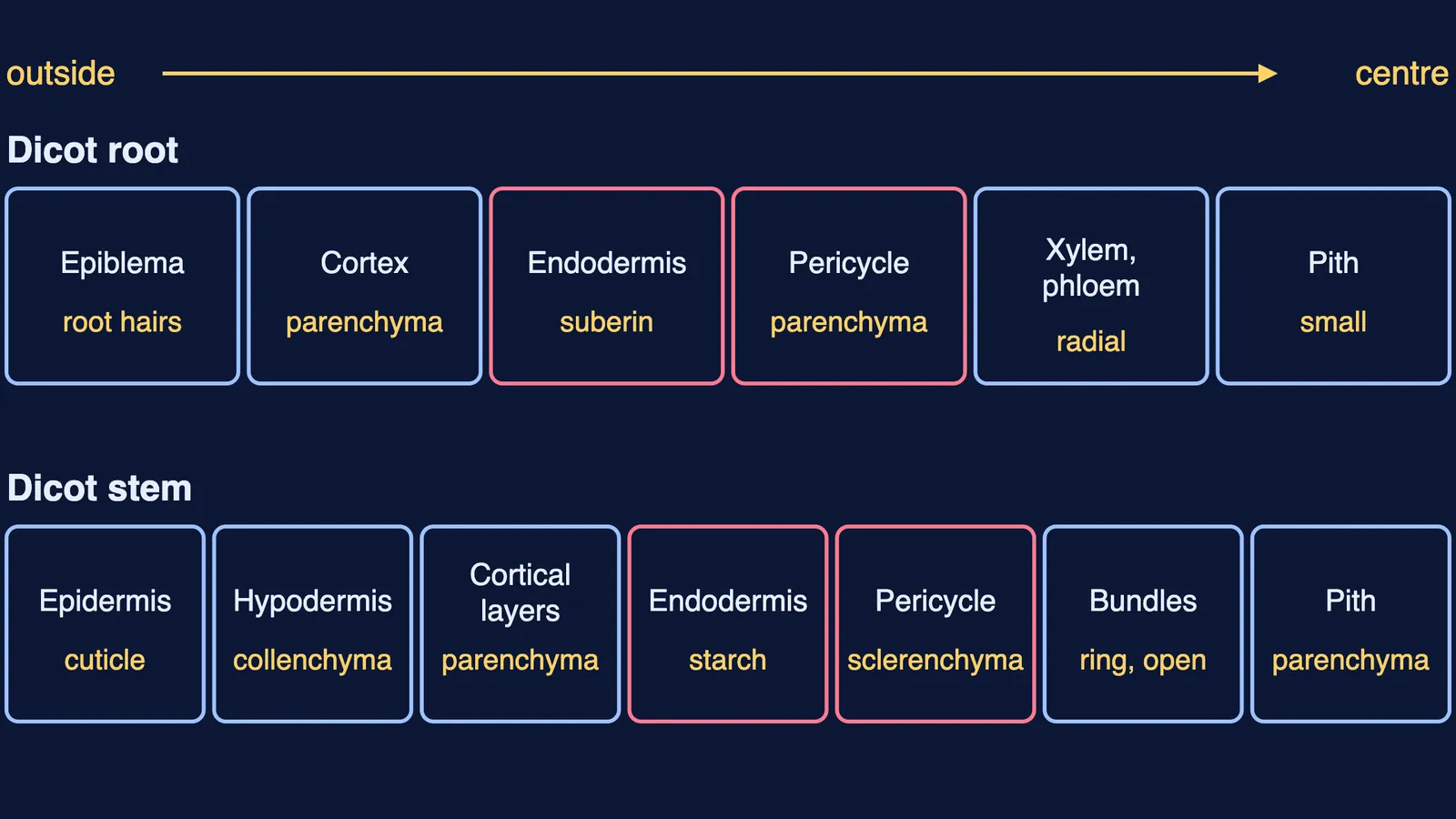
How to attack this format: walk the section from the surface to the centre, as in the diagram above, and stop at the layer the statement names. Check its cell type and its job.
Codes for Q1 to Q5:
(1) Both statements are correct
(2) Both statements are incorrect
(3) Statement I is correct, Statement II is incorrect
(4) Statement I is incorrect, Statement II is correct
Q1. Statement I: Root hairs are unicellular elongations of epidermal cells. Statement II: Epidermal cells are parenchymatous, with a large vacuole.
Answer: (1). Both lines restate section 6.1.1.
Q2. Statement I: In a dicot root, casparian strips are deposited on the tangential as well as the radial walls of endodermal cells. Statement II: Casparian strips are made of lignin.
Answer: (3). NCERT names the material as suberin.
Q3. Statement I: Every epidermal cell touching a guard cell is a subsidiary cell. Statement II: Guard cells regulate the opening and closing of stomata.
Answer: (4). Only sometimes do a few nearby epidermal cells become subsidiary cells.
Q4. Statement I: The collenchymatous hypodermis gives mechanical strength to a young dicot stem. Statement II: Medullary rays are radially placed sclerenchyma cells lying between vascular bundles.
Answer: (3). Medullary rays are parenchymatous.
Q5. Statement I: The vascular bundles of a dorsiventral leaf have no bundle sheath. Statement II: In a dicot leaf with reticulate venation, all veins are of the same thickness.
Answer: (2). A thick-walled bundle sheath surrounds the bundles, and the veins vary in thickness.
Which of these anatomy statements are correct?
How to attack this format: tick or cross each lettered line, then find the option that lists exactly the ticked letters, no more and no fewer.
Q6. Which statements about the ground tissue system are correct?
A. Mesophyll is the ground tissue of leaves.
B. Xylem and phloem belong to the ground tissue.
C. The chapter summary divides the ground tissue into cortex, pericycle and pith.
D. The epidermis of the root is part of the ground tissue.
(1) A and B only
(2) A and C only
(3) B and D only
(4) A, C and D only
Answer: (2). Ground tissue excludes epidermis and vascular bundles.
Q7. Which statements about a sunflower root T.S. are correct?
A. The cortex is thin-walled parenchyma with intercellular spaces.
B. The endodermis has barrel-shaped cells with large intercellular spaces.
C. Parenchyma between xylem and phloem is conjunctive tissue.
D. The pericycle is made of thick-walled parenchyma cells.
(1) A, B and C only
(2) B and D only
(3) A and C only
(4) A, C and D only
Answer: (4). Endodermal cells lack intercellular spaces.
How do you match List-I with List-II in this chapter?
How to attack this format: write your own four pairs before reading the codes, then look for that full line. If none matches, rethink only your least certain pair.
Q8. Match the layer with its feature.
List-I: (A) Epiblema (B) Endodermis of dicot stem (C) Pith of dicot stem (D) Hypodermis of monocot stem
List-II: (I) Rich in starch grains (II) Sclerenchymatous (III) Cells protrude as root hairs (IV) Central rounded parenchyma with large intercellular spaces
(1) A-III, B-I, C-IV, D-II
(2) A-I, B-III, C-IV, D-II
(3) A-III, B-II, C-IV, D-I
(4) A-IV, B-I, C-III, D-II
Answer: (1). Sections 6.2.1, 6.2.3 and 6.2.4.
Q9. Match the type of vascular bundle with its description.
List-I: (A) Open (B) Radial (C) Closed (D) Conjoint
List-II: (I) No cambium (II) Cambium between phloem and xylem (III) Xylem and phloem on the same radius (IV) Xylem and phloem alternate on different radii
(1) A-I, B-IV, C-II, D-III
(2) A-II, B-III, C-I, D-IV
(3) A-II, B-IV, C-I, D-III
(4) A-III, B-IV, C-I, D-II
Answer: (3). These are the definitions in section 6.1.3.
Q10. Match the leaf structure with its feature.
List-I: (A) Palisade parenchyma (B) Spongy parenchyma (C) Bundle sheath of a dicot leaf (D) Epidermis of an isobilateral leaf
List-II: (I) Loose, oval or round cells reaching the lower epidermis (II) Stomata on both surfaces (III) Elongated cells, vertical and parallel (IV) Thick-walled cells around each bundle
(1) A-I, B-III, C-IV, D-II
(2) A-III, B-I, C-II, D-IV
(3) A-III, B-IV, C-I, D-II
(4) A-III, B-I, C-IV, D-II
Answer: (4). See sections 6.2.5 and 6.2.6.
Which single-correct MCQs round off the chapter?
How to attack this format: strike any option that borrows a feature from a neighbouring layer.
Q11. Which description fits the epidermis of the primary plant body?
(1) Usually single-layered, of elongated, compactly arranged cells
(2) Several layers of loose, rounded cells
(3) Semi-lunar patches of sclerenchyma
(4) Cells with dense cytoplasm and no vacuole
Answer: (1). Section 6.1.1 describes a continuous, usually single layer with a large vacuole.
Q12. According to NCERT, which of these may bear a few stomata?
(1) The endodermis of a root
(2) The epidermis of a young dicot stem
(3) The pith of a dicot stem
(4) The pericycle of a root
Answer: (2). NCERT says this epidermis may bear a few stomata.
What comes after this anatomy set?
Sort your misses by format: two-statement, multi-statement, matching or MCQ.
Beside each, write the organ, layer and NCERT section.
Sketch that section unaided, then retry those items.
New to the chapter? Read how to prepare Anatomy of Flowering Plants for NEET.
Can you sketch all six root, stem and leaf sections yet? Fermi's AI tutor works out what you already know and builds a plan for the session.


