On this page
A power series converges inside a disc and then stops. Analytic continuation tells you what the function is outside that disc, and it sits behind the much-misquoted claim that 1 + 2 + 3 + … "equals" −1/12.
What is analytic continuation?
The NIST Digital Library of Mathematical Functions puts it this way (DLMF §1.10): if f₁ is analytic on D₁, f₂ is analytic on D₂, and they agree on an arc where the domains overlap, then f₂ is an analytic continuation of f₁.
In plain terms, a second formula matches the first where both work and keeps going further. Continuing along a path repeats this with a chain of overlapping domains.
How do you continue Σzⁿ beyond its disc of convergence?
The geometric series Σzⁿ converges only for |z| < 1, where it equals 1/(1 − z); the function blows up at z = 1, on the edge of the disc. Our guide to finding the radius of convergence of a power series shows the test that gives R = 1.
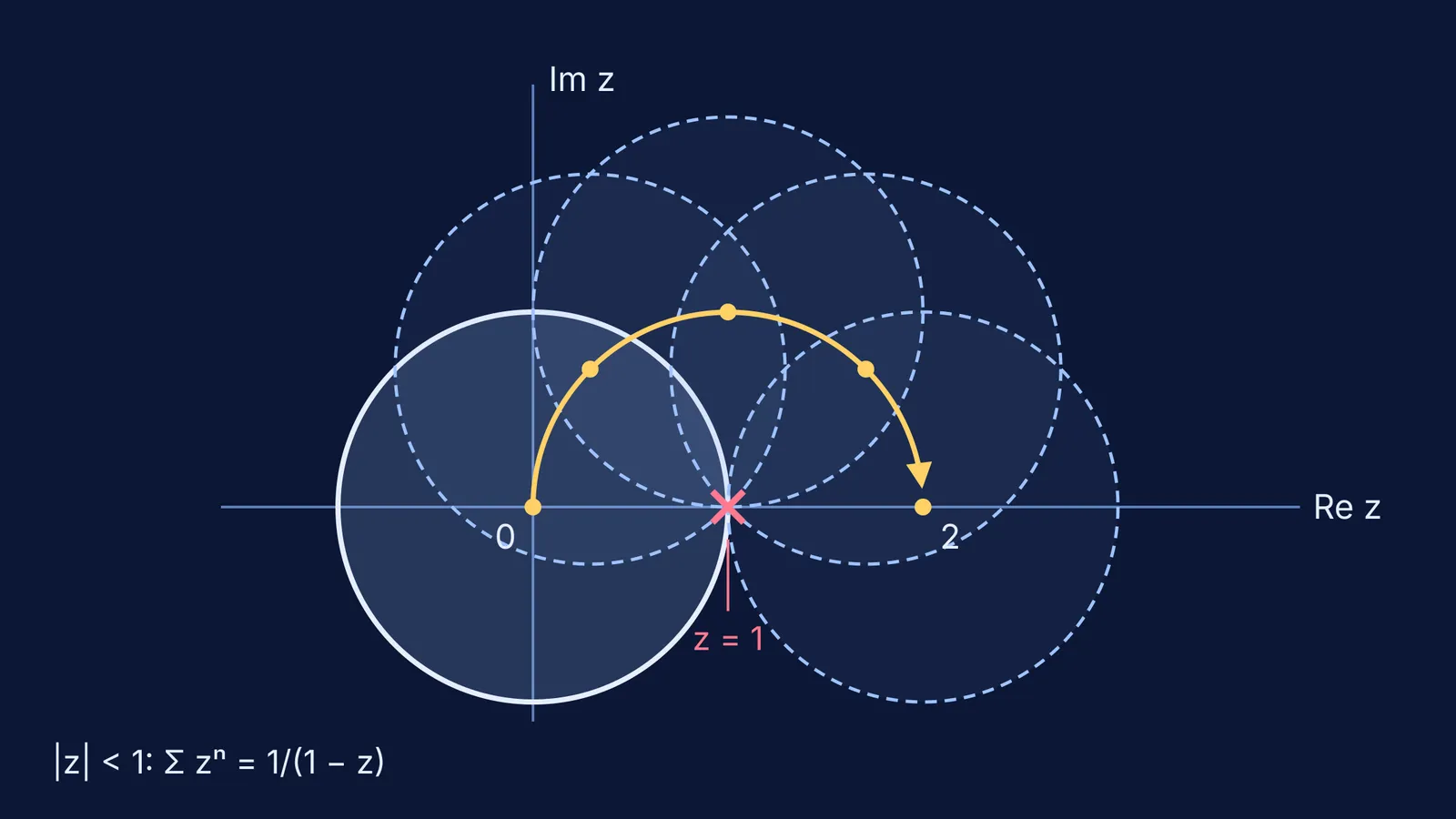
Now pick a new centre a, anywhere except 1, and expand again:
1/(1 − z) = 1/((1 − a) − (z − a)) = Σ (z − a)ⁿ / (1 − a)ⁿ⁺¹
It converges for |z − a| < |1 − a|, the distance from a to the pole. Take a = −1: you get Σ (z + 1)ⁿ / 2ⁿ⁺¹, with radius 2, which reaches z = −2, where the original series diverges.
Check it at z = −2:
The new series becomes 1/2 − 1/4 + 1/8 − 1/16 + …
That is a geometric series with first term 1/2 and ratio −1/2, so its sum is (1/2)/(3/2) = 1/3.
The closed form gives 1/(1 − (−2)) = 1/3. The continuation agrees.
The diagram at the top does the same around the pole: discs of radius 1 carry the function from 0 to 2 without touching z = 1.
Why is analytic continuation unique?
The identity theorem settles it. Two functions analytic on a domain that agree on an arc, or on infinitely many points with a limit point in it, are equal throughout the domain (DLMF §1.10).
Once your new series matches the old one on a small overlap, nothing is left to choose along that path. Change the path, though, and the value can change.
Why do the square root and log change value going round zero?
For 1/(1 − z), every path gives the same answer, because its only problem is a pole. For square roots and logarithms, z = 0 is a branch point.
Follow √z round the unit circle. With z = e^(it), start at √1 = 1 and keep √z = e^(it/2) continuous. At t = 2π you are back at z = 1, but √z = e^(iπ) = −1. DLMF lists exactly these two branches of the square root, √r e^(iθ/2) and −√r e^(iθ/2) (DLMF §1.10). A second circuit returns +1.
The logarithm never comes back. DLMF writes its general value as Ln z = ln z + 2kπi, where k counts the net crossings of the negative real axis along the path (DLMF §4.2). Each anticlockwise circuit adds 2πi.
Is ζ(−1) = −1/12 really the sum 1 + 2 + 3 + …?
The zeta function starts as ζ(s) = Σ 1/nˢ, a series that converges only for Re s > 1. Everywhere else ζ(s) is defined by analytic continuation, and its only singularity is a simple pole at s = 1 (DLMF §25.2).
For negative integers, DLMF gives ζ(−n) = −Bₙ₊₁/(n + 1) (DLMF §25.6). With n = 1 and the Bernoulli number B₂ = 1/6 (DLMF §24.2), ζ(−1) = −(1/6)/2 = −1/12.
Put s = −1 into the series and you get 1 + 2 + 3 + …, which diverges. So ζ(−1) = −1/12 is not a sum of counting numbers. It is the value at s = −1 of the one analytic function that equals Σ 1/nˢ for Re s > 1, just as 1/(1 − z) gives −1 at z = 2 while 1 + 2 + 4 + … diverges.
Other methods assign values to divergent series, as Grandi's series and Cesàro's 1/2 shows. For where zeta comes from, see how primes build the zeta function.
How do you practise analytic continuation?
Find where the function fails: poles and branch points.
Expand about a new centre; the radius is the distance to the nearest singularity.
Check one value on the overlap, as we did at z = −2.
Track your path round any branch point.
If poles or branch cuts feel shaky, the Fermi Concept Library covers concepts across physics, chemistry, biology, mathematics and computing. When an expansion goes wrong, the Fermi Problem Library has a step-by-step solver that explains the reasoning, so you can see which step slipped.