On this page
"A Square and A Cube" is Chapter 1 of Ganita Prakash, Part I, the NCERT Class 8 maths textbook (code hegp1; first edition July 2025, reprinted January 2026). CBSE's 2026-27 curriculum starts at Class IX; Class 8 follows the NCERT book and is assessed by the school.
What does Chapter 1 of Ganita Prakash cover?
The chapter opens with 100 lockers toggled by 100 people. A locker ends open only if its number has an odd number of factors, and only squares do: a square has a factor that is its own partner factor.
Then, in order:
Square numbers: n × n is written n². A perfect square's last digit is always 0, 1, 4, 5, 6 or 9; trailing zeros come in an even count.
Perfect squares and odd numbers: the first n odd numbers add up to n²; the nth odd number is 2n − 1.
Square roots: if y = x², x is a square root of y. A perfect square has a positive and a negative root; the chapter uses only the positive one, written √.
Cubic numbers: n × n × n is written n³; 1, 8, 27, … are perfect cubes.
Taxicab numbers: 1729 = 1³ + 12³ = 9³ + 10³, the Hardy–Ramanujan Number.
Perfect cubes and consecutive odd numbers: 1, then 3 + 5, then 7 + 9 + 11, and so on, give the cubes.
Cube roots: if y = x³, x is the cube root of y, written ∛y.
A pinch of history: Babylonian lists of squares and cubes from as far back as 1700 BCE, and the Sanskrit terms varga, ghana, varga-mula and ghana-mula (square, cube, square root, cube root).
How do you check if a number is a perfect square?
Three methods from the book, with our numbers:
1. List the squares. Is 1444 a square? 37² = 1369, 38² = 1444: yes.
2. Subtract successive odd numbers. Try 30: 30 − 1 = 29, 29 − 3 = 26, 26 − 5 = 21, 21 − 7 = 14, 14 − 9 = 5, then 5 − 11 is below 0. We never reach 0, so 30 is not a square.
3. Prime factorisation. When the prime factors can be sorted into two identical groups, the number is a perfect square.
1764 = 2 × 2 × 3 × 3 × 7 × 7 = (2 × 3 × 7)², so √1764 = 42.
1690 = 2 × 5 × 13 × 13. The 2 and 5 are unpaired: not a square. × 10 gives 16900 = 130².
How do you find a square root by narrowing the interval?
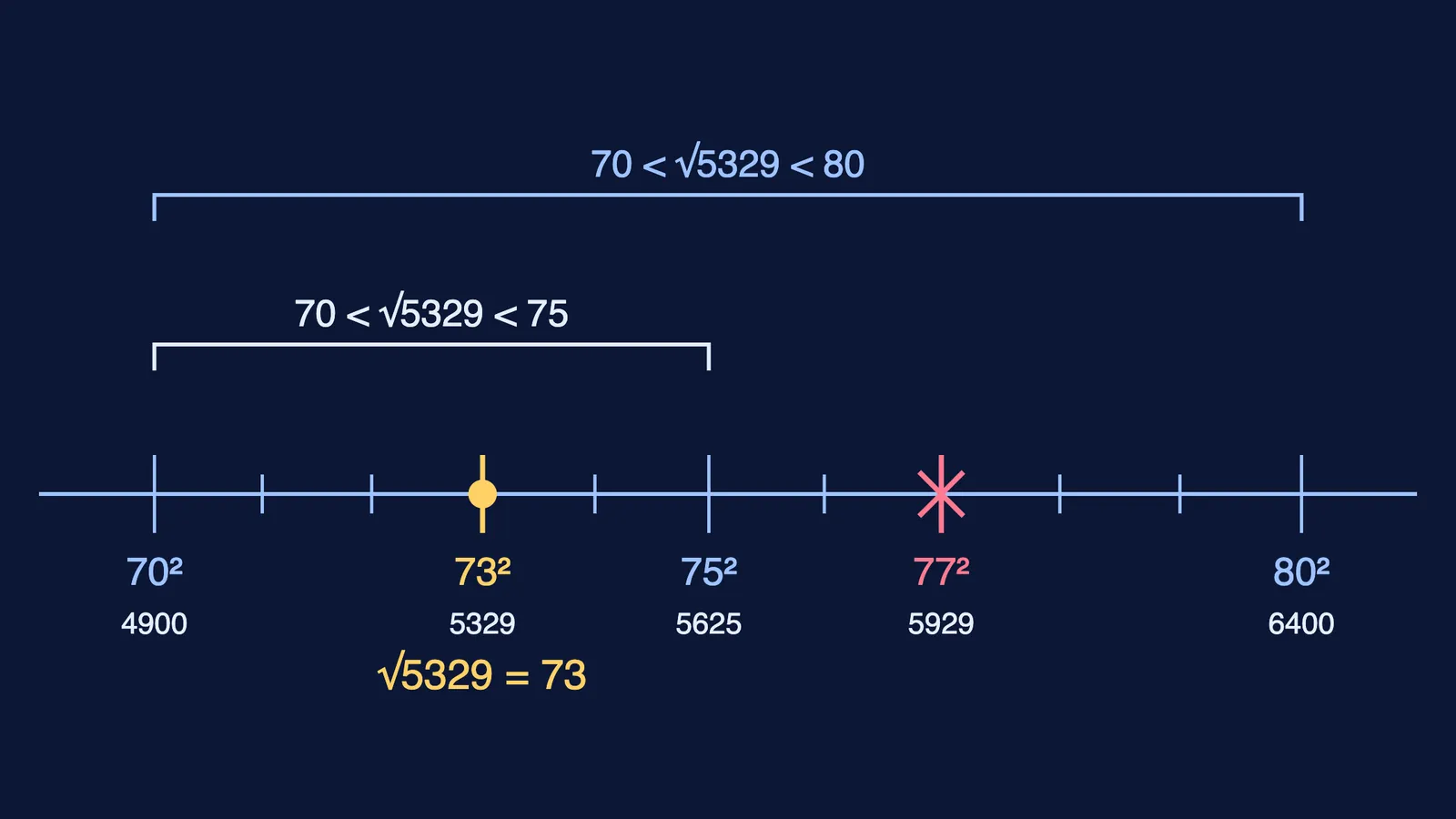
For larger squares, narrow the search. The diagram shows our example.
70² = 4900 and 80² = 6400, so 70 < √5329 < 80.
5329 ends in 9, so the root ends in 3 or 7: 73 or 77.
75² = (70 + 5)² = 4900 + 700 + 25 = 5625. That exceeds 5329, so 70 < √5329 < 75 and 77 is out.
73² = 4900 + 420 + 9 = 5329, so √5329 = 73.
It also estimates non-squares: 54² = 2916 and 55² = 3025, so √3000 lies between them, nearer 55.
How do you test for a perfect cube?
When the prime factors can be sorted into three identical groups, the number is a perfect cube.
Is 48778 a cube? 48778 = 2 × 29 × 29 × 29. The 29s form a triplet; the 2 stands alone. Multiply by 2 × 2 = 4: 48778 × 4 = 195112 = (2 × 29)³ = 58³, so ∛195112 = 58.
Practice questions on squares and cubes
Mark labels are our suggestion.
(1 mark) Which of 3487, 5776 and 8122 cannot be a perfect square? *Answer: 3487 and 8122 (last digits 7 and 2). 5776 = 76².*
(2 marks) Given 61² = 3721, find 62². *Answer: add the 62nd odd number, 123, to get 3844.*
(3 marks) What smallest number must 2156 be multiplied by to give a perfect square? Find the root. *Answer: 2156 = 2 × 2 × 7 × 7 × 11, so 11; 23716 = 154².*
(3 marks) Find ∛250047 by prime factorisation. *Answer: 250047 = 3⁶ × 7³ = (3² × 7)³, so 63.*
(2 marks) Seven consecutive odd numbers add up to 7³. Find the smallest. *Answer: 343 ÷ 7 = 49 is the middle one, so 43.*
See also why only squares have an odd count of factors, why each cube splits into a run of odd numbers, and our Class 8 squares and square roots guide.
How does this chapter connect to the rest of the book?
The book's preface names squares and cubes, exponents and the evolution of numbers as foundations for later learning. Chapter 2, "Power Play", turns to short ways of writing very large numbers; Chapter 5, "Number Play", returns to properties of numbers.
Unsure where to start? Fermi's AI tutor works out what you already know and builds a plan for the session.