

On this page
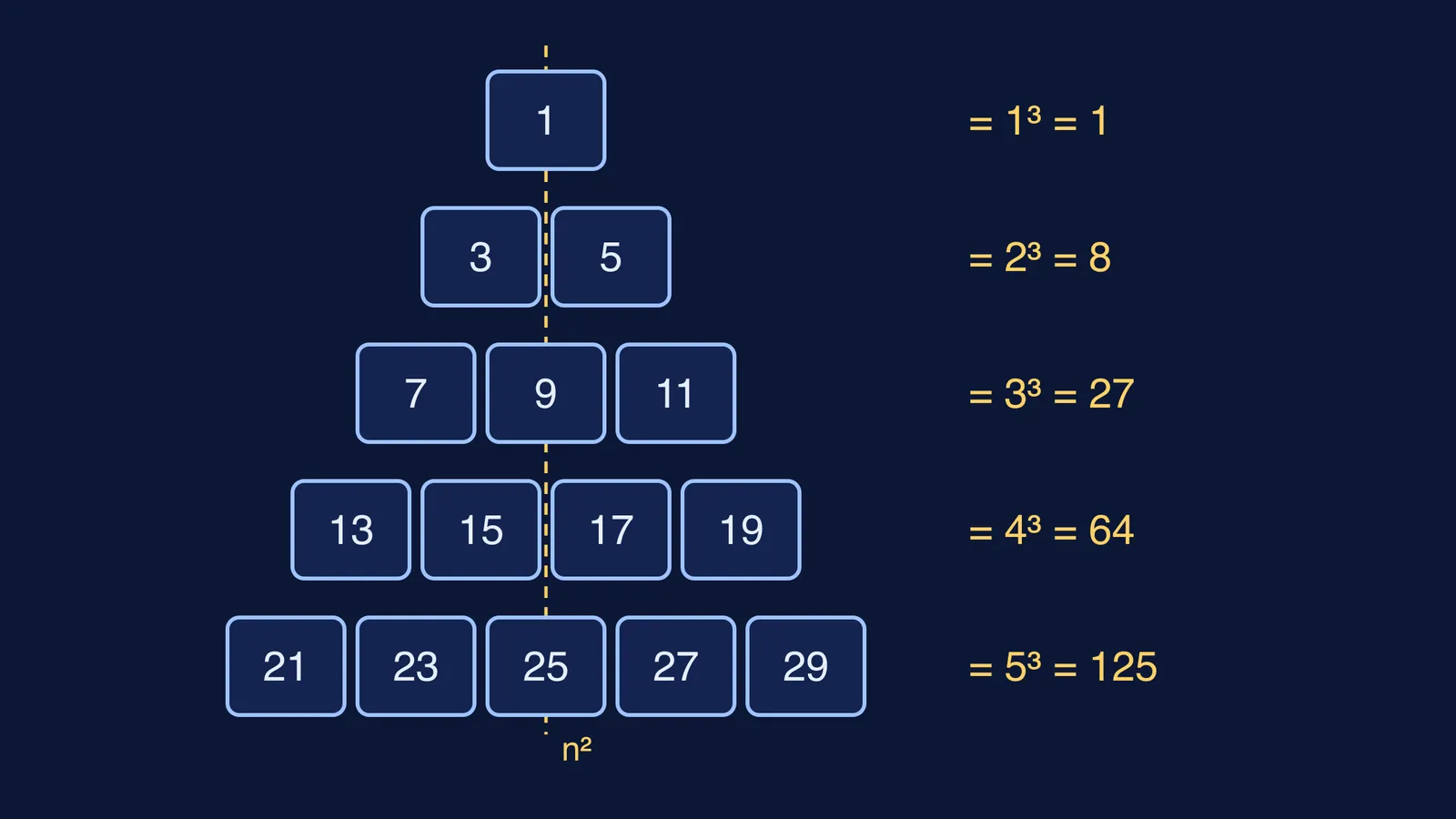
Write the odd numbers in order and cut them into groups of one, two, three, four and so on. Add up each group and you get the cubes: 1, 8, 27, 64, 125. This works for every whole number, and the proof is short.
Why is n³ the sum of n consecutive odd numbers?
Here are the first five groups:
1 = 1 = 1³
3 + 5 = 8 = 2³
7 + 9 + 11 = 27 = 3³
13 + 15 + 17 + 19 = 64 = 4³
21 + 23 + 25 + 27 + 29 = 125 = 5³
Nicomachus of Gerasa, who lived about 60 to 120 CE, pointed out this pattern at the end of Chapter 20 of his Introduction to Arithmetic (Wikipedia: Squared triangular number). His book was the standard arithmetic text for more than 1000 years (MacTutor History of Mathematics).
The proof has two steps: find where group n starts, then find its average.
Step 1, the start. Groups 1 to n − 1 come before group n, and together they hold 1 + 2 + … + (n − 1) = n(n − 1)/2 odd numbers. The k-th odd number is 2k − 1. So group n starts with odd number n(n − 1)/2 + 1, which is 2[n(n − 1)/2 + 1] − 1 = n² − n + 1. Check it: n = 3 gives 7, and n = 4 gives 13. Both match the list.
Step 2, the average. The group has n odd numbers, each 2 more than the last. It runs from n² − n + 1 up to (n² − n + 1) + 2(n − 1) = n² + n − 1. Evenly spaced numbers average (first + last)/2, which here is n².
So the sum is (how many) × (average) = n × n² = n³.
How do you write any cube as consecutive odd numbers?
Use this three-step recipe:
Work out n². This is the centre of the group.
Start at n² − n + 1.
Write down n odd numbers from there. The last one should be n² + n − 1.
Worked example, 6³: n² = 36, so start at 31. The group is 31 + 33 + 35 + 37 + 39 + 41. Pair the outside numbers inwards: 31 + 41, 33 + 39 and 35 + 37 each make 72. Three pairs of 72 make 216, which is 6³.
Now backwards: which cube is 91 + 93 + … + 109? Count the terms: (109 − 91)/2 + 1 = 10. The average is (91 + 109)/2 = 100. So the sum is 10 × 100 = 1000 = 10³.
If n is odd, n² sits in the middle of the group (9 in 7 + 9 + 11). If n is even, n² is even, so it falls between the two middle numbers, as 36 falls between 35 and 37.
What does this pattern have to do with the sum of cubes?
Add the first n groups together. On one side you get 1³ + 2³ + … + n³. On the other you have added the first 1 + 2 + … + n = n(n + 1)/2 odd numbers.
The first m odd numbers always add up to m²: they run from 1 to 2m − 1, so they average m. (The same 1, 3, 5, 7 pattern is behind why free-fall distances go 1 : 3 : 5 in successive seconds.)
Put m = n(n + 1)/2 and you get 1³ + 2³ + … + n³ = [n(n + 1)/2]². This is Nicomachus's theorem (Wolfram MathWorld). For n = 4: 1 + 8 + 27 + 64 = 100 = 10². Nicomachus himself only described the odd-number groups; the general formula follows from them, but he did not go further (Wikipedia). For a picture of the same theorem, see our visual proof that the sum of cubes is a square.
Where do students usually slip?
Position versus value. The 6th odd number is 11, not 6. Use 2k − 1.
Counting terms. From a to b in steps of 2 there are (b − a)/2 + 1 terms, not (b − a)/2.
Any run of odd numbers. 3 + 5 + 7 = 15 is not a cube. The group must have exactly n terms and be centred on n².
If a step like the start formula still feels shaky, the Fermi Problem Library has worked problems with a step-by-step solver that explains the reasoning rather than printing an answer. If the real gap is arithmetic progressions, the Fermi Concept Library gives each concept its own lesson and shows where it fits in the map.
Try 12³ now: start at 133, write twelve odd numbers up to 155, and check that they add up to 12 × 144 = 1728.


