On this page
In 1905 Wyndham Dunstan, H. A. D. Jowett and Ernest Goulding sealed polished, nearly pure iron in glass tubes of moist oxygen, kept them at a steady 34 °C for three months, and found "not the slightest trace of rust". An identical set left on the bench, where the temperature rose and fell, rusted heavily. The only difference was whether liquid water could condense on the metal. They also showed that iron rusts with no carbon dioxide at all. Their paper is "The Rusting of Iron", J. Chem. Soc. Trans. 87, 1548–1574.
Quotes here come from the paper, read in the scanned 1905 volume. It is signed from the Scientific Department, Imperial Institute.
What did chemists think made iron rust in 1905?
The accepted view came from experiments by Crace Calvert (1871) as interpreted by Crum Brown (1888). Iron was thought to need the oxygen and the carbonic acid of the air, with liquid water. Crum Brown's equations, as the paper prints them:
4(Fe + H₂O + CO₂) = 4FeCO₃ + 4H₂
4FeCO₃ + 6H₂O + O₂ = 2Fe₂(OH)₆ + 4CO₂
Both balance. In the second, count oxygen: 12 + 6 + 2 = 20 on the left and 12 + 8 = 20 on the right; iron, carbon and hydrogen match too. On this theory alkalis stop rusting because they absorb carbonic acid, "without which rusting was supposed to be unable to occur".
What did the sealed tubes show?
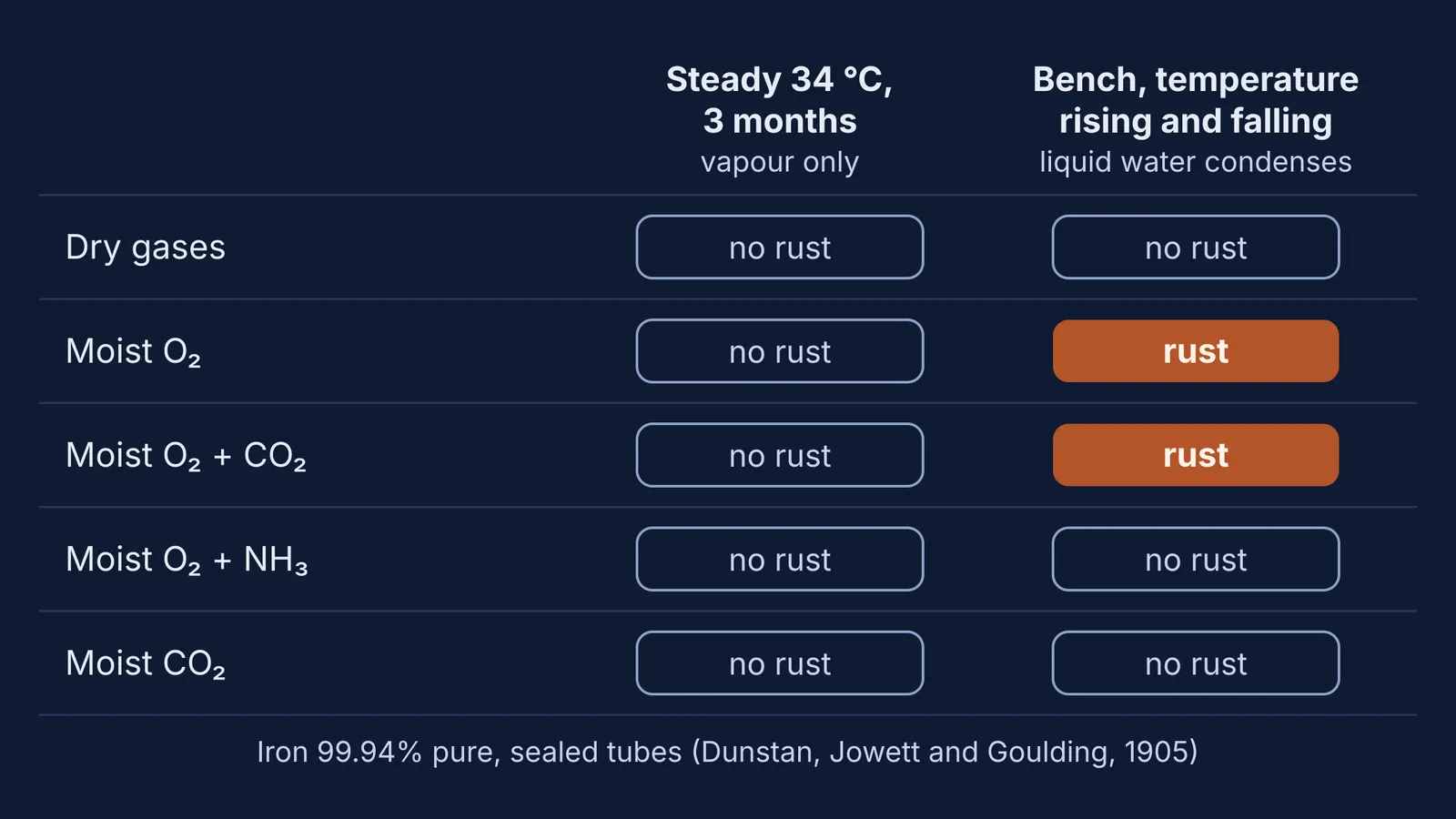
The team used iron "shown by analysis to contain 99.94 per cent. of iron". Each polished plate was heated in hydrogen inside a hard-glass tube, cooled, and the tube was pumped out and filled with one gas. One series used gases dried over phosphoric oxide. The other used gases saturated with water vapour. To stop water condensing "due to fluctuation of temperature", the tubes sat in a thermostat at 34 °C for three months.
Their results table:
Dry gases: no visible action at 34 °C or on the bench.
Moist oxygen: none at 34 °C; on the bench, "Large amount of rust formed".
Moist oxygen and carbon dioxide: none at 34 °C; on the bench, "Copious rusting".
Moist oxygen and ammonia: no visible action in either.
Moist carbon dioxide: no visible action in either.
Their reading: when "the temperature fluctuates and liquid water is deposited on the metal, rusting occurs in the presence of oxygen alone or mixed with carbon dioxide, but not in carbon dioxide alone or in oxygen mixed with ammonia."
They then removed CO₂ completely. Water distilled from lime and permanganate and oxygen washed through potassium hydroxide were let onto clean iron. Rust began at once: "a substance of a green colour being produced which rapidly changed to the red colour characteristic of rust".
Why did a steady 34 °C stop the rust?
Water vapour is not liquid water. The paper does not say at what temperature the gases were saturated, so take 25 °C as an illustration. Saturation vapour pressures below are approximate (Buck equation).
Water in the gas. Saturated at 25 °C, the gas holds water vapour at about 3.17 kPa.
Capacity at 34 °C. Air at 34 °C can hold about 5.32 kPa before water condenses.
Relative humidity in the thermostat. 3.17 ÷ 5.32 = 0.60, or about 60%. Below 100%, so no liquid forms on the iron.
On the bench. If the room cools below 25 °C, the gas is now above its saturation pressure. Water condenses as a thin film on the cold metal, and rust starts.
This is why the bench tubes rusted and the thermostat tubes did not.
Why does a film of liquid water matter?
Rusting is a cell. NCERT's Class 12 electrochemistry chapter describes it in four steps.
Anode. 2Fe(s) → 2Fe²⁺(aq) + 4e⁻, E°(Fe²⁺/Fe) = −0.44 V.
Cathode. O₂(g) + 4H⁺(aq) + 4e⁻ → 2H₂O(l), E° = 1.23 V.
Overall. 2Fe(s) + O₂(g) + 4H⁺(aq) → 2Fe²⁺(aq) + 2H₂O(l), E°cell = 1.67 V. Iron, oxygen, hydrogen and charge (+4 on each side) all balance.
Rust. 2Fe²⁺(aq) + 2H₂O(l) + ½O₂(g) → Fe₂O₃(s) + 4H⁺(aq), and the oxide comes out hydrated as Fe₂O₃·xH₂O. Charge is +4 on both sides.
The electrons run through the metal, but the ions need a path too. Fe²⁺ has to leave the anode and charge has to move between the anode and cathode spots. A liquid film, with ions dissolved in it, is that path. Vapour is not. Our post on corrosion as an electrochemical cell works through the cell numbers.
So is CO₂ needed for rusting?
Not needed, but it helps. NCERT says the H⁺ in step 2 "is believed to be available from H₂CO₃" formed when CO₂ dissolves in water, or from other acidic oxides. Dunstan's team agree that CO₂ takes part: it "accelerates the rusting process", and they call its role "subsidiary and not essential".
The two views fit. CO₂ adds H⁺ and ions to the film, which speeds the cell up. Without it, oxygen is still reduced, using water instead of H⁺: O₂ + 2H₂O + 4e⁻ → 4OH⁻. Fe²⁺ and OH⁻ give Fe(OH)₂, and air oxidises it: 4Fe(OH)₂ + O₂ → 4FeO(OH) + 2H₂O. Check: 4 Fe, 10 O and 8 H on each side. For how pH changes this cell, see why alkali stops iron rusting.
What did Dunstan get wrong?
Their mechanism. They proposed that iron reduces water and the hydrogen forms hydrogen peroxide with oxygen, which then turns FeO into rust. They admitted that "hydrogen peroxide cannot be actually detected during the rusting of iron". The idea did not survive, and the electrochemical picture above is what NCERT teaches.
They also rejected Whitney's 1903 electrochemical theory because no hydrogen gas appeared during rusting. Their observation was right; the inference was not. In neutral water with oxygen present, the cathode reduces O₂, so no H₂ is expected. Their experiment stands even though their explanation fell.
Worked example: what is rust made of?
They analysed rust made from pure iron, oxygen and water: 62.16% iron, 1.14% hydrogen and 35.97% oxygen. They wrote it Fe₂O₂(OH)₂, which is Fe₂O₃·H₂O, or 2FeO(OH).
Moles per 100 g. Fe: 62.16 ÷ 55.845 = 1.113. O: 35.97 ÷ 15.999 = 2.248. H: 1.14 ÷ 1.008 = 1.131.
Divide by the smallest. Fe : O : H = 1 : 2.02 : 1.02, so FeO₂H, which is FeO(OH).
Check. FeO(OH) is 88.85 g mol⁻¹, so iron is 55.845 ÷ 88.85 = 62.85%. Their figure is close.
Mass gain. From 4Fe + 3O₂ + 2H₂O → 4FeO(OH), 1 g of iron gives 1.591 g of rust and takes up 0.430 g of O₂ and 0.161 g of water.
In real rust x in Fe₂O₃·xH₂O varies, so this is one sample, not a fixed formula. For board and JEE questions on these steps, Fermi Test Prep offers JEE Main and Advanced preparation with an AI tutor.
Quick checklist
Pure iron in moist O₂ at a steady 34 °C did not rust in three months.
The same tubes rusted once temperature changes condensed liquid water.
Moist CO₂ alone and O₂ with ammonia gave no rust.
CO₂ speeds rusting by adding H⁺ and ions; it is not required.
The liquid film carries ions between anode and cathode.
The hydrogen peroxide mechanism was wrong; the electrochemical cell is today's model.