

On this page
The steel bars inside a concrete bridge sit in damp pores with oxygen all around them, and they can stay free of rust for decades. Leave the same steel out in the rain and it rusts within days. The difference is the pore water in concrete, which is strongly alkaline, typically pH 12.5 to 13.5 according to the overview of reinforced concrete durability on Wikipedia. That makes "Why does an alkaline medium inhibit rusting?" a real engineering question as well as a board question. This post gives the usual textbook answer, then works the numbers to show why that answer is incomplete, and gives the better reason.
What does the usual board answer say?
NCERT writes the cathode reaction of rusting as O₂ + 4H⁺ + 4e⁻ → 2H₂O, with the H⁺ coming from carbonic acid in the water film. Our post on corrosion as an electrochemical cell works through that acid-medium cell, with E°cell = 1.67 V.
The usual answer follows from this equation: an alkaline medium neutralises the H⁺ ions, so the cathode reaction cannot happen and rusting stops.
That is the answer most markers expect for two marks, so learn it. But it has a gap. In alkali, oxygen is still reduced. The reaction is simply written with water instead of H⁺: O₂ + 2H₂O + 4e⁻ → 4OH⁻. It is the same couple, and only its potential changes with pH. So the real question is whether that change is large enough to stop the cell.
Does the rusting cell stop working in alkali?
Work it out at pH 13, the pH of concrete pore water. Use E° values from the NCERT table and take p(O₂) = 1 bar to keep the numbers simple.
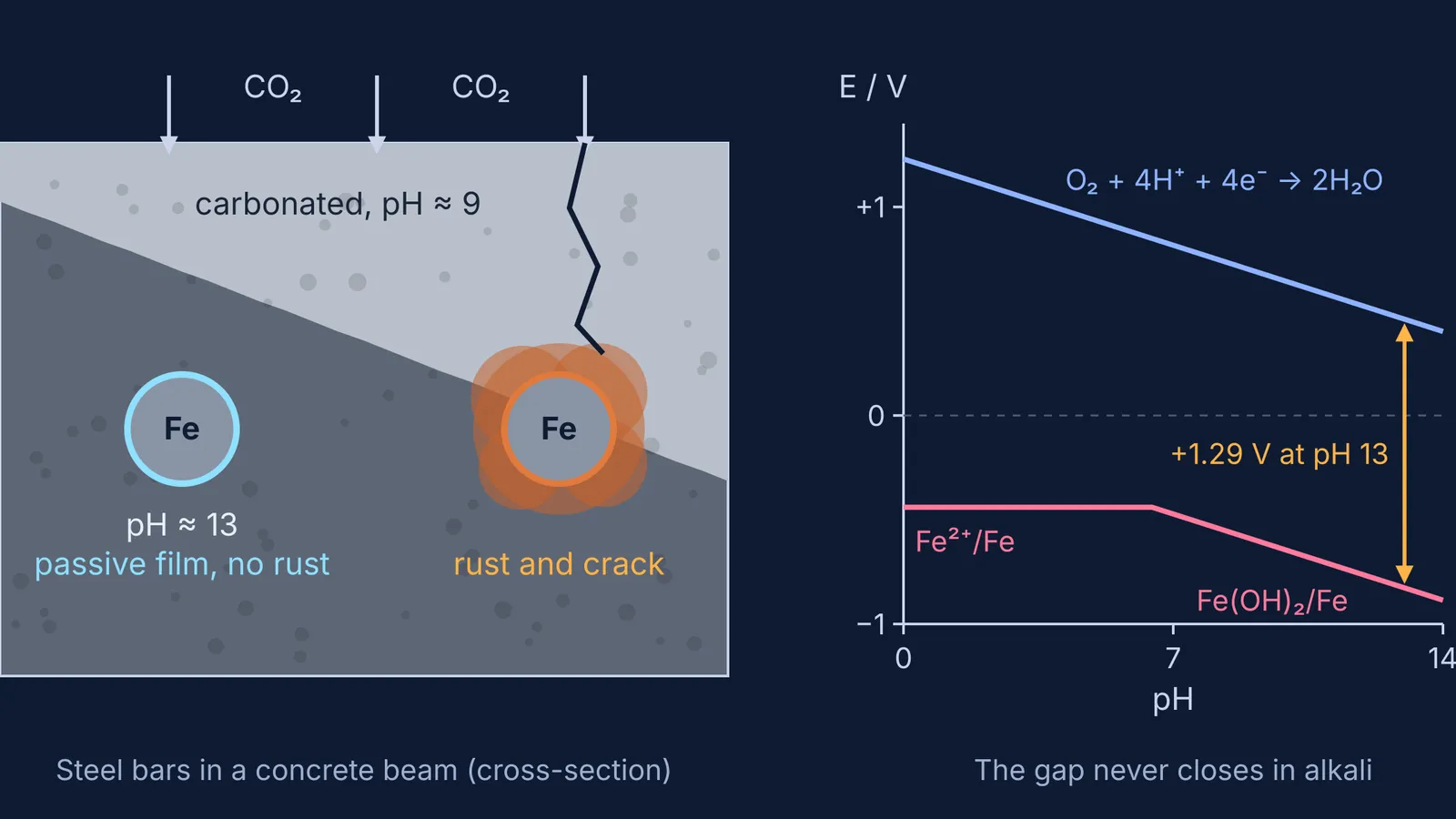
Cathode potential. For the oxygen couple, E = 1.23 − 0.0591 pH. At pH 0 that is 1.23 V, at pH 7 it is 0.82 V, and at pH 13 it is 1.23 − 0.77 = 0.46 V. The cathode does get weaker, by 0.77 V.
What the anode makes. In strong alkali, Fe²⁺ does not stay in solution. It precipitates as Fe(OH)₂, so [Fe²⁺] is fixed by the solubility product. Take Ksp(Fe(OH)₂) ≈ 8 × 10⁻¹⁶, a common table value. At pH 13, [OH⁻] = 0.1 M, so [Fe²⁺] = 8 × 10⁻¹⁶ / (0.1)² = 8 × 10⁻¹⁴ M.
Anode potential. For Fe²⁺ + 2e⁻ → Fe, the Nernst equation gives E = −0.44 + (0.0591/2) log(8 × 10⁻¹⁴) = −0.44 − 0.39 = −0.83 V. The anode becomes more negative, so iron is easier to oxidise, not harder.
Cell EMF. E(cell) = 0.46 − (−0.83) = +1.29 V.
Free energy. For 2Fe + O₂ + 2H₂O → 2Fe(OH)₂, n = 4, so ΔG = −4 × 96 485 × 1.29 ≈ −497 kJ per 2 mol of iron.
The EMF falls from 1.67 V in 1 M acid to 1.29 V at pH 13, but it stays large and positive. Rusting is still strongly favoured.
Now repeat the calculation at pH 9 or pH 11. You get 1.29 V again. Once Fe(OH)₂ forms, both electrode potentials fall by 0.0591 V for every pH unit, so the gap between them stays the same. Ksp values for Fe(OH)₂ differ between tables (from about 5 × 10⁻¹⁷ to 8 × 10⁻¹⁶). The smaller value makes the EMF about 1.32 V, so the conclusion does not change. Thermodynamics does not explain why steel in concrete stays bright.
If you want to practise this kind of Nernst calculation, the Fermi Problem Library has worked problems with a step-by-step solver that explains the reasoning.
Why does a passive film protect iron in alkali?
The real reason is kinetic. In neutral water, the Fe²⁺ formed at the anode is soluble. It diffuses away and is oxidised to Fe₂O₃·xH₂O some distance from the metal. That rust is loose and porous, it flakes off, and fresh iron is exposed.
In strong alkali, the iron oxides and hydroxides are almost insoluble. The first iron that oxidises stays on the surface as a very thin, tightly bound film of iron oxide, a few nanometres thick. Iron ions cannot get out through this film easily, so the anode reaction slows to a tiny rate. This is called passivation: the metal has not become less reactive, it has been sealed off. Concrete also slows the cathode, because oxygen has to diffuse through the damp pores to reach the steel.
You have met the same idea before. Chromium oxide does it for stainless steel and its passive film, and aluminium oxide does it for aluminium in concentrated nitric acid. A Pourbaix diagram maps the potential and pH conditions in which iron's protective oxide is stable. It shows where a film can form, but not how fast corrosion goes, so engineers still measure rates.
Why does the steel in old concrete start to rust?
Two things break the passive film.
Carbonation. Carbon dioxide from the air slowly diffuses into the concrete and reacts with the calcium hydroxide in the cement: Ca(OH)₂ + CO₂ → CaCO₃ + H₂O. The Wikipedia summary of concrete degradation gives the result: the pore-water pH falls from 12.5–13.5 to about 8.5. Steel is protected above roughly pH 11 and starts to corrode below about pH 10. The carbonated layer moves inward over the years. When it reaches the steel, the film is lost and rusting begins.
Chloride ions. Cl⁻ breaks the passive film locally even when the pH is still 13. It comes from sea spray, unwashed sea sand in the mix, or de-icing salt. The attack makes deep pits rather than an even layer. This is the same chloride effect behind why iron rusts faster near the sea.
Rust takes up more space than the iron it came from. As it forms around a bar, it pushes on the concrete, cracks it and makes pieces break off. The cracks let in more water, CO₂ and chloride, so the damage speeds up. This is why builders specify a minimum thickness of concrete cover over the bars and use clean, washed sand.
What should you write in an exam?
Common slips to avoid:
Using 1 M Fe²⁺ in the Nernst equation at pH 13. Fe(OH)₂ precipitates, so [Fe²⁺] is tiny.
Saying "no H⁺, so no cathode". Oxygen is still reduced, to OH⁻.
Treating passivation as a new, unreactive form of iron. It is a surface film, and chloride or low pH removes it.
Treating this as home advice. Strong alkali is caustic, and household iron is protected by paint, oil or zinc, not by soaking it in base.
Quick checklist
Concrete pore water is about pH 12.5 to 13.5.
At pH 13 the oxygen cathode is at 0.46 V and the Fe(OH)₂ anode at about −0.83 V.
The rusting EMF stays about +1.29 V at any pH where Fe(OH)₂ forms.
Alkali protects iron kinetically, through a passive oxide film.
Carbonation (pH down to about 8.5 to 9) and chloride ions destroy the film.
In board answers, give the H⁺ reason; for reasoning questions, add passivation.


