

On this page
NCERT teaches zinc extraction as roast, then reduce with coke: ZnO + C → Zn + CO. That route exists, but it is not how most zinc is made. A British Geological Survey commodity profile put the share made by the electrolytic process at about 85% of world production. India's main producer, Hindustan Zinc, runs this roast–leach–electrowin route at its Rajasthan smelters; its Chanderiya smelter page describes oxidation in a roaster, leaching and electrolysis, with the roaster gases sent to an acid plant. The odd part is the last step. Judged by E° alone, it should not work.
How is zinc made by electrolysis instead of coke?
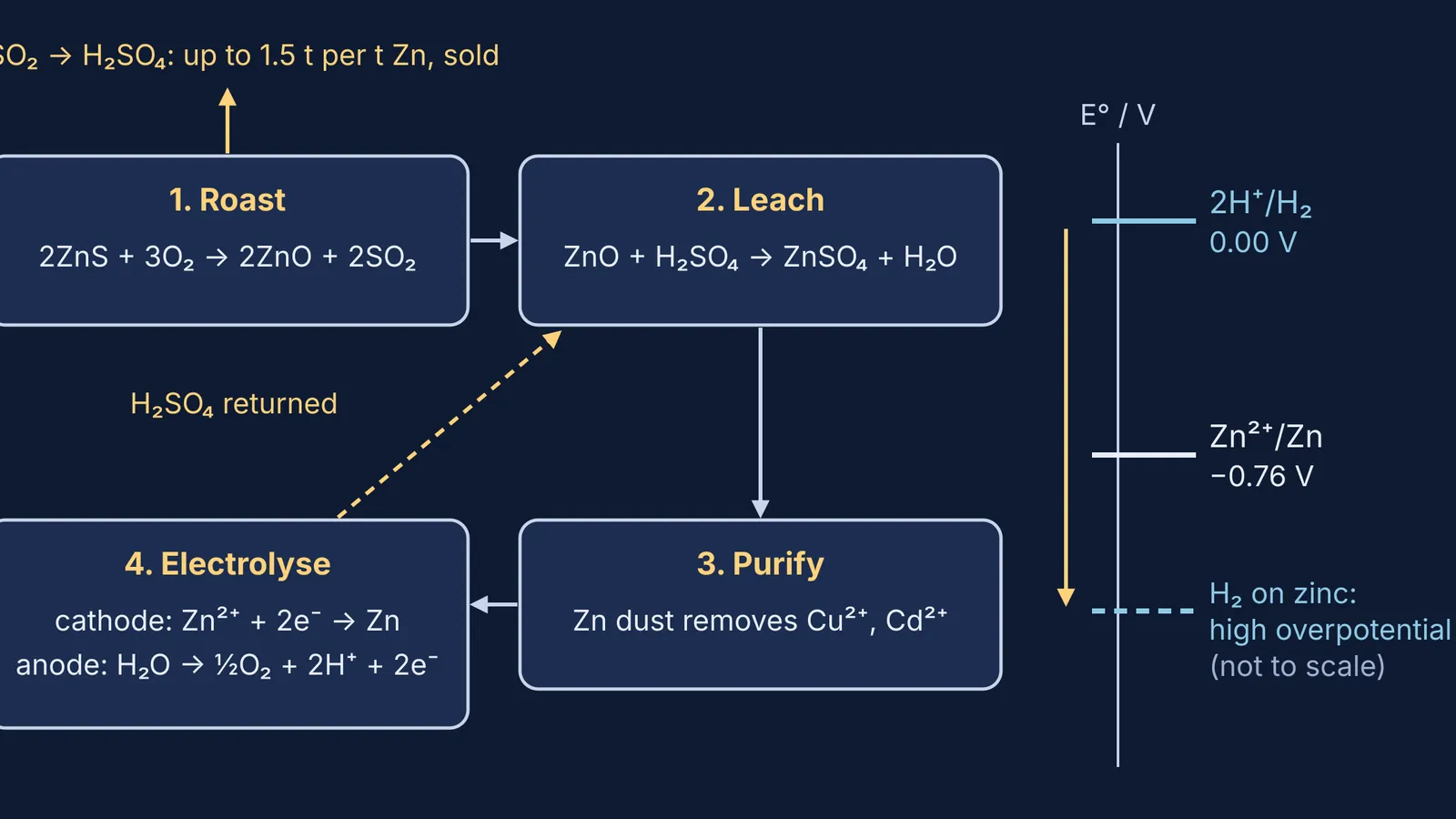
The coke route, with zinc leaving the furnace as vapour, is covered in extraction of zinc from zinc blende. The electrolytic route starts the same way and then turns wet:
Roast. The ZnS concentrate is heated in air: 2ZnS + 3O₂ → 2ZnO + 2SO₂. The SO₂ goes to a contact-process plant and becomes sulphuric acid.
Leach. The roasted solid (calcine) is dissolved in dilute sulphuric acid: ZnO + H₂SO₄ → ZnSO₄ + H₂O.
Purify. Zinc dust is stirred in to remove nobler metals (more on this below).
Electrolyse. The ZnSO₄ solution flows through cells where zinc plates onto aluminium cathodes. It is stripped off, melted and cast, as the BGS profile describes.
The overall cell reaction is ZnSO₄ + H₂O → Zn + H₂SO₄ + ½O₂. In ionic form: Zn²⁺ + H₂O → Zn + 2H⁺ + ½O₂ (charge 2+ on both sides). The cell gives back the acid that the leach used, so the solution goes round in a loop.
Why should hydrogen form before zinc at the cathode?
At the cathode, two species in the solution could take electrons:
Zn²⁺ + 2e⁻ → Zn, E° = −0.76 V
2H⁺ + 2e⁻ → H₂, E° = 0.00 V
At a cathode, the reduction with the higher (less negative) E° is expected first. H⁺ wins by 0.76 V. The solution is also acidic, and the cell keeps making more acid as it runs. On paper you would get hydrogen bubbles and no zinc at all. That is exactly what happens when you drop zinc into dilute acid in the lab.
Why does zinc deposit anyway?
The answer is overpotential, the same idea why chlorine, not oxygen, forms at the anode in brine uses at the anode. E° says which reaction is favoured. It says nothing about how fast it goes. Making H₂ on a zinc surface is very slow: H atoms have to form on the metal and then pair up, and zinc is a poor surface for that. To make hydrogen at a useful rate on zinc, you must push the electrode far more negative than 0.00 V. That extra push is the hydrogen overpotential. Its size depends on the current density and the state of the surface, but on zinc it is large enough that the effective hydrogen line drops below zinc's −0.76 V. So zinc deposits, and only a small share of the current goes to hydrogen.
Note the structure of the argument. On E° alone, zinc should lose. Kinetics turns the result around, just as it does for chlorine at the anode. In both cases the electrode surface matters as much as the ions.
Why must the zinc solution be purified so thoroughly?
The overpotential belongs to zinc. If a nobler metal deposits on the cathode alongside zinc, it gives hydrogen an easy surface, and the hydrogen overpotential collapses at that spot. A US Bureau of Mines study summarised by 911Metallurgist notes that copper, arsenic, antimony, germanium and tellurium lower the hydrogen overvoltage for zinc deposition, and that a few ppm of cobalt and nickel made deposited zinc go back into solution faster than it plated. Hydrogen bubbles off and current is wasted.
So the impurities are removed first, using NCERT's displacement reactions. Zinc dust displaces metals that sit above it in the E° series:
Zn + Cu²⁺ → Zn²⁺ + Cu (E° Cu²⁺/Cu = +0.34 V)
Zn + Cd²⁺ → Zn²⁺ + Cd (E° Cd²⁺/Cd = −0.40 V)
Both ions sit above zinc in the E° series, so zinc reduces them to metal and they settle out as a solid cake. This is the same reaction you see in why zinc displaces copper, done in a tank.
Worked example: charge, zinc dust and acid for 1 kg and 1 t of zinc
The cell voltage and current efficiency below are illustrative plant-type values (published figures are around 3.4 V and around 90%); real plants vary.
Part (a): charge and energy per kilogram of zinc
Moles of Zn = 1,000 g ÷ 65.38 g/mol = 15.30 mol.
Charge = 15.30 × 2 × 96,485 C = 2.95 × 10⁶ C.
In ampere-hours: 2.95 × 10⁶ ÷ 3,600 = 820 Ah.
At 90% current efficiency: 820 ÷ 0.90 = 911 Ah.
At 3.4 V: 911 Ah × 3.4 V = 3,100 Wh, about 3.1 kWh per kg.
Minimum voltage from E°: the cathode makes Zn (−0.76 V) and the anode makes O₂ from water (+1.23 V), so at least 1.23 + 0.76 = 1.99 V. The rest goes on oxygen overpotential at the anode and the resistance of the solution.
The same Faraday-to-kWh method is used for aluminium in how many kWh to make 1 kg of aluminium, but there the electrolyte is molten and no water competes.
Part (b): zinc dust to purify 100 m³ of leach liquor
Take liquor with 500 mg/L Cu²⁺ and 300 mg/L Cd²⁺ (illustrative values).
Volume = 100 m³ = 100,000 L.
Cu²⁺ = 100,000 × 0.500 g = 50,000 g ÷ 63.55 = 787 mol.
Cd²⁺ = 100,000 × 0.300 g = 30,000 g ÷ 112.41 = 267 mol.
Each ion needs one Zn, so Zn = 787 + 267 = 1,054 mol × 65.38 g/mol = 69 kg of zinc dust, the stoichiometric minimum.
Part (c): sulphur balance per tonne of zinc
1 t Zn = 15,300 mol, from 15,300 mol of ZnS.
Roasting gives 15,300 mol SO₂, and the contact process (2SO₂ + O₂ → 2SO₃, SO₃ + H₂O → H₂SO₄) gives 15,300 mol H₂SO₄.
15,300 × 98.08 g/mol = 1.50 t of H₂SO₄, a maximum, since real roasters leave some sulphur and iron-bearing residues.
Because the cell regenerates the leach acid, this roaster acid is not needed in the loop and can be sold.
If Faraday's law sums with current efficiency still trip you up, the Fermi Problem Library has worked problems with a step-by-step solver that explains the reasoning.
Safety note: zinc electrowinning involves hot sulphuric acid, acid mist and, upstream, SO₂ from the roaster. Do not try electrolysing zinc sulphate at home, especially with lead electrodes.
Quick checklist
Most zinc is made by roast–leach–electrowin, not by coke reduction.
On E° alone, H⁺ (0.00 V) is reduced before Zn²⁺ (−0.76 V).
Zinc deposits because hydrogen has a high overpotential on zinc.
Impurities such as Cu, Ge, Sb, Co and Ni spoil deposition, so zinc dust removes nobler metals first.
Zn²⁺ + H₂O → Zn + 2H⁺ + ½O₂: the cell regenerates the leach acid.
1 kg Zn needs 820 Ah in theory; minimum voltage 1.99 V.


