

On this page
NCERT asks how much charge is needed to deposit 40 g of aluminium. The answer is about 4.29 × 10⁵ C, and most students stop there. Board and JEE questions often take one more step: how much electrical energy does that charge cost, in kilowatt-hours? Energy is charge times voltage, but the answer brings in an idea the textbook skips. Only about a quarter of the voltage across an aluminium cell does the chemistry. The rest becomes heat, and that heat has a job to do.
How much charge does 1 kg of aluminium need?
At the cathode of the Hall–Héroult cell, aluminium ions are reduced:
Al³⁺ + 3e⁻ → Al
Each mole of aluminium needs 3 moles of electrons, which is 3 faradays.
Moles of Al. n = 1000 g ÷ 26.98 g mol⁻¹ = 37.06 mol.
Moles of electrons. 3 × 37.06 = 111.2 mol e⁻.
Charge. Q = 111.2 × 96 485 C mol⁻¹ = 1.07 × 10⁷ C.
Use 26.98, not 27, for three significant figures. For the basics, see electrolysis and Faraday's laws: mass deposited and products. This post starts where that one stops, at the coulombs.
How do you turn coulombs into kilowatt-hours?
Electrical energy is E = QV, where V is the voltage across the cell. Then convert using 1 kWh = 1000 W × 3600 s = 3.6 × 10⁶ J.
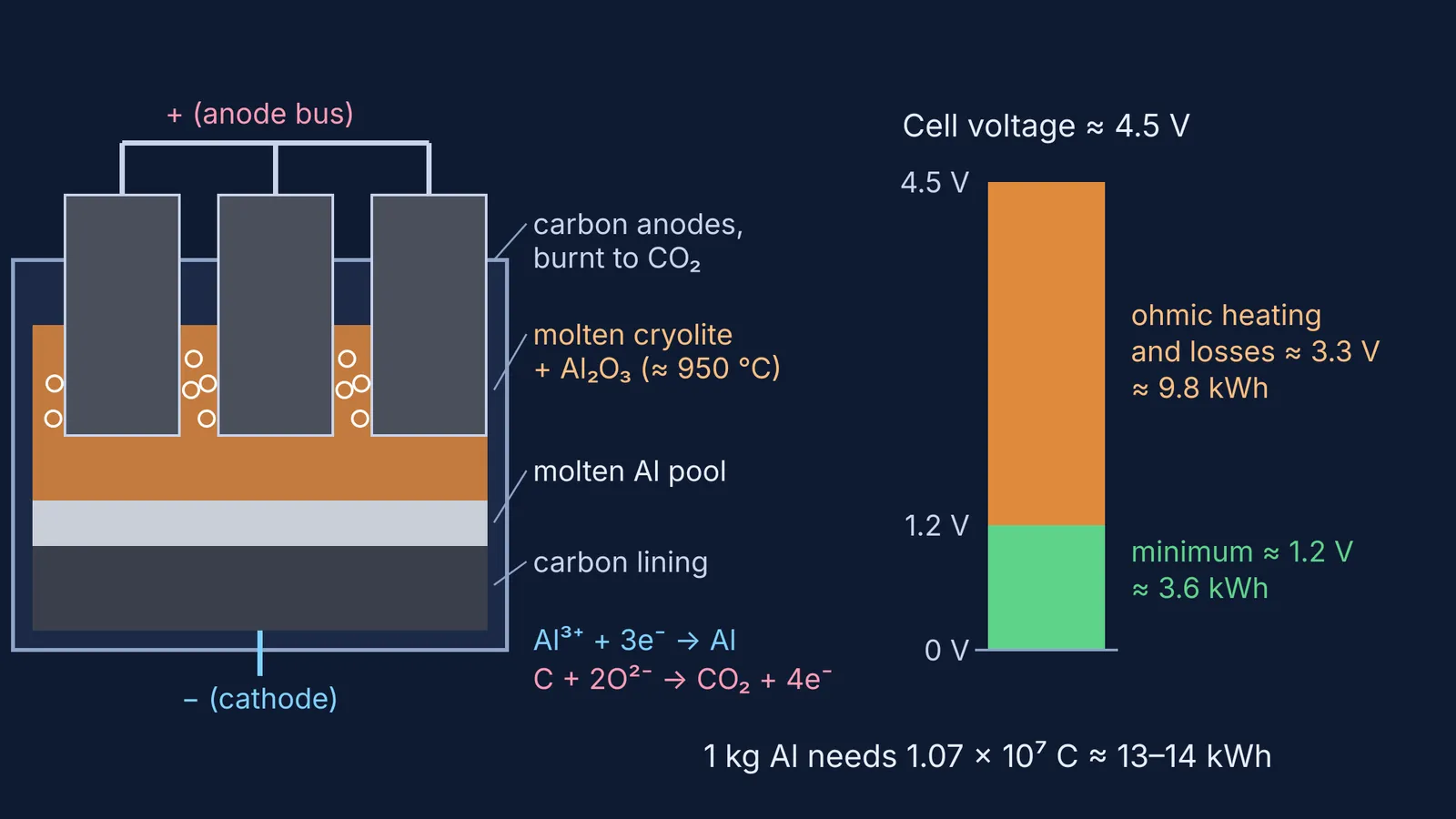
The voltage to use is the cell voltage, the voltage actually applied across a working cell. It is not E° for any half-reaction. In this worked example we take an illustrative cell voltage of 4.5 V, which is in the range usually quoted for these cells (roughly 4 to 4.5 V).
Worked example: electrical energy to make 1 kg of aluminium.
Charge. Q = 1.07 × 10⁷ C (from above).
Energy at 4.5 V. E = QV = 1.073 × 10⁷ × 4.5 = 4.83 × 10⁷ J.
Convert to kWh. 4.83 × 10⁷ ÷ 3.6 × 10⁶ = 13.4 kWh.
Allow for current efficiency. Not all the current makes aluminium. Some is lost, for example when dissolved aluminium is reoxidised in the bath. With an illustrative current efficiency of 95%, the charge needed is 1.07 × 10⁷ ÷ 0.95, so the energy becomes 13.4 ÷ 0.95 = 14.1 kWh per kg.
That is about 14 MWh for every tonne of metal. Why actual mass falls short of the Faraday mass is covered in current efficiency in electrolysis.
These numbers are an estimate built from illustrative inputs, not a measured plant figure. Smelters report their own energy use. If you need a real figure, look up the current values in the International Aluminium Institute's smelting energy intensity statistics rather than trusting a remembered number.
What is the minimum voltage, and where does the rest go?
The overall reaction with a carbon anode is:
2Al₂O₃ + 3C → 4Al + 3CO₂
Check the balance: 4 Al, 6 O and 3 C on each side. Twelve electrons are transferred. At the cathode Al³⁺ gains electrons; at the anode carbon is oxidised, C + 2O²⁻ → CO₂ + 4e⁻.
The smallest voltage that can drive this reaction is E = ΔG/nF. You can estimate it from 298 K data:
ΔG° = 3ΔfG°(CO₂) − 2ΔfG°(Al₂O₃) = 3(−394.4) − 2(−1582.3) = +1981 kJ.
E = 1 981 000 ÷ (12 × 96 485) = 1.71 V at 298 K.
The cell runs at about 950 °C, not 25 °C. The reaction makes a gas from solids, so ΔS is positive and ΔG falls as temperature rises. At the operating temperature the minimum is usually quoted as about 1.2 V. Treat this as approximate: the exact value depends on the temperature and on whether you assume the anode gives CO₂ or some CO.
Without the carbon, the cell would have to split alumina into aluminium and oxygen gas, 2Al₂O₃ → 4Al + 3O₂. From 298 K data that needs 2 × 1582.3 kJ ÷ (12 × 96 485) = 2.73 V. Burning the anode carbon supplies part of the energy, which is why the carbon anode lowers the voltage. It also means the anode is used up. It is not an inert electrode.
Now split the 4.5 V:
About 1.2 V drives the chemistry: 1.2 × 1.07 × 10⁷ C = 3.6 kWh per kg.
About 3.3 V, roughly 73% of the total, goes into resistance (mostly of the molten bath), electrode overpotentials and contacts. It ends up as heat: 3.3 × 1.07 × 10⁷ C = 9.8 kWh per kg.
That heat is not simply waste. It keeps the cryolite–alumina bath molten and heats the alumina fed into it, so the cell needs no separate furnace. Why aluminium has to be won by electrolysis at all, instead of by carbon reduction, is explained in why aluminium is extracted by electrolysis.
How much carbon anode burns for each kilogram of aluminium?
From 2Al₂O₃ + 3C → 4Al + 3CO₂, 3 mol of C are used for every 4 mol of Al.
Mass of carbon per 4 mol Al: 3 × 12.01 = 36.03 g.
Mass of 4 mol Al: 4 × 26.98 = 107.9 g.
Ratio: 36.03 ÷ 107.9 = 0.334 kg of carbon per kg of Al.
This is the theoretical figure for CO₂ only. Real cells burn somewhat more (some carbon reacts with air and some CO forms), so the anode blocks are replaced regularly.
What does this mean on the electricity bill?
Two illustrative calculations show how the numbers scale. Neither is a figure for a real plant.
One cell for one day. Suppose a cell carries 300 kA at 4.5 V with 95% current efficiency.
Charge in 24 h: 300 000 A × 86 400 s = 2.59 × 10¹⁰ C.
Aluminium: 0.95 × 2.59 × 10¹⁰ × 26.98 ÷ (3 × 96 485) = 2.30 × 10⁶ g, about 2.3 tonnes.
Energy: power = 300 000 A × 4.5 V = 1.35 MW, and 1.35 MW × 24 h = 32.4 MWh.
Check: 32 400 kWh ÷ 2295 kg = 14.1 kWh per kg, the same as before.
The cost of the electricity. At an illustrative price of ₹5 per kWh, 14.1 kWh costs about ₹71 for each kilogram of aluminium, before any other cost. This is why aluminium smelting is so sensitive to the price of electricity. It is also why recycled aluminium is attractive: remelting scrap needs no electrolysis, so it skips the 1.07 × 10⁷ C per kilogram entirely.
If you want more electrolysis and energy problems worked step by step, the Fermi Problem Library has a solver that explains the reasoning at each stage.
Quick checklist
1 kg Al = 37.06 mol, needing 3 F per mole: Q = 1.07 × 10⁷ C.
Energy = QV, and 1 kWh = 3.6 × 10⁶ J.
Use the cell voltage (about 4 to 4.5 V), not E°.
At 4.5 V: 13.4 kWh per kg; at 95% current efficiency: about 14.1 kWh per kg.
Thermodynamic minimum with a carbon anode: about 1.2 V at cell temperature, so about 3.6 kWh per kg.
The rest becomes heat that keeps the bath molten.
Anode carbon burned: at least 0.334 kg per kg of Al.


