

On this page
You might wonder why we cannot just toss aluminium ore into a blast furnace with coal, the way we do with iron. Iron extraction relies on carbon to strip the oxygen away, leaving the pure metal behind. This is cheap, effective, and has been used for thousands of years.
However, if you try this with aluminium, nothing happens at standard furnace temperatures. Aluminium sits much higher in the reactivity series than iron. Its small, highly charged Al³⁺ ions form exceptionally strong, stable ionic bonds with oxygen ions. To separate them, you need a reducing agent that wants oxygen even more than aluminium does, which is a very tall order at room temperature.
Why can't carbon reduce aluminium oxide?
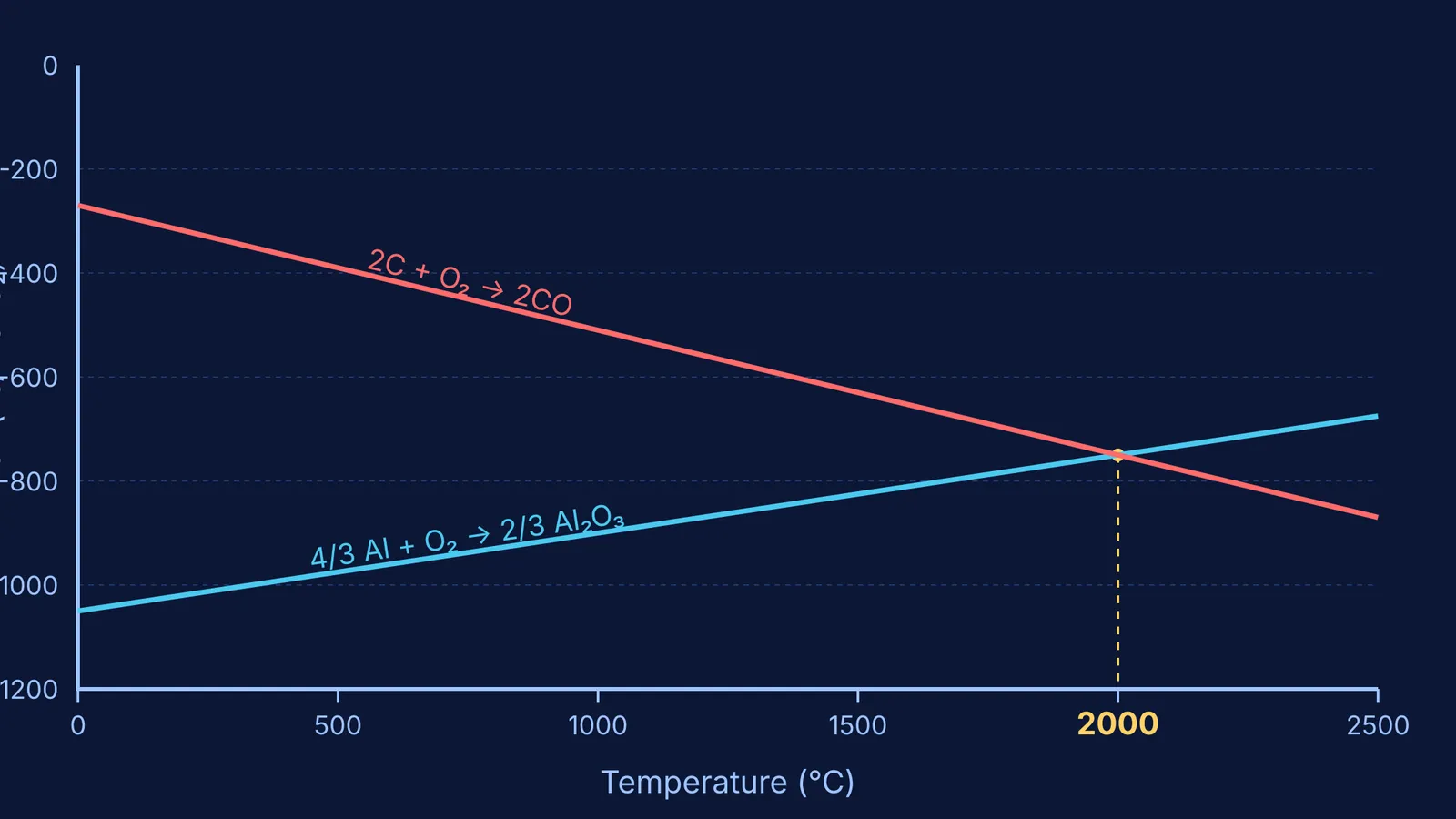
The stability of metal oxides changes as they heat up. The Ellingham diagram is a thermodynamic graph that tracks exactly how much energy is needed to form different oxides at various temperatures. It plots the standard Gibbs free energy of formation against temperature, showing which reactions are thermodynamically favourable.
If you look at the diagram, the line for aluminium oxide is extremely low, meaning it is highly stable. The line for carbon monoxide (formed when carbon takes oxygen) slopes downwards as it gets hotter. At typical blast furnace temperatures, carbon's line is well above aluminium's. This means carbon is thermodynamically too weak to rip oxygen away from the metal.
This is a step up from the basic extraction of metals in Class 10, which focuses on moderately reactive metals like zinc and iron where carbon works perfectly.
What is the 2000 °C problem with aluminium carbide?
If you push the heat high enough, carbon does eventually win. The Ellingham diagram shows that carbon's curve drops below aluminium's curve at roughly 2000 °C (Wikipedia: Ellingham diagram). Above this threshold, carbothermic reduction is theoretically possible.
However, operating a smelter at 2000 °C is an industrial nightmare. For one, aluminium has a boiling point of 2470 °C (Wikipedia: Aluminium), meaning the liquid metal would be perilously close to vaporising inside the furnace.
More critically, chemistry gets in the way. At 2000 °C, the newly freed aluminium reacts immediately with the excess carbon in the furnace to form a brittle, unwanted compound called aluminium carbide (Al₄C₃) instead of pure metallic aluminium (Wikipedia: Aluminium carbide).
If you find reading thermodynamic graphs tricky, the Fermi Concept Library maps out metallurgy and the Ellingham diagram, and the AI tutor can draw the figure to show exactly where carbon's line overtakes aluminium's.
How is aluminium extracted by electrolysis?
Because carbon fails us, we have to force the reaction using electrons directly. The industrial solution is the Hall-Héroult process, which uses electricity as the reducing agent.
While copper is purified from its crude state using electricity—a process known as electrolytic refining—aluminium relies on electrolysis just to be separated from oxygen in the first place.
Aluminium oxide (alumina) has a naturally high melting point of 2072 °C (Wikipedia: Hall-Héroult process). To make electrolysis practical, the alumina is dissolved in a molten mineral called cryolite (Na₃AlF₆). This acts as a solvent, bringing the operating temperature down to a much more manageable 940–980 °C.
Once the mixture is molten, a massive electric current is passed through it. The electricity provides the electrons needed to reduce the Al³⁺ ions at the cathode, pooling as pure, liquid aluminium at the bottom of the cell.
At the same time, oxygen ions migrate to the positively charged carbon anode. They surrender their electrons to form oxygen gas. Because the operating temperature is still nearly 1000 °C, this freshly formed oxygen immediately attacks the carbon anodes, reacting to produce carbon dioxide gas. The carbon anodes literally burn away during the process and must be continuously replaced.
If you are reviewing the reactivity series and why different metals need different extraction methods, bring your syllabus to Fermi's AI tutor. It will work out what you already know about oxidation and build a plan for the session to cover the rest.
How do you predict metal extraction methods?
When preparing for exams like the JEE or NEET, you can predict how a metal is extracted just by looking at its reactivity. Use this simple framework:
Low reactivity (gold, silver, platinum): Often found native in the Earth's crust. No chemical reduction is needed.
Moderate reactivity (zinc, iron, copper, lead): Found as oxides or sulphides. Extracted using carbon (coke) reduction in a furnace because they sit below carbon in the reactivity series at achievable temperatures.
High reactivity (potassium, sodium, calcium, magnesium, aluminium): Found as stable oxides or chlorides. Must be extracted using electrolytic reduction because carbon either requires unachievable temperatures or forms unwanted carbides.


