

On this page
Pick any whole number, say 100, and build it by adding numbers from 1, 2, 3, 5, 8, 13, 21, 34, 55, 89. You always can. Add one rule, never use two neighbours from the list, and there is exactly one way. That is Zeckendorf's theorem, and it turns the Fibonacci numbers into a number system almost as tidy as binary.
What does Zeckendorf's theorem say?
Zeckendorf's theorem states that every positive integer can be written uniquely as a sum of distinct Fibonacci numbers, no two of which are consecutive in the sequence (Wikipedia, Zeckendorf's theorem). That sum is called the Zeckendorf representation of the number.
It is named after Edouard Zeckendorf, a Belgian army doctor and amateur mathematician (Wikipedia, Edouard Zeckendorf), who published it in 1972 in the Bulletin of the Royal Society of Sciences of Liège (Wikipedia). Wolfram MathWorld also lists an earlier Dutch-language paper on the same representation by C. G. Lekkerkerker, in the journal Simon Stevin, dated 1951-52 (MathWorld, Zeckendorf's theorem).
The sequence begins 1, 1, 2, 3, but the two 1s count once here, so 1 and 2 are neighbours. The no-neighbours rule is what makes the answer unique. Without it, 64 has several Fibonacci sums, including 34 + 21 + 8 + 1 and 55 + 5 + 3 + 1, but only 55 + 8 + 1 avoids neighbours (Wikipedia).
How do you write 100 as a sum of Fibonacci numbers?
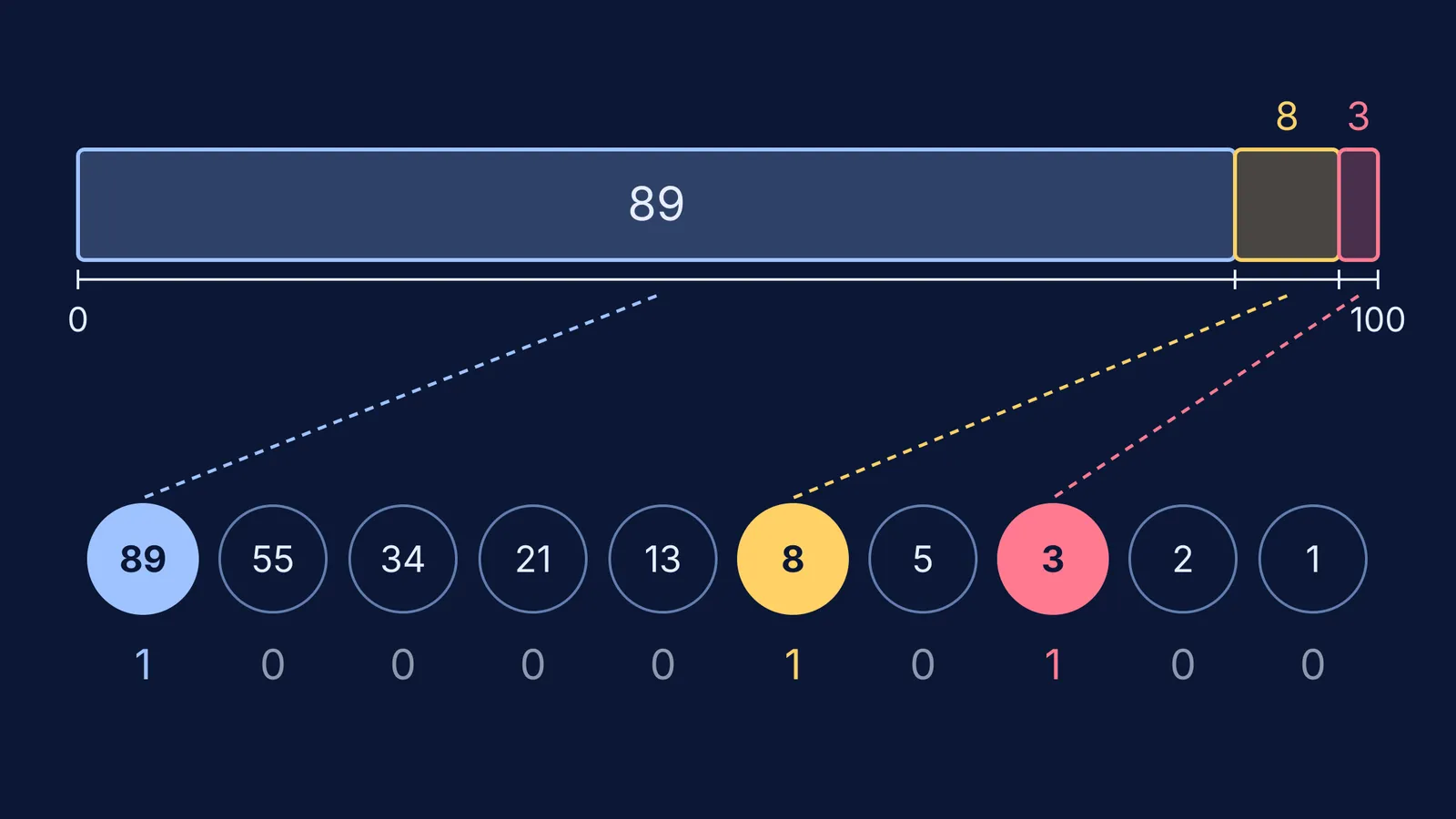
Use the greedy method: take the largest Fibonacci number that fits, subtract it, and repeat with what is left (Wikipedia).
The largest Fibonacci number not above 100 is 89. Remainder: 100 − 89 = 11.
The largest not above 11 is 8. Remainder: 11 − 8 = 3.
3 is itself a Fibonacci number. Remainder: 0.
So 100 = 89 + 8 + 3, and no two of 3, 8 and 89 are neighbours in the list.
If you have met the greedy method for writing a fraction as a sum of unit fractions, this is the same habit: grab the biggest piece that fits and deal with the remainder.
Why are consecutive Fibonacci numbers never needed?
First, neighbours can always be merged: each Fibonacci number is the sum of the two before it, so 21 + 34 = 55 and 5 + 8 = 13.
Second, the greedy method never picks a neighbour. Suppose F is the largest Fibonacci number not above n, and G is the next one up. Then n is less than G, so the remainder n − F is less than G − F, which is exactly the Fibonacci number just below F. The next greedy pick must therefore skip F's lower neighbour; this is the induction step in the standard existence proof (Wikipedia, proof). For 100, the remainder 11 is less than 144 − 89 = 55, so 55 can never be chosen.
Uniqueness rests on one identity: adding every second Fibonacci number downward from any term gives one less than the next Fibonacci number above that term (Wikipedia). For example, 34 + 13 + 5 + 2 = 54 = 55 − 1. So a neighbour-free sum whose largest term is below F totals less than F, and two different neighbour-free sums never match.
If a step in an argument like this one loses you, the Fermi Problem Library has worked problems with a step-by-step solver that explains the reasoning rather than printing an answer.
What is Fibonacci coding?
Write 1 for each Fibonacci number used and 0 for each skipped, largest first, and you get bits with no two 1s side by side. The OEIS lists these strings as sequence A014417: 1, 10, 100, 101, 1000 for the numbers 1 to 5 (OEIS A014417).
Fibonacci coding is a universal code that turns positive integers into binary code words: it takes the Zeckendorf string, reverses it so the smallest place comes first, and appends one extra 1 (Wikipedia, Fibonacci coding). Since a Zeckendorf string never contains 11, the only 11 in a code word is at its end, so a reader of a long bit stream knows where each number stops.
For 100, reading the places from 1 up to 89 gives 0010100001; the final 1 makes the code word 00101000011.
A 20-minute practice plan
Write the Fibonacci numbers up to 987 on one line.
Use the greedy method on 20, 50, 100 and 1000. You should get 13 + 5 + 2, 34 + 13 + 3, 89 + 8 + 3 and 987 + 13.
For each, write the bit string and confirm it has no 11.
Turn two into Fibonacci code words, then decode one by dropping the final 1 and adding the place values of the other 1s.
For the induction idea underneath the proof, the Fermi Concept Library gives every concept in mathematics its own lesson and its place in the map. And if you like these numbers turning up in unexpected places, see where the Fibonacci numbers hide in Pascal's triangle and how the golden ratio appears as a continued fraction.


