

On this page
An Egyptian fraction is a fraction written as a sum of distinct unit fractions, fractions with 1 on top, such as 5/6 = 1/2 + 1/3 (Greedy algorithm for Egyptian fractions, Wikipedia). Every positive fraction can be written this way, and one simple method always works.
Where do Egyptian fractions come from?
The best-known source is the Rhind papyrus, named after the Scottish Egyptologist Henry Rhind, who bought it in Luxor in 1858 (MacTutor History of Mathematics). It was copied more than 3,500 years ago by a scribe called Ahmes, who says he was copying a document about 200 years older (same source).
Its first part is a table that writes 2/n as unit fractions for every odd n from 3 to 101; for example, 2/15 = 1/10 + 1/30 (Rhind Mathematical Papyrus, Wikipedia). The papyrus also holds 84 word problems whose final answers are all written as Egyptian fractions (Egyptian fraction, Wikipedia). The same article notes that the 9th-century Jain mathematician Mahāvīra studied related problems of splitting numbers into unit fractions in India.
How does the greedy algorithm work?
The first published systematic method appeared in 1202 in the Liber Abaci of Leonardo of Pisa, better known as Fibonacci, who offered it as a last resort after simpler tricks (Greedy algorithm for Egyptian fractions). It is called greedy because each step grabs the largest unit fraction that still fits.
For a fraction x/y smaller than 1:
Divide y by x and round up to a whole number d. Then 1/d is the largest unit fraction not bigger than x/y.
Subtract: x/y − 1/d. Simplify the result.
If the remainder is a unit fraction, write it down and stop. Otherwise repeat with the remainder.
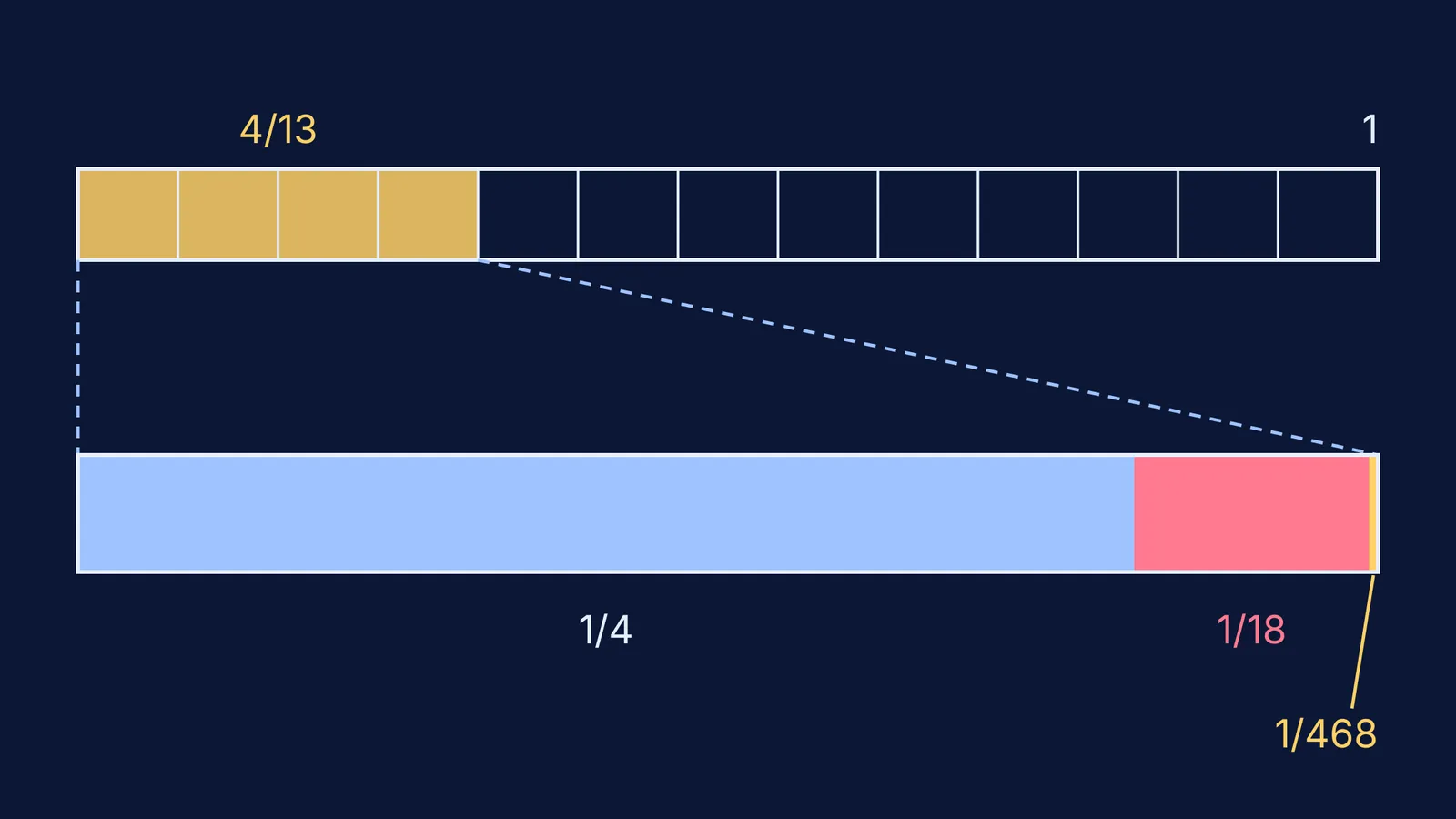
Here is 4/13, worked in full:
13 ÷ 4 = 3.25, which rounds up to 4. So 4/13 − 1/4 = 16/52 − 13/52 = 3/52.
52 ÷ 3 = 17.33..., which rounds up to 18. So 3/52 − 1/18 = 54/936 − 52/936 = 2/936 = 1/468.
The remainder is a unit fraction, so you stop: 4/13 = 1/4 + 1/18 + 1/468.
Why does the greedy algorithm always end?
The trick is to find a whole number that must get smaller every round.
Say the remainder is x/y and you pick d by rounding y/x up. Because d is the smallest whole number with dx ≥ y, the number before it fails: (d − 1)x < y.
The new remainder is x/y − 1/d = (dx − y)/(yd).
Its numerator dx − y is less than x, because dx − y < x is the same statement as (d − 1)x < y.
A positive whole number that falls every round can only fall so many times. Starting from numerator x, you need at most x unit fractions.
In the 4/13 example the numerators went 4, 3, then 2, which simplified to 1; simplifying only helps. Similar algebra shows each new remainder is smaller than 1/d, so no unit fraction repeats.
Is the greedy answer always the shortest?
No, and 5/121 shows how badly it can go (Greedy algorithm for Egyptian fractions). The numerators fall one at a time, 5, 4, 3, 2, 1, so you get five terms:
5/121 = 1/25 + 1/757 + 1/763309 + 1/873960180913 + 1/1527612795642093418846225
That last denominator has 25 digits. Yet 5/121 = 1/33 + 1/121 + 1/363 works too: over 363 it is (11 + 3 + 1)/363 = 15/363 = 5/121. The same article reports a worse case, 31/311, where the greedy method gives ten terms and the last denominator has over 500 digits.
The scribes did not always choose the greedy answer either: greedy turns 2/15 into 1/8 + 1/120, while the Rhind table gives 1/10 + 1/30.
How can you practise Egyptian fractions?
A 20-minute session you can do with a notebook:
Run the greedy method on 2/n for n = 5, 7, 9 and 11, then compare with the Rhind table entries for the same n.
Prove that for odd n the greedy method always gives 2/n = 1/((n + 1)/2) + 1/(n(n + 1)/2). Hint: 2/n − 2/(n + 1) = 2/(n(n + 1)).
Do the first two steps of 5/121 by hand and confirm you reach 1/25 and 1/757.
Check every answer by adding it back, as in the callout above.
If the subtraction or the rounding step keeps going wrong, the Fermi Problem Library has worked problems with a step-by-step solver that explains the reasoning, so you can see which line broke.
For more fraction practice, read Fractions in Disguise: percentages, profit and compounding, then try continued fractions and the golden ratio or the largest amount two coins can't pay.


