

On this page
You meet Pascal's triangle as a table of binomial coefficients and the Fibonacci numbers as a puzzle about rabbits. Tilt the triangle and one becomes the other. Here is where they sit, why they must be there, and a counting proof you can check on paper.
Where are the Fibonacci numbers in Pascal's triangle?
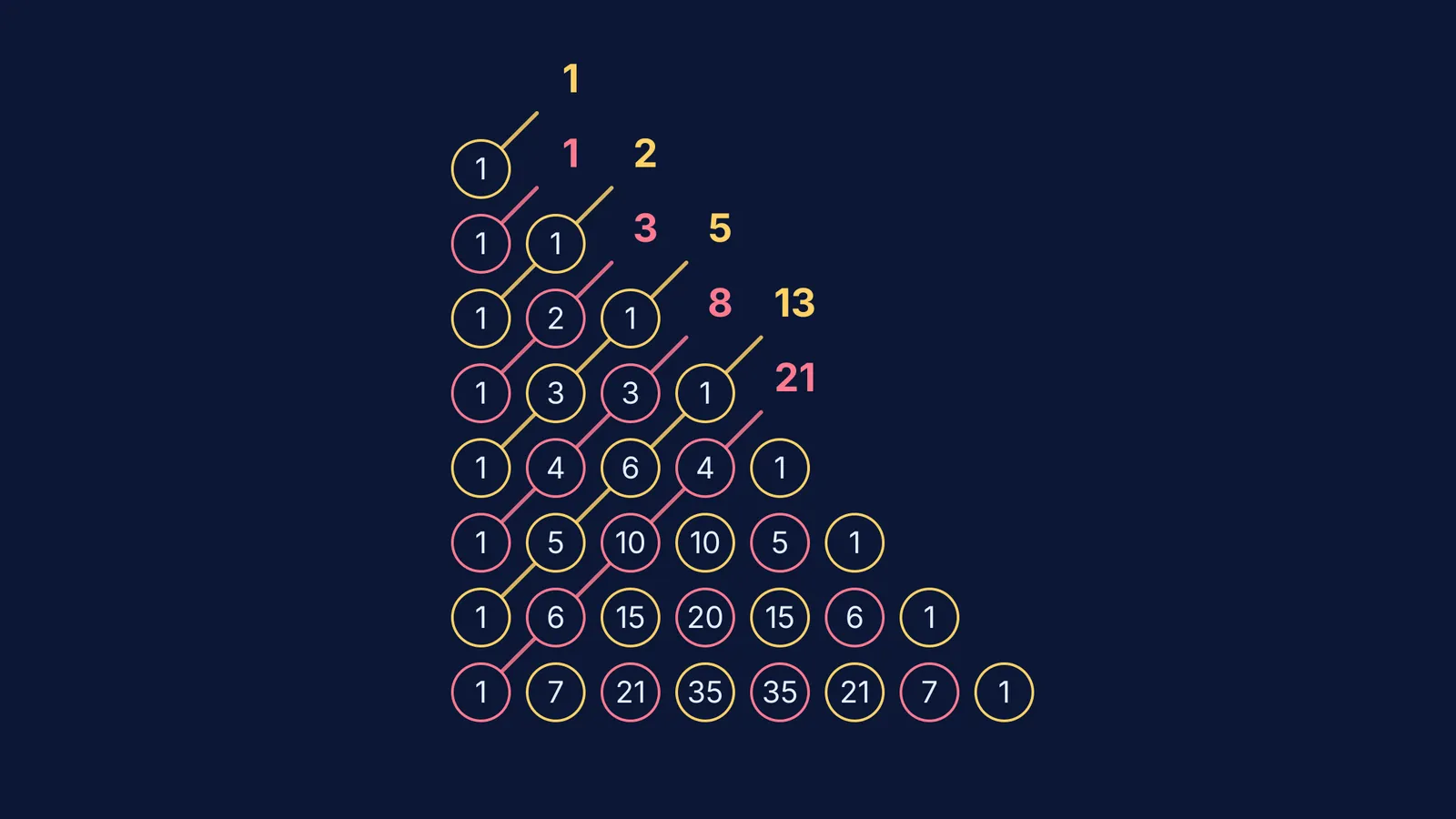
Write Pascal's triangle left-justified, so row n starts in the first column and holds C(n, 0), C(n, 1), and so on. Start at the first entry of any row and walk up one row and right one column, again and again, until you run out of numbers. These are the "shallow" diagonals, and the Wikipedia article on the Fibonacci sequence states that the Fibonacci numbers are the sums of binomial coefficients along them.
The first eight rows:
Row 0: 1 = 1
Row 1: 1 = 1
Row 2: 1 + 1 = 2
Row 3: 1 + 2 = 3
Row 4: 1 + 3 + 1 = 5
Row 5: 1 + 4 + 3 = 8
Row 6: 1 + 5 + 6 + 1 = 13
Row 7: 1 + 6 + 10 + 4 = 21
The OEIS entry A000045 records the same fact: F(n) is the diagonal sum of the entries in Pascal's triangle at a 45-degree slope. Its references include Édouard Lucas's 1876 note on the triangle; the triangle itself is far older, as our story on Yang Hui's triangle in China shows.
What is the formula F(n+1) = Σ C(n − k, k)?
The diagonal that starts in row n picks up C(n, 0), C(n − 1, 1), C(n − 2, 2) and so on, stopping when the bottom number would exceed the top one. With F(0) = 0 and F(1) = 1, the OEIS lists the identity as F(n+1) = Σ binomial(n − j, j) for j = 0 to ⌊n/2⌋.
For n = 6: C(6, 0) + C(5, 1) + C(4, 2) + C(3, 3) = 1 + 5 + 6 + 1 = 13, and 13 is F(7).
Why does it work? A proof from Pascal's rule
Call the diagonal sum D(n). We show D(n) follows the Fibonacci rule D(n) = D(n − 1) + D(n − 2). Treat C(a, b) as 0 when b is negative or larger than a.
Pascal's rule says C(m, k) = C(m − 1, k) + C(m − 1, k − 1). Apply it to every term: C(n − k, k) = C(n − 1 − k, k) + C(n − 1 − k, k − 1).
Add the first pieces over k. You get Σ C((n − 1) − k, k), which is exactly D(n − 1).
Add the second pieces over k and put j = k − 1. Each becomes C((n − 2) − j, j), and the total is D(n − 2).
So D(n) = D(n − 1) + D(n − 2). Since D(0) = 1 = F(1) and D(1) = 1 = F(2), induction gives D(n) = F(n + 1) for every n.
In pictures: each entry is the sum of the two entries above it, one on the previous diagonal and one on the diagonal before that. Pascal's rule also drives the induction proof in our post on the hockey stick identity.
Is there a proof by counting?
The Wikipedia article notes that the number of ways to write n as an ordered sum of 1s and 2s is F(n+1); for a staircase of 5 steps climbed one or two at a time, that is 8 ways.
If you take k double steps, you make n − k moves in total, and you only have to choose which k of them are doubles: C(n − k, k) ways. Adding over every possible k gives Σ C(n − k, k), so the two counts must match.
Check it for n = 5: no doubles gives C(5, 0) = 1, one double gives C(4, 1) = 4, two doubles give C(3, 2) = 3. That is 1 + 4 + 3 = 8, the row-5 diagonal above. If this style of argument is new to you, our guide to counting with a bijection builds the habit.
How do you practise this so it sticks?
With a pencil, not a calculator:
Draw rows 0 to 9 left-justified, shade the diagonals in two colours, and check that the last sum is 55.
Write the Pascal's-rule proof for n = 7 with actual numbers instead of letters.
List every way to climb 6 steps one or two at a time, group them by the number of doubles, and match each group to an entry of the row-6 diagonal.
If a step in the proof does not click, the Fermi Problem Library has worked problems with a step-by-step solver that explains the reasoning rather than printing an answer. For binomial coefficients themselves, the Fermi Concept Library gives every concept in mathematics its own lesson.


