

On this page
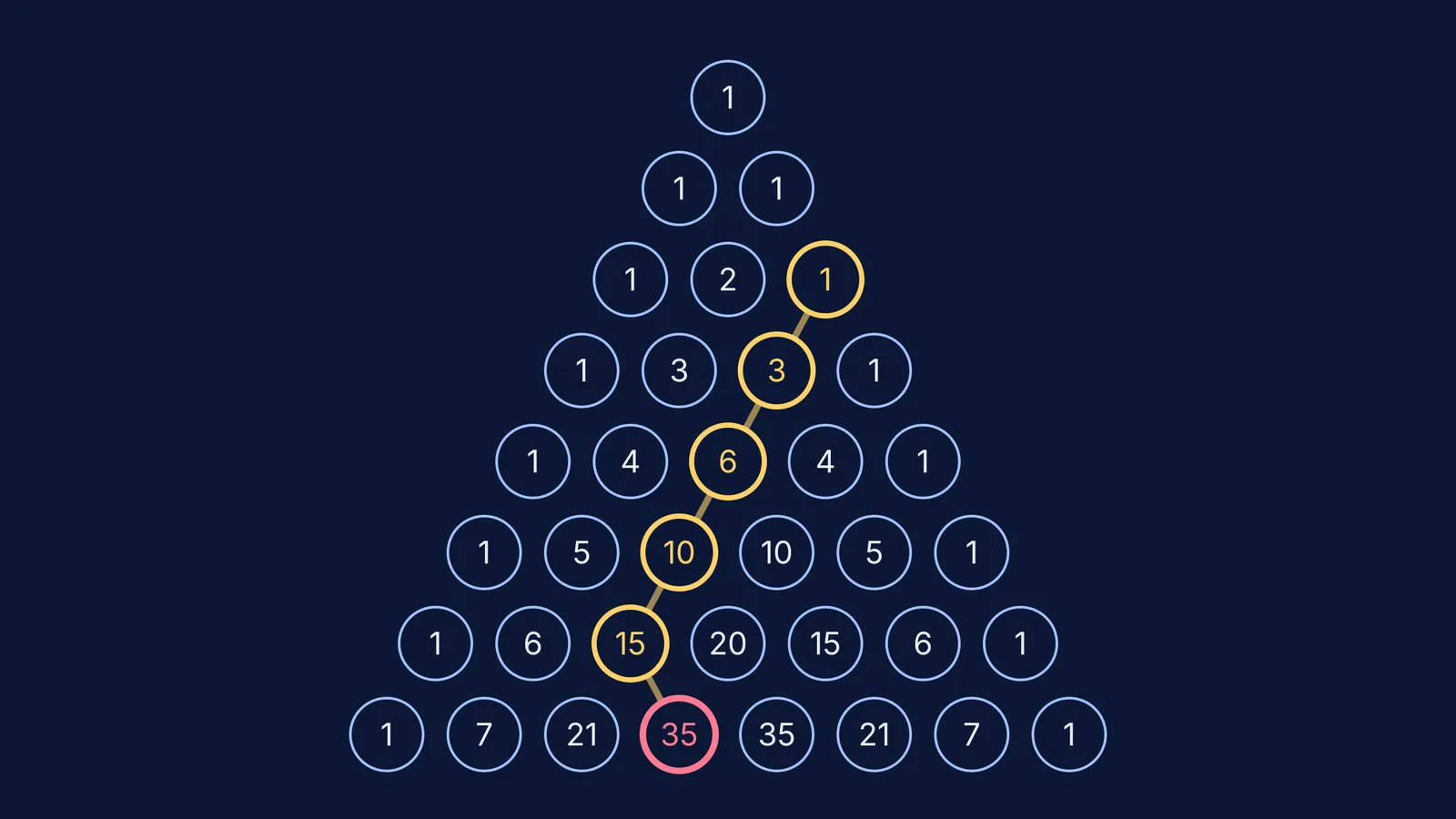
Walk down a diagonal of Pascal's triangle from its edge, adding as you go. The total is already in the triangle, one row below your last number and one step towards the middle. That is the hockey stick identity, and it turns many series sums into one binomial coefficient.
What does the hockey stick identity say?
For whole numbers n ≥ r ≥ 0, C(r, r) + C(r+1, r) + C(r+2, r) + ... + C(n, r) = C(n+1, r+1), as stated on Wikipedia's hockey-stick identity page. In sigma notation: the sum of C(k, r) for k from r to n equals C(n+1, r+1).
The same page lists other names for it: the Christmas stocking identity, the boomerang identity, Fermat's identity and Chu's theorem. Wolfram MathWorld's Pascal's triangle entry gives the same sum and notes that the diagonals of the triangle hold the figurate numbers.
Try it with r = 2 and n = 6, the picture at the top of this post:
1 + 3 + 6 + 10 + 15 = 35 = C(7, 3).
The five numbers are the handle; the 35 is the blade.
How do you prove the hockey stick identity by induction?
The engine is Pascal's rule, C(n, k) = C(n−1, k) + C(n−1, k−1): each entry is the sum of the two entries above it (Pascal's rule).
Base case, n = r: the left side is C(r, r) = 1 and the right side is C(r+1, r+1) = 1.
Assume the sum up to C(m, r) equals C(m+1, r+1).
Add the next term, C(m+1, r). By Pascal's rule, C(m+1, r+1) + C(m+1, r) = C(m+2, r+1), which is the formula for n = m+1.
How do you prove it by counting?
Count the ways to choose r+1 numbers from {1, 2, ..., n+1}. Directly, that is C(n+1, r+1).
Now sort the same choices by their largest number, as the hockey-stick identity page does. If the largest number chosen is k+1, the other r numbers come from {1, ..., k}, in C(k, r) ways. The largest number can be anything from r+1 to n+1, so k runs from r to n. Each choice falls into exactly one case, so adding the cases gives the sum of C(k, r) = C(n+1, r+1).
Check it with the picture. Choose 3 numbers from {1, ..., 7}: C(7, 3) = 35 ways. If the largest is 3, there is C(2, 2) = 1 way; largest 4, C(3, 2) = 3; largest 5, 6; largest 6, 10; largest 7, 15. The cases add to 35.
Counting one set two ways is a close cousin of the matchings in our guide to counting with a bijection.
How is the hockey stick identity used to sum series?
Any sum you can rewrite as binomial coefficients down one diagonal collapses to a single term. Three examples:
Natural numbers: k = C(k, 1), so 1 + 2 + ... + n = C(n+1, 2) = n(n+1)/2.
Products of neighbours: k(k+1) = 2 × C(k+1, 2), so 1·2 + 2·3 + ... + n(n+1) = 2 × C(n+2, 3) = n(n+1)(n+2)/3. For n = 3: 2 + 6 + 12 = 20, and 3·4·5/3 = 20.
Squares: k² = 2 × C(k, 2) + C(k, 1), so 1² + 2² + ... + n² = 2 × C(n+1, 3) + C(n+1, 2) = n(n+1)(2n+1)/6. For n = 3: 1 + 4 + 9 = 14, and 3·4·7/6 = 14.
A routine for any such sum:
Write the general term using products of consecutive integers.
Turn each product of r consecutive integers into r! × C(top, r).
C(k, r) is zero when k is below r, so starting the sum at k = 1 changes nothing.
Apply the identity, then test n = 1 and n = 2.
For the r! × C(n, r) step, keep the permutations and combinations formulas to hand, along with the full list of binomial theorem formulas.
If the rewriting step is where you stall, the Fermi Problem Library has worked problems with a step-by-step solver that explains the reasoning rather than printing an answer.
A short practice: draw rows 0 to 8 of the triangle, shade three hockey sticks, check each total against C(n+1, r+1), then explain one by counting to someone at home.


