

On this page
This set follows set 1 of our NEET work, energy and power questions and tests the sub-topics that set left out. All eight questions are new. Take g = 10 m/s².
The NMC syllabus for NEET (UG)-2026 puts all of this in Unit 4: work, energy and power, including conservative and non-conservative forces, motion in a vertical circle and collisions. If the chapter is still new, read our guide to preparing work, energy and power for NEET first.
How should you use this practice set?
Give yourself 12 minutes for all eight.
Before calculating, name the tool: work, energy, power or momentum.
Pick an option before reading the answer.
Read every trap, even when right.
Easy: net work, friction and power on a slope
Q1 (easy). A student lifts a 5 kg crate straight up through 2 m at constant speed. The total work done on the crate by all the forces acting on it is
(A) 0 (B) +100 J (C) −100 J (D) +200 J
Answer: (A). Speed is constant, so ΔK = 0 and the net work is zero: the student does +100 J, gravity −100 J. Trap: (B) is the student's work alone, not the total.
Q2 (easy). A block sliding on a rough level floor comes to rest in 3 m. On the same floor, the same block starting at twice the speed stops in
(A) 3 m (B) 6 m (C) 12 m (D) 24 m
Answer: (C). Friction does work −f d = −½mv², and f is the same, so d ∝ v². Doubling v gives 4 × 3 = 12 m. Trap: (B) treats distance as proportional to speed.
Q3 (easy). A 1200 kg car climbs a straight road that rises 1 m for every 20 m along it, at a steady 15 m/s. Air drag and rolling resistance together are 400 N. The power the engine delivers to the wheels is
(A) 6 kW (B) 9 kW (C) 15 kW (D) 186 kW
Answer: (C). At steady speed the driving force balances mg sin θ + 400 = 600 + 400 = 1000 N, so P = Fv = 1000 × 15 = 15 kW. Trap: (A) forgets the component of gravity along the slope.
Medium: springs, round trips and two moving bodies
Q4 (medium). A 1 kg ball is dropped from rest 0.7 m above the top of a light vertical spring of stiffness 50 N/m. The greatest kinetic energy the ball has while falling and compressing the spring is
(A) 7 J (B) 8 J (C) 9 J (D) 10 J
Answer: (B). The ball speeds up until the spring force equals its weight, at x = mg/k = 0.2 m. There, K = mg(0.7 + 0.2) − ½kx² = 9 − 1 = 8 J, so v = 4 m/s. Trap: (A) stops at the moment of contact, but gravity still beats the spring force for the first 0.2 m.
Q5 (medium). A 2 kg block is pushed 5 m up a rough incline (sin θ = 0.6, cos θ = 0.8, μ = 0.25) and then slides back down to its starting point. Over the round trip, the work done by gravity and by friction are
(A) 0 and 0 (B) 0 and −40 J (C) −60 J and −40 J (D) 0 and −20 J
Answer: (B). Gravity is conservative, so its work over a closed path is zero. Friction, 0.25 × 2 × 10 × 0.8 = 4 N, opposes motion on both legs: −4 × 10 = −40 J. Trap: (A) treats friction as conservative, as if the downhill leg gave its work back.
Q6 (medium). A 1 kg ball moving at 6 m/s catches up with a 2 kg ball moving at 3 m/s in the same direction, and they collide elastically head-on. The velocity of the 2 kg ball just after the collision is
(A) 2 m/s (B) 4 m/s (C) 5 m/s (D) 6 m/s
Answer: (C). Momentum: v₁ + 2v₂ = 12. Elastic, so the relative speed reverses: v₂ − v₁ = 3. Then v₁ = 2 m/s and v₂ = 5 m/s, and kinetic energy stays at 27 J. Trap: (D) swaps the velocities, a shortcut that works only for equal masses.
Hard: leaving a curved surface and a three-step chain
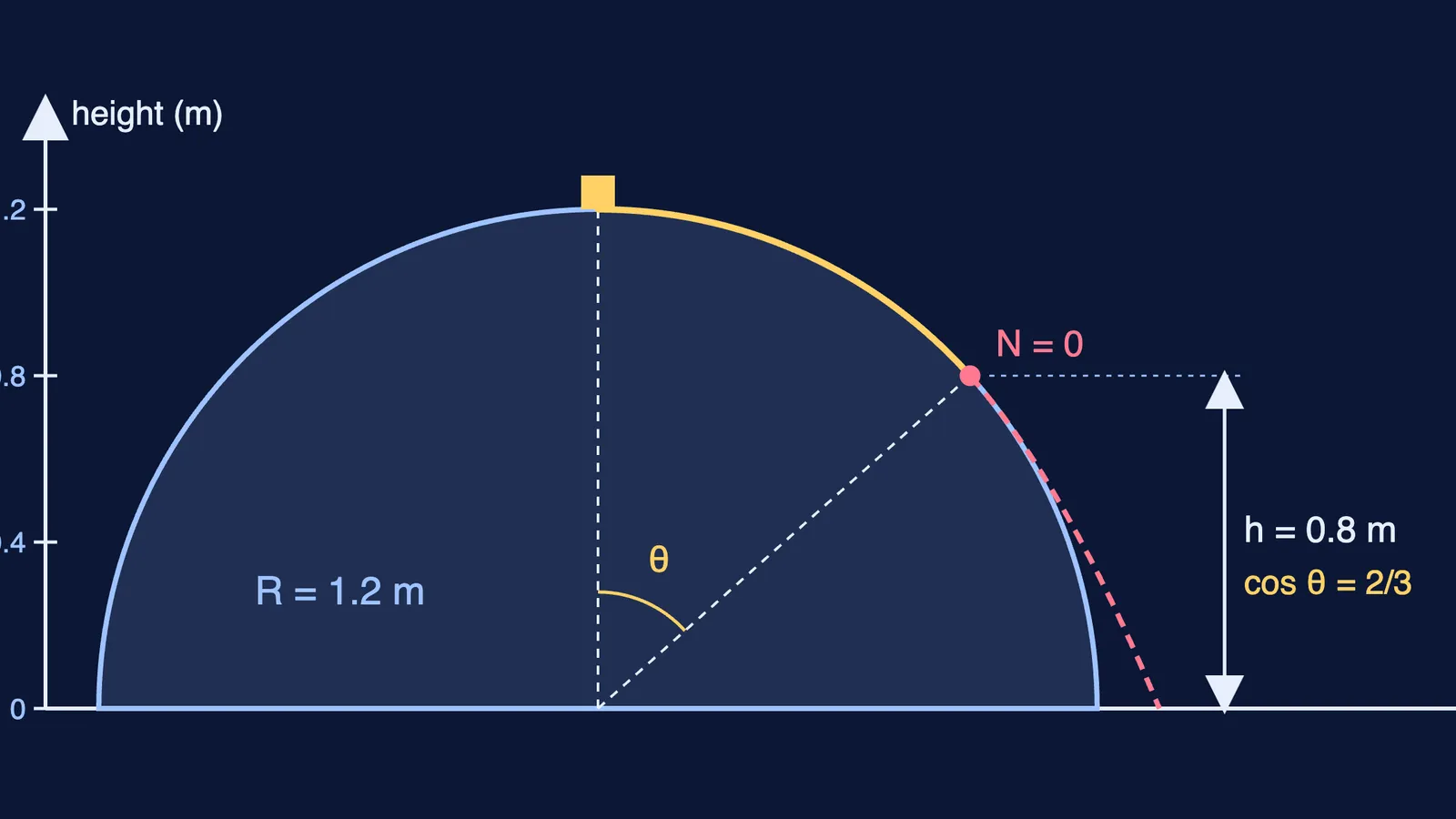
Q7 (hard). A small block slides from rest at the top of a smooth hemisphere of radius 1.2 m fixed on the ground. At what height above the ground does it leave the surface?
(A) 0.4 m (B) 0.6 m (C) 0.8 m (D) 1.2 m
Answer: (C). At angle θ from the vertical, energy gives v² = 2gR(1 − cos θ). It leaves when the normal force reaches zero, so mg cos θ = mv²/R. Then cos θ = 2(1 − cos θ), cos θ = 2/3, and the height is 2R/3 = 0.8 m. Trap: (A) is how far the block has dropped, not its height.
Q8 (hard). A 2 kg bob hangs on a light string 0.45 m long. It is pulled aside until the string is horizontal and released. At the lowest point it hits a 1 kg block at rest on a rough floor (μ = 0.4) in an elastic head-on collision. How far does the block slide?
(A) 0.5 m (B) 1.1 m (C) 2.0 m (D) 2.25 m
Answer: (C). The bob arrives at √(2gL) = 3 m/s. Elastic collision: the block gets 2m₁u/(m₁ + m₂) = 4 m/s, and the bob carries on at 1 m/s. Friction stops the block in v²/2μg = 16/8 = 2 m. Trap: (D) hands the block all 9 J of the bob's energy, but the bob keeps 1 J.
What should you revise if you missed one?
Q1 or Q2: the work-energy theorem, NCERT Class 11 Chapter 5, sections 5.2 to 5.6.
Q3: power as Fv, section 5.10.
Q4 or Q5: spring energy and conservative forces, sections 5.7 to 5.9.
Q6 or Q8: elastic collisions in one dimension, section 5.11.
Q7: energy conservation with a circular-motion condition.
If one kind of slip keeps returning, the Fermi Problem Library has worked problems with a step-by-step solver that explains the reasoning rather than printing an answer. For sign errors, read three work-energy mistakes and how to avoid them.


