

On this page
This set follows our first set of work, energy and power JEE Main questions and covers what it skipped, from instantaneous power and potential energy curves to a 2D collision. Take g = 10 m/s².
Unit 4 of the NTA syllabus for JEE (Main) 2027 lists conservative and non-conservative forces, power, and elastic and inelastic collisions in one and two dimensions alongside work and energy; the textbook is Chapter 5 of NCERT Class 11 Physics. New to the chapter? Start with our guide to preparing work, energy and power for JEE Main.
How should you use this second practice set?
Allow 25 minutes. Q6 asks for a number.
Name the tool first: work-energy theorem, energy conservation, momentum or graph area.
Commit to an answer before reading the solution, and note the trap behind each miss.
If one slip keeps returning, the Fermi Problem Library has worked problems with a step-by-step solver that explains the reasoning rather than printing an answer.
Easy: can you tell power, work and energy transfer apart?
Q1 (easy). A constant net force of 4 N acts on a 2 kg block starting from rest. The power delivered by the force at t = 3 s is
(A) 12 W (B) 24 W (C) 36 W (D) 72 W
Answer: (B). a = 2 m/s², so v = 6 m/s at 3 s and P = Fv = 4 × 6 = 24 W. Trap: (A) is the average power, 36 J ÷ 3 s.
Q2 (easy). A 2 kg parcel is carried up a winding staircase along an 8 m path and left on a shelf 3 m up. The work done on it by gravity is
(A) −160 J (B) −60 J (C) +60 J (D) 0
Answer: (B). Gravity is conservative, so only the height change counts: W = −mgh = −2 × 10 × 3 = −60 J. Trap: (A) uses the 8 m path, which matters only for forces like friction.
Q3 (easy). A 1 kg ball moving at 4 m/s makes a head-on elastic collision with a 3 kg ball at rest. What fraction of its kinetic energy is passed to the 3 kg ball?
(A) 1/4 (B) 1/3 (C) 1/2 (D) 3/4
Answer: (D). v₂ = 2m₁u/(m₁ + m₂) = 2 m/s, so the 3 kg ball gets 6 J of the 8 J, which is 4m₁m₂/(m₁ + m₂)² = 3/4. Trap: (A) is the share the 1 kg ball keeps as it bounces back at 2 m/s.
Medium: how do graphs and energy curves change the method?
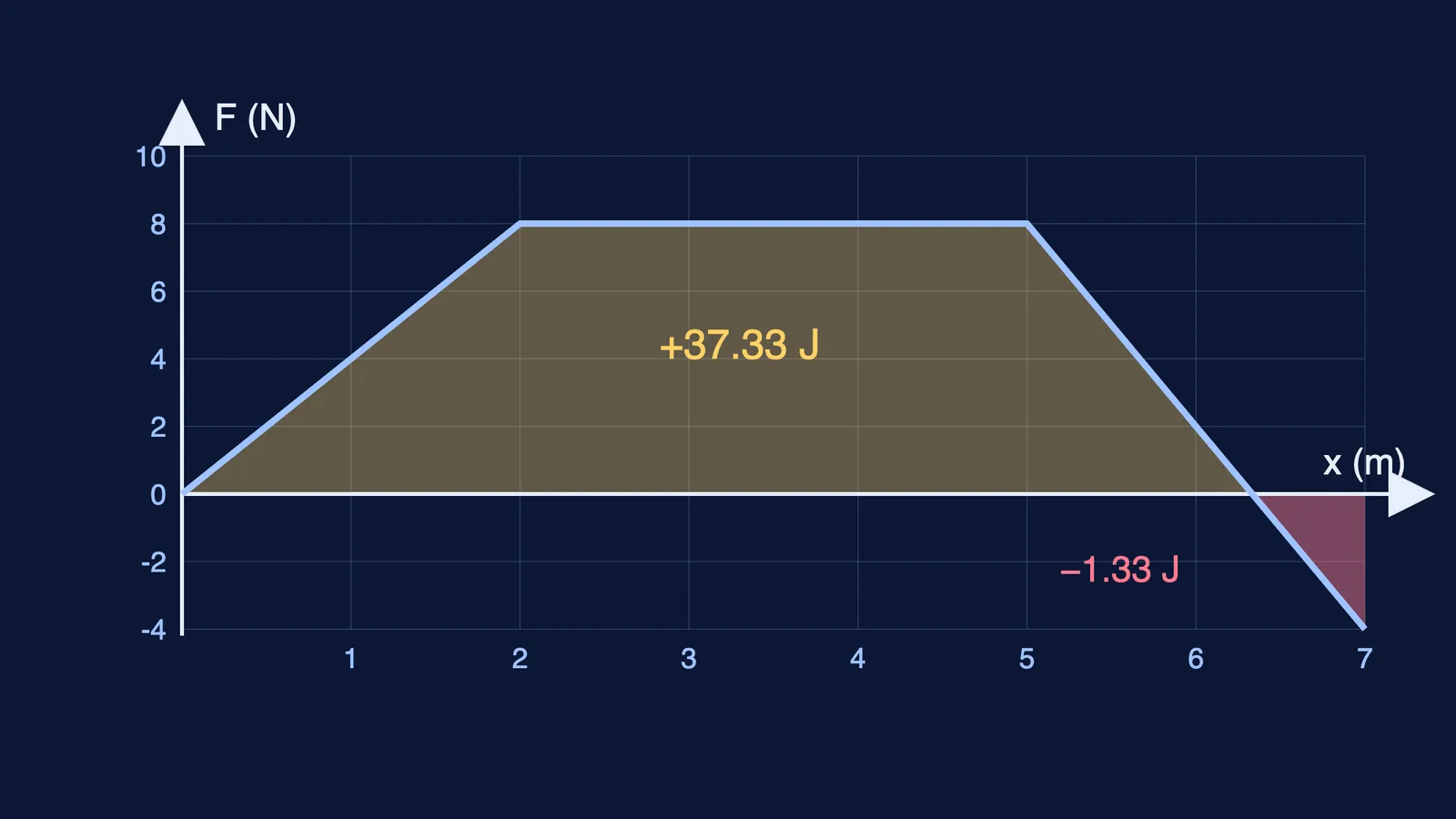
Q4 (medium). A 4 kg cart on a smooth track passes x = 0 at 1 m/s. The only horizontal force on it rises linearly from 0 to 8 N over x = 0 to 2 m, stays 8 N to x = 5 m, then falls linearly to −4 N at x = 7 m. Its kinetic energy at x = 7 m is
(A) 36.0 J (B) 38.0 J (C) 39.3 J (D) 40.7 J
Answer: (B). Work is the signed area under the graph. F crosses zero at x = 19/3 m, so the area above the axis is 112/3 J and below it −4/3 J, net 36 J. The cart started with ½ × 4 × 1² = 2 J, so it ends with 38 J. Trap: (D) counts the area below the axis as positive.
Q5 (medium). A 0.5 kg particle moves along the x-axis with potential energy U(x) = (x⁴ − 8x² + 4) J, x in metres. It rests at x = 2 m. The least speed it must be given there to reach x = 0 is
(A) 4 m/s (B) 5.66 m/s (C) 6.93 m/s (D) 8 m/s
Answer: (D). dU/dx = 4x³ − 16x is zero at x = 0 and ±2 m; d²U/dx² is +32 at ±2 m (stable) and −16 at x = 0 (an unstable hump). The barrier is U(0) − U(2) = 4 − (−12) = 16 J, so ½ × 0.5 × v² = 16 gives v = 8 m/s. Trap: (C) uses |U(2)| = 12 J, forgetting U(0) = 4 J.
Q6 (medium, numerical). A uniform chain 2.5 m long lies on a smooth table with 1.5 m of it hanging over the edge. Released from rest, find its speed, in m/s, at the instant the last link leaves the table.
Answer: 4. With the table top as zero, the hanging 0.6M has its centre 0.75 m down, so U = −4.5M. At the end the centre is 1.25 m down, U = −12.5M. Then ½Mv² = 8M gives v = 4 m/s. Trap: 4.47 treats the chain as a point falling 1 m.
Hard: what changes when both bodies move?
Q7 (hard). On a smooth floor, a 2 kg block at 3 m/s hits a light spring (600 N/m) attached to a 1 kg block at rest. The maximum compression of the spring is
(A) 7.1 cm (B) 10 cm (C) 14.1 cm (D) 17.3 cm
Answer: (B). At maximum compression the blocks share one velocity, (2 × 3)/3 = 2 m/s. Kinetic energy falls from 9 J to 6 J, so ½ × 600 × x² = 3 and x = 0.1 m. Trap: (D) puts all 9 J into the spring, as if the 1 kg block were a wall.
Q8 (hard). A 2 kg ball moving east at 3 m/s and a 1 kg ball moving north at 6 m/s collide and stick together. The kinetic energy lost is
(A) 3 J (B) 12 J (C) 15 J (D) 27 J
Answer: (C). Momentum (6, 6) kg m/s gives the pair 2√2 m/s at 45°. Kinetic energy falls from 27 J to ½ × 3 × 8 = 12 J, a loss of 15 J. Trap: (A) adds the momenta as plain numbers, 12 kg m/s, giving 4 m/s and a 3 J loss.
What should you revise if you got these wrong?
Q1: instantaneous power, NCERT section 5.10.
Q2, Q5 or Q6: conservative forces and potential energy, sections 5.7 and 5.8.
Q4: work as area under an F-x graph, section 5.5.
Q3, Q7 or Q8: momentum first, then kinetic energy, section 5.11.
Then read three work-energy mistakes that quietly cost marks.


