

On this page
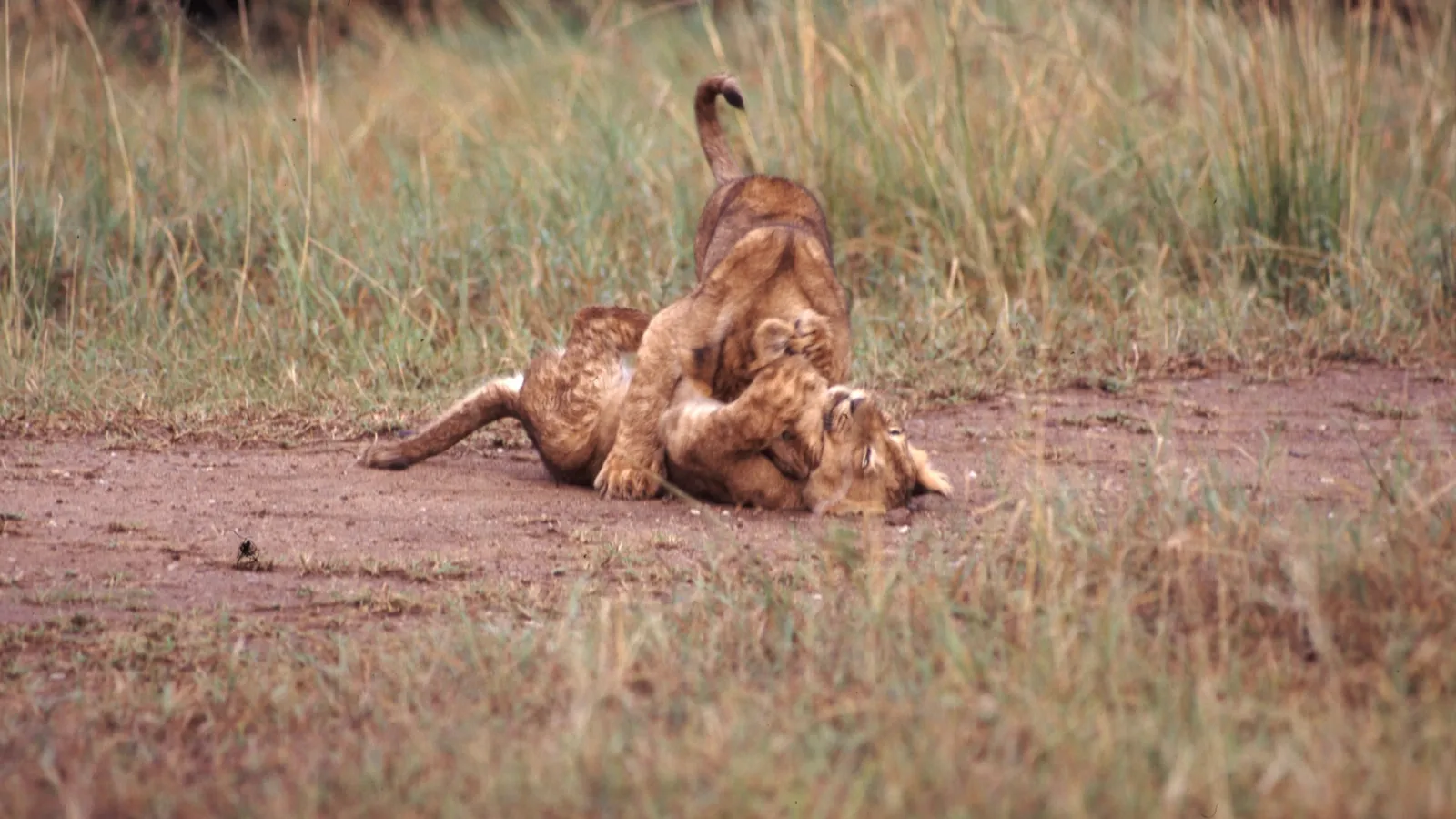
Watch two street puppies for five minutes and you will see bites, pins, chases and the odd yelp. Then both start again. The short answer is that play fighting is practice, but not quite the practice most people expect.
Why do young animals play fight at all?
Play fighting looks like a real fight with the danger taken out. In rats, one of the best-studied cases, partners compete to reach each other's nape, the back of the neck, and nuzzle it with the snout if they get there, according to a 2022 review by Sergio Pellis and colleagues in Frontiers in Behavioral Neuroscience. The same review says rough-and-tumble play with peers in the juvenile period influences the development of the medial prefrontal cortex and the social skills linked to it.
Researchers point to three things the practice may be for:
Recovering from surprises. In Mammalian play: training for the unexpected (Quarterly Review of Biology, 2001), Marek Špinka, Ruth Newberry and Marc Bekoff proposed that play trains animals to recover from sudden loss of control, such as falling over, and to cope emotionally with surprises. Young animals create those surprises on purpose by putting themselves at a disadvantage, which the authors call self-handicapping.
Knowing your own strength. In a 2020 study of domestic pigs in Scientific Reports, researchers staged contests at eight weeks of age between 19 high-play and 19 low-play pairs of unfamiliar pigs. High-play pairs fought in a way that fitted judging their own fighting ability; low-play pairs fitted neither pattern the researchers tested.
Social limits. The Pellis review describes play as a mix of competing and cooperating, and links the experience of swapping roles to the development of social skills.
Does play fighting make animals better fighters and hunters?
Less clearly than you might think. Lynda Sharpe studied wild meerkats and found that the animals that later won fights for the dominant position had not play fought more often as youngsters, or won more play fights, than the littermates they beat (Animal Behaviour, 2005).
So the popular idea that a pouncing cub is simply training to hunt or fight is the least settled.
How do animals know it is only play?
They signal it. Marc Bekoff's 1995 paper in Behaviour, Play signals as punctuation, studied the play bow, front legs down and rump up, in adult and infant dogs, infant wolves and infant coyotes. Bows were not random: they came around actions that could be misread, especially biting with rapid side-to-side shaking of the head. Bekoff tested whether the bow says "I want to play despite what I am going to do or just did", and the timing of the bows supported that idea.
Monkeys use their faces. The primate play face, an open mouth with the lower teeth showing, is homologous to the human face when laughing, as a 2013 PLOS ONE study of geladas by Giada Mancini, Pier Francesco Ferrari and Elisabetta Palagi explains. Play sessions in which a gelada copied its partner's play face within 1.0 second lasted longer than those in which the copy came later, within 5.0 seconds.
The stronger player can also hold back. A rat on its back wins a counterattack about 30% of the time when the rat on top is anchored, but over 70% of the time when the top rat stands on it with all four paws, report Pellis, Pellis and Ham in Frontiers in Ethology (2024). Standing that way gives up some of the advantage, making it more likely that roles swap.
Play or a real fight: how can you tell?
This five-point check pulls together the signals above. It is a rule of thumb, not a scientific test.
Are there invitations? Look for bows in dogs and open-mouthed play faces in monkeys, especially just before or after a rough bite.
Do roles switch? In play, the animal on top ends up underneath some of the time.
Is the bigger one holding back? Loose pins and letting the smaller one win a round are signs of play.
Do both come back for more? Players pause and restart. An animal that runs off and stays away has stopped playing.
Do faces match? Quickly copied play faces go with longer play in geladas.
If one animal keeps yelping and trying to escape, treat it as a real fight. Do not reach in with your hands to separate dogs; if one is hurt, call a local animal welfare group.
What can a biology student take from this?
Play fighting is a good test case for a classic exam question: is a behaviour innate, learned or both? Try the three-question test in our post on innate vs learned behaviour with Indian examples, then compare it with how baya weavers build hanging nests through instinct and practice. The idea of practising movements also connects to how muscle memory works in the brain.
If terms such as homologous or prefrontal cortex slow you down, the Fermi Concept Library has a lesson for every concept in biology, each with its place in the map.


