

On this page
The WHO tuberculosis fact sheet says that to be effective, TB medicines need to be taken daily for 4 to 6 months. The same page estimates that 10.6 million people fell ill with TB in 2025 and 1.13 million died, and that about a quarter of new cases were in India.
The long course comes from the biology of one unusual bacterium.
Why does TB treatment take six months?
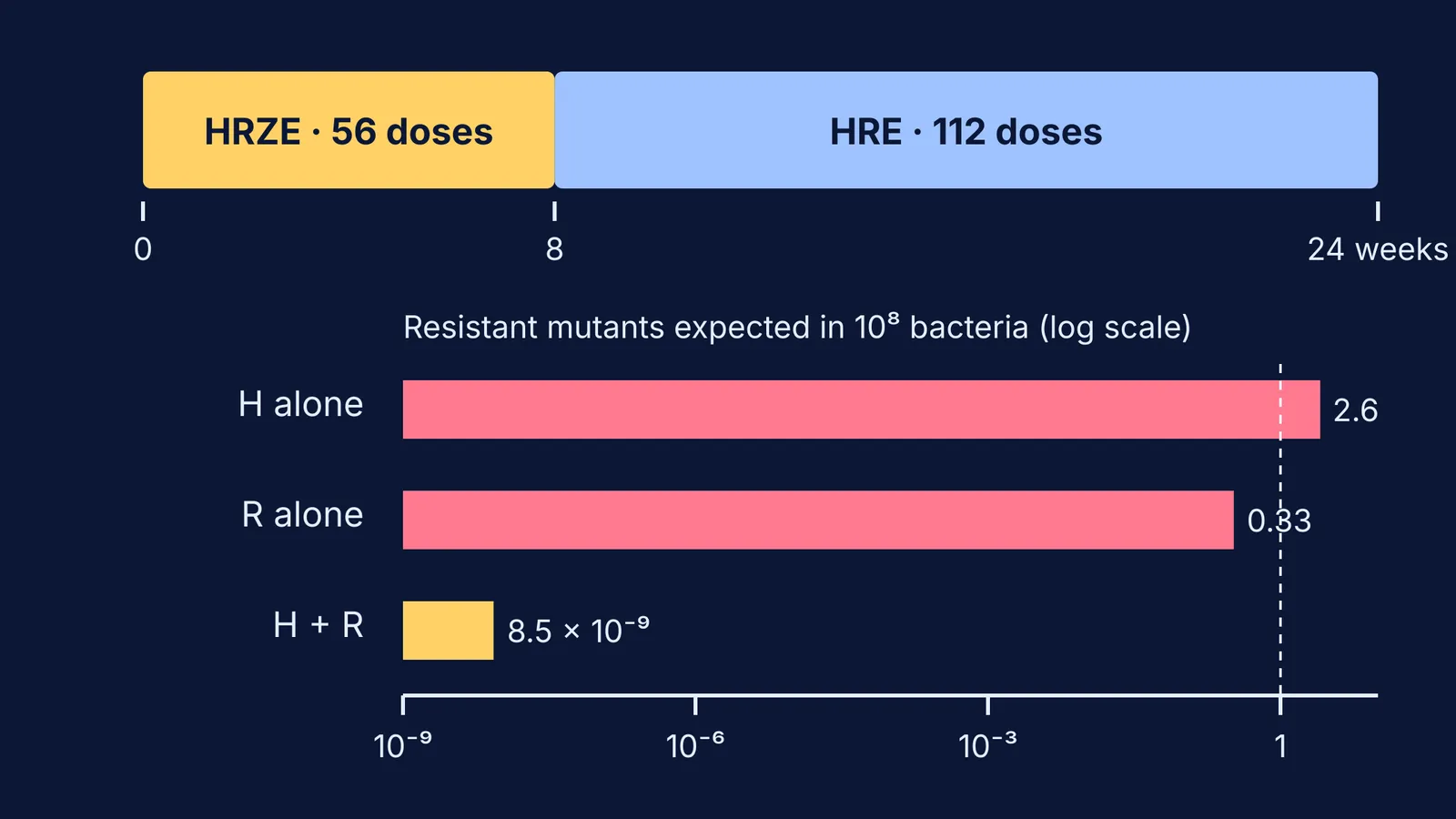
India's standard regimen for drug-sensitive TB is written as 2HRZE/4HRE, according to the ICMR Standard Treatment Workflow for drug-sensitive TB. The intensive phase is 8 weeks (56 daily doses) of isoniazid (H), rifampicin (R), pyrazinamide (Z) and ethambutol (E). The continuation phase is 16 weeks (112 daily doses) of isoniazid, rifampicin and ethambutol. For some forms, such as TB of the central nervous system or the skeleton, the workflow extends the continuation phase.
In 2022, WHO guidelines on drug-susceptible TB added a 4-month regimen of rifapentine, isoniazid, pyrazinamide and moxifloxacin, with the standard 6-month regimen remaining an alternative for pulmonary TB. Three features of the bacterium explain why even that takes months.
Why is Mycobacterium tuberculosis so hard to kill quickly?
First, it is slow. Mycobacterium tuberculosis has a doubling time of 12 to 24 hours under optimal conditions, according to a 2013 review by Delogu, Sali and Fadda. A 2007 PLoS Medicine paper by Connolly, Edelstein and Ramakrishnan points out that virtually all classes of antibiotics need bacteria to be replicating to work, so a microbe that divides rarely is a hard target.
Second, it is wrapped in wax. Delogu and colleagues describe a cell wall that is an exceptionally strong barrier to drugs, built around long fatty acids called mycolic acids. This waxy wall is also why TB bacteria hold on to the red dye in the Ziehl-Neelsen acid-fast stain. Two key drugs attack it: isoniazid targets mycolic acid synthesis and ethambutol targets arabinogalactan, another wall component.
Connolly and colleagues note that isoniazid cuts bacteria in broth culture a thousandfold in two hours, but it takes more than 14 days of therapy to get the same thousandfold drop in a patient's sputum.
What are dormant TB bacteria in granulomas?
Third, many bacteria stop growing altogether. Immune cells wall the infection off in a ball of tissue called a granuloma. The Delogu review describes granulomas as low in oxygen and nutrients, and the bacteria respond by turning dormant. Dormant bacteria are killed by only some drugs, such as pyrazinamide and rifampicin, and resist others such as isoniazid.
Connolly and colleagues call this phenotypic resistance: the bacteria are genetically sensitive, but while they are not replicating, the drugs barely touch them. They also note that the length of therapy needed for a cure correlates with the overall number of bacteria.
Why are TB drugs always given in combination?
In any large bacterial population, a few carry chance mutations that make them resistant to one drug. In a 2002 review in Antimicrobial Agents and Chemotherapy, Stephen Gillespie gives mutation rates of 2.56 × 10⁻⁸ per bacterium per cell division for isoniazid and 3.32 × 10⁻⁹ for rifampicin. The same review says the number of bacteria in a lesion is usually calculated as 10⁸, and that the risk of resistance to two drugs has been assumed to be the product of the two separate risks.
A rough worked example with those figures (treating each rate as the share of bacteria that are mutants, a simplification):
Isoniazid alone: 10⁸ × 2.56 × 10⁻⁸ ≈ 2.6 resistant bacteria expected.
Rifampicin alone: 10⁸ × 3.32 × 10⁻⁹ ≈ 0.33 expected.
Both: 10⁸ × 2.56 × 10⁻⁸ × 3.32 × 10⁻⁹ ≈ 8.5 × 10⁻⁹, almost never.
Each drug kills the mutants the other misses. The WHO fact sheet warns that stopping TB medicines early or without medical advice can prompt the bacteria to become resistant. It defines multidrug-resistant TB (MDR-TB) as TB caused by bacteria that do not respond to rifampicin and isoniazid, the two most effective first-line drugs, and estimates that only about two in five people with MDR-TB accessed treatment in 2025.
To see how course length shapes which bacteria survive, try this antibiotic resistance simulation on dose length. For how other antibiotic classes attack bacteria, see cell wall, ribosome and DNA targets.
How to explain long TB treatment in an exam answer
Four points cover it:
Slow growth: drugs that act on dividing cells get few chances.
Waxy wall: mycolic acids make the cell wall hard for drugs to cross.
Dormancy: bacteria walled off in granulomas stop dividing and survive drugs that kill growing cells.
Resistance: several drugs are given together because a bacterium resistant to all of them at once is very unlikely.
For questions about TB care in India, the government's Nikshay Sampark TB helpline is 1800-11-6666, listed on the Central TB Division website.
For cell walls, immunity and microbial genetics, each concept has its own lesson in the Fermi Concept Library. For worked problems, the Fermi Problem Library has a step-by-step solver that explains the reasoning rather than printing an answer.


