

On this page
On a cold January morning in Delhi or Lucknow, you may visit the toilet more often than in May, even while drinking less. Physiologists call it cold-induced diuresis, and a National Academies review by Beau Freund and Michael Sawka credits Gibson in 1909 with showing that cold itself increases urine flow.
Why do we urinate more in winter?
It happens as a chain of four steps.
Cold skin, narrow vessels. When your skin cools, the small blood vessels in your skin, hands and feet narrow (vasoconstriction) to save heat, part of the same heat-saving system as why we shiver when we are cold.
More blood in the core. The blood squeezed out of the skin moves into the chest and the large veins. Freund and Sawka write that "the central movement of fluid caused by peripheral vasoconstriction is likely to be involved" in cold-induced diuresis (National Academies).
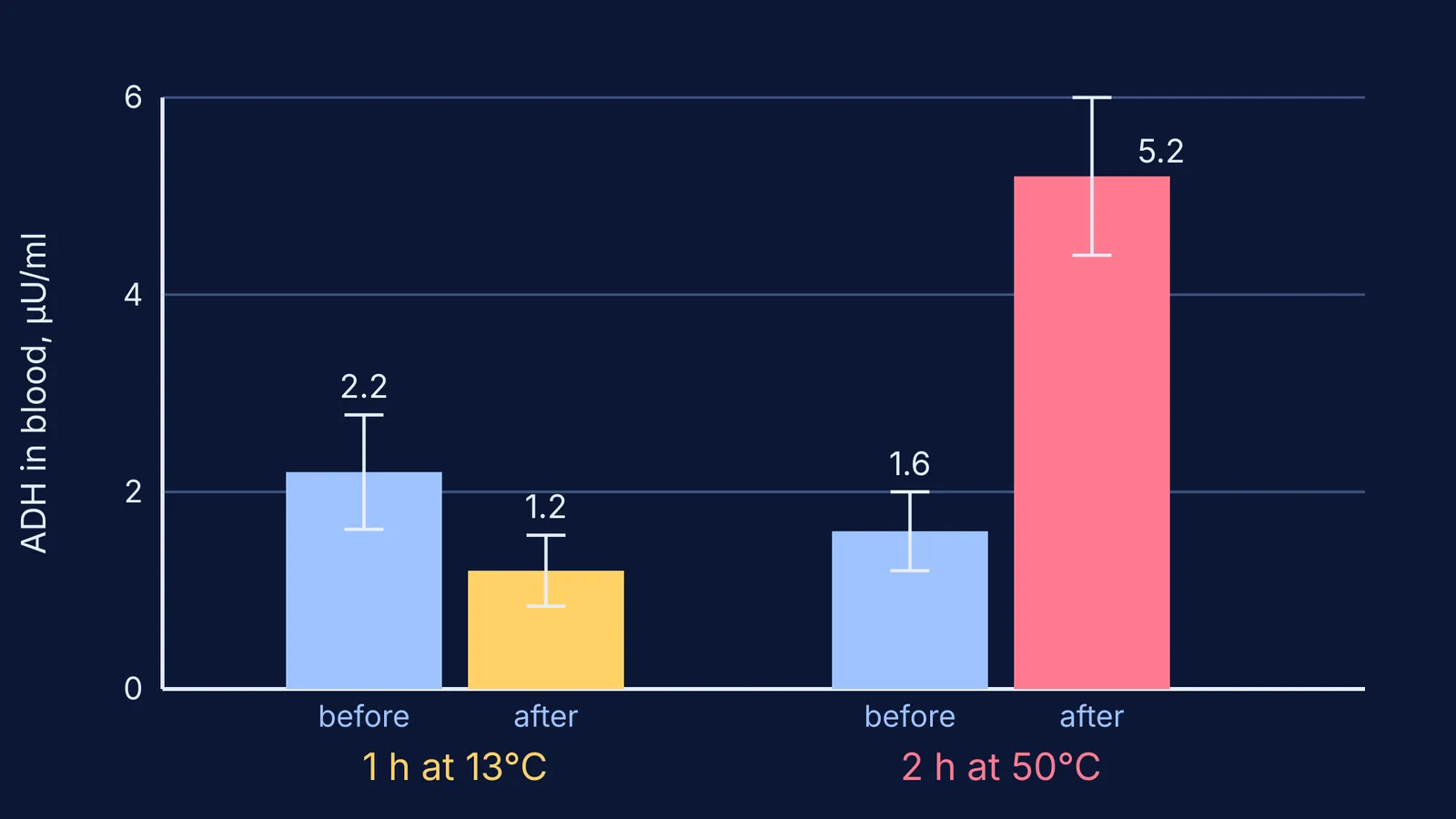
Stretch sensors read "too much fluid". Volume receptors in the chest sense the extra blood and signal the brain to release less ADH. In a 1968 study by William Segar and Ward Moore, blood ADH fell from 2.2 to 1.2 μU/ml in six people who sat at 13°C for one hour.
Less ADH, more urine. ADH tells the kidney's collecting duct to insert water channels so water returns to the blood. Less ADH means more water stays in the urine; see how the collecting duct and ADH set urine volume.
Winter also closes a water exit. You sweat very little in the cold, so water that would leave through your skin in summer leaves through your kidneys.
Why is urine less and darker in summer?
In hot weather, the chain runs the other way. Blood moves out to the skin to shed heat, and you lose water as sweat.
In the same Segar and Moore study, eight people who sat at 50°C for two hours saw blood ADH rise from 1.6 to 5.2 μU/ml, about three times higher.
The National Academies report on water intake gives the scale of sweat loss: the average daily sweat loss was 2.3 litres for 26 men in the tropics and 4.9 litres for 97 men in the desert. The same report says urine output generally averages 1 to 2 litres a day, and about 500 ml a day is the minimum when urine is as concentrated as the kidneys can make it.
More ADH plus less water to spare means your kidneys hold water back, so you pass less urine and it is more concentrated and darker. For the colour side, see why urine turns dark yellow when you are dehydrated.
Does peeing more in winter mean you are losing too much water?
Usually not. Freund and Sawka describe cold-induced diuresis as self-limiting: as you lose water, the effect shrinks or stops (National Academies).
Longer-term data point the same way. A 2026 study of 29,755 adults in Malmö, Sweden estimated that 21 days at 0°C went with 14.9% higher copeptin, a blood stand-in marker for ADH, than 21 days at 14.3°C. After a long cold spell, the body may shift towards holding water.
The NHS sums up the main type 1 diabetes symptoms as the 4 Ts: toilet, thirsty, tired, thinner.
How can you track your own fluid in and out?
A two-day diary turns this chapter into an experiment. Pick one cold day and one warm day with a similar routine. Count drinks in your usual steel tumbler or chai cup, and write one line each time something goes in or out:
Time: when you drank or went to the toilet.
In: what you drank, in tumblers or cups.
Out: each toilet trip, with a colour note: pale, yellow or dark.
Conditions: indoors or outdoors, cold or warm, sweaty or not.
An invented example: Riya, a Class 11 student in Jaipur, logs a January day and an April day. In January she drinks six tumblers, makes seven trips, mostly pale, two of them right after a cold morning bus ride. In April she drinks nine tumblers but makes four trips, and notes dark urine after sports practice.
What Riya can conclude:
Extra pale trips after time in the cold fit cold-induced diuresis: blood moved inwards and ADH likely dropped.
Fewer trips despite drinking more in April suggest sweat took the difference.
Dark afternoon urine is her cue to drink more on warm days.
If linking the diary to the textbook chain of vasoconstriction, volume receptors, ADH and collecting duct feels shaky, the Fermi Concept Library gives each biology concept its own lesson and shows where it sits in the map.
Your next cold-morning dash to the toilet is your kidneys balancing your core blood volume.


