

On this page
The yellow in your urine is waste from your own blood. Your body keeps retiring old red blood cells, and one of their pieces travels through the liver, the gut and the bloodstream before the kidneys pass it out as a yellow pigment.
Where does the yellow in urine come from?
It starts with red blood cells. According to the Merck Manual, red blood cells survive about 120 days and are then cleared mostly by the spleen, and partly by the liver. The same source explains that haemoglobin is taken apart: the iron and amino acids are reused, and the haem part is broken down to bilirubin.
From there, the US National Library of Medicine sets out the next steps, and the full text of the BilR paper fills in the detail:
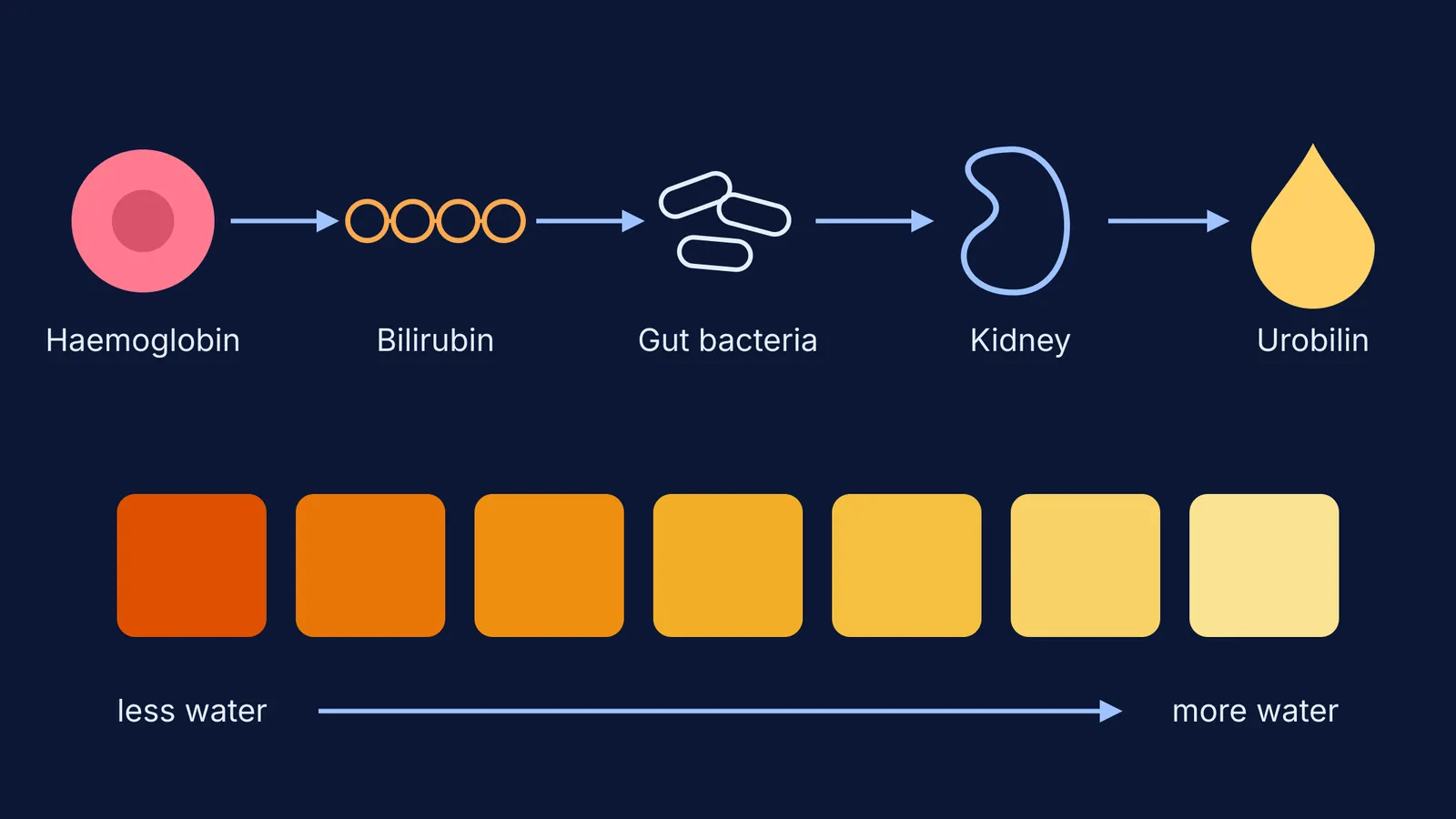
Old red blood cells are broken down and their haemoglobin yields bilirubin.
Bilirubin is secreted, in bile, into the gut.
Gut bacteria reduce bilirubin to urobilinogen, which is colourless.
Urobilinogen is sent to the kidneys.
It is converted to urobilin, the waste product that gives urine its yellow colour.
Urobilin is the pigment many textbooks still call urochrome; Wikipedia's urobilin entry lists the two names as one chemical and describes urobilinogen as colourless.
Step 3 was a puzzle until recently. In January 2024, a team from the University of Maryland and the NIH reported in Nature Microbiology that a gut bacterial enzyme they named BilR (bilirubin reductase) turns bilirubin into urobilinogen. They found the BilR gene in the gut microbes of nearly all healthy adults, but less often in newborns and in people with inflammatory bowel disease.
Why does urine go pale when you drink a lot of water?
The pigment comes from the slow, steady turnover of red blood cells, so its supply changes slowly. What changes quickly is how much water the kidneys let go with it.
Drink three glasses of water and your kidneys release more water. The same amount of pigment is now spread through more liquid, so each drop holds less of it and looks paler. Skip water on a hot afternoon and the kidneys hold water back, so the pigment is packed into less liquid and the colour deepens. The hormone that controls this is ADH, and our post on why urine turns dark yellow when you are dehydrated walks through it, along with how the collecting duct sets urine volume.
The UK's NHS advice on dehydration puts it plainly: drink enough during the day so that your pee is a pale colour, and treat dark yellow, strong-smelling pee as a sign of dehydration.
Why is urine darker in the morning?
Overnight you go hours without drinking, and your body cuts urine production while you sleep. In a study of 92 healthy children aged 3 to 14 in The Journal of Urology, average urine output fell from about 43 ml per hour in the day to about 26 ml per hour at night. Less water, same pigment: the first urine of the morning is more concentrated, so it looks darker.
How do you use a urine colour chart?
Sports scientists use urine colour as a quick field check. A 1994 study in the International Journal of Sport Nutrition found it good enough for field settings where close estimates are acceptable, though not as precise as laboratory tests. Here is a simple way to read the shades, based on the sources above.
Pale straw or light yellow: the pale colour the NHS says to aim for.
Clear like water: very dilute urine, the same pigment spread through a lot of water.
Dark yellow and strong-smelling: a sign of dehydration in the NHS list.
Dark first thing in the morning only: urine concentrated after a night without drinking.
Orange, pink, red, green, blue or brown: often something you ate or took.
That last line matters. MedlinePlus lists beets and blackberries (pink or red), B-complex vitamins or carotene (dark yellow or orange) and some medicines as common causes of unusual colours. It also says to see a doctor if you have blood in your urine even once, clear dark-brown urine, or an unusual colour that cannot be explained and does not go away.
Where does this fit in your biology syllabus?
The urochrome story joins two chapters that students often learn separately: body fluids and circulation (red blood cells, haemoglobin) and excretory products (kidneys, urine). If you are revising the second, our excretory products mnemonics help you remember the rest of the chapter. If the haem-to-bilirubin step still feels hazy, the Fermi Concept Library gives each biology and chemistry concept its own lesson and shows where it sits in the map, so you can see how blood and excretion connect.
Next time someone asks why urine is yellow, you can answer in one breath: old blood, a gut enzyme, and the kidneys deciding how much water to send with it.


