

On this page
The NCERT Class 12 biology textbook says colour blindness "occurs in about 8 per cent of males and only about 0.4 per cent of females" (NCERT, Principles of Inheritance and Variation). That is a twentyfold gap from the same X-linked genes. Hardy-Weinberg explains most of it once you make one switch: count X chromosomes, not people.
Why is colour blindness more common in males?
The genes for the red and green cone pigments, OPN1LW and OPN1MW, are on the X chromosome (MedlinePlus Genetics). MedlinePlus explains that in males, who have only one X chromosome, one altered copy of the gene is enough to cause the condition, while females need two altered copies.
A male is hemizygous for X-linked genes: he has one copy, so there is no second allele to mask a recessive one. The US National Eye Institute estimates that about 1 in 12 men have colour vision deficiency.
Why is male frequency q but female frequency q²?
Let q be the frequency of the colour-blind allele among all X chromosomes in the population, and p = 1 − q.
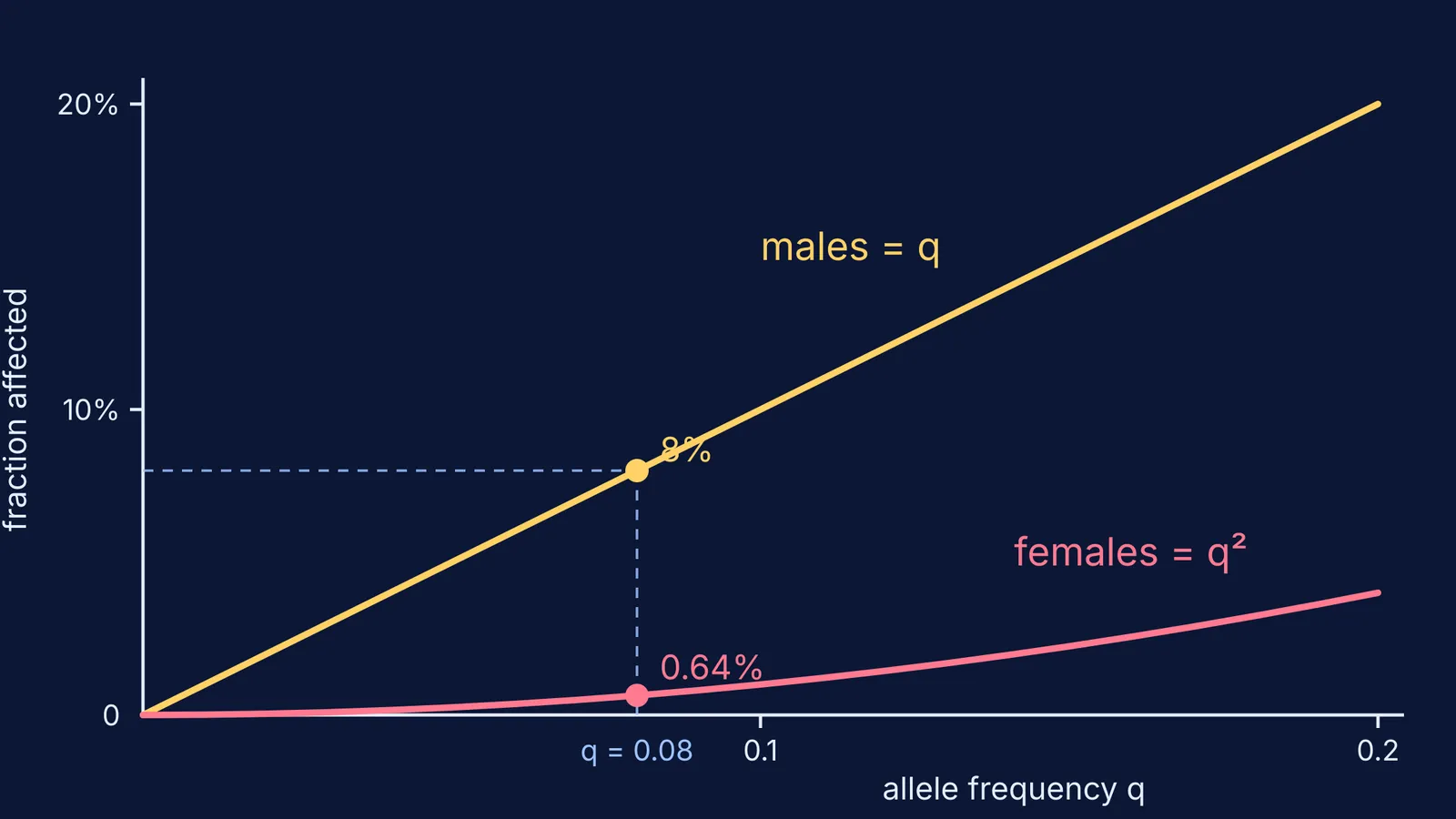
A son gets one X, from his mother. The chance it carries the allele is q. His phenotype shows his single allele directly, so the fraction of affected males is q. No square, no square root.
A daughter gets two X chromosomes, one from each parent. Under random mating, both must carry the allele: q × q = q². Carrier daughters are 2pq, and unaffected non-carriers are p².
At equilibrium, males show genotype frequencies p and q while females show p², 2pq and q² (Hardy-Weinberg principle, sex linkage section). Population geneticists Jan Graffelman and Bruce Weir point out that males receive their X from their mother, so male allele frequencies equal the female allele frequencies of the previous generation; equilibrium on the X needs equal allele frequencies in both sexes plus Hardy-Weinberg proportions in females (Heredity, 2016).
Worked example: if 8% of males are colour-blind, how many females are?
Affected males = q, so q = 0.08.
p = 1 − 0.08 = 0.92.
Affected females = q² = 0.08 × 0.08 = 0.0064, which is 0.64%.
Carrier females = 2pq = 2 × 0.92 × 0.08 = 0.1472, about 14.7%.
Check the females add up: p² + 2pq + q² = 0.8464 + 0.1472 + 0.0064 = 1.
Ratio of affected males to affected females = q ÷ q² = 1 ÷ q = 12.5.
Picture a college with 1,000 boys and 1,000 girls. The model predicts about 80 colour-blind boys, about 6 colour-blind girls, and about 147 girls who carry the allele without knowing it. These are model numbers, not survey data.
Step 6 is the pattern worth remembering. The male-to-female ratio is 1/q, so the rarer the allele, the wider the gap. At q = 0.01, affected males outnumber affected females 100 to 1. The same logic sits behind NCERT's remark that a female haemophilic is "extremely rare": her mother must be at least a carrier and her father must be affected (NCERT). For the family-level version, see how to solve X-linked crosses for colour blindness and haemophilia.
Why is the real female figure lower than 0.64%?
NCERT's female figure, about 0.4%, is below the 0.64% that q² predicts (NCERT). MedlinePlus gives about 1 in 12 males and 1 in 200 females among people of Northern European ancestry (MedlinePlus Genetics). With q ≈ 0.083, q² predicts about 0.7% of females, against an observed 0.5%: close, but again a little low.
Part of the shortfall may come from the fact that red-green colour blindness involves two genes, OPN1LW and OPN1MW, not one allele. A woman with a red-pigment fault on one X and a green-pigment fault on the other still has a working copy of each gene, yet a single-allele q² counts her as affected. Exam questions treat colour blindness as one allele, and in the exam hall so should you.
What mistakes do students make in X-linked Hardy-Weinberg questions?
Taking the square root of the male frequency. √0.08 ≈ 0.28 is the autosomal habit, and it is wrong here.
Using q² for males. Males have one X, so there is nothing to square.
Missing a reversed question. If you are given the female frequency, q = √(female frequency), and the male frequency is that q.
Mixing percent and decimal: 0.64% is 0.0064, not 0.64.
Try one yourself: if 1 in 50 males has an X-linked recessive trait, q = 0.02 and affected females are q² = 0.0004, or 1 in 2,500.
If the autosomal method still feels shaky, start with how to solve a Hardy-Weinberg numerical for p and q, then find carrier frequency from incidence. If you keep reaching for the square root, work a few X-linked questions in the Fermi Problem Library, where the step-by-step solver explains the reasoning rather than printing an answer. To revise hemizygosity and sex linkage, the Fermi Concept Library gives each concept its own lesson.
If you think you might be colour-blind yourself, an eye doctor can test your colour vision properly.


