

On this page
People are mostly awake by day, so the night is the part of the clock wild animals can still have to themselves. Here is what the research found, how Indian leopards and elephants fit, and what the shift costs them.
Why are wild animals becoming more nocturnal near humans?
The biggest test of the idea is a 2018 meta-analysis in Science by Kaitlyn Gaynor and colleagues at the University of California, Berkeley (Gaynor et al., 2018). A meta-analysis pools the results of many separate studies to see whether a pattern holds across all of them.
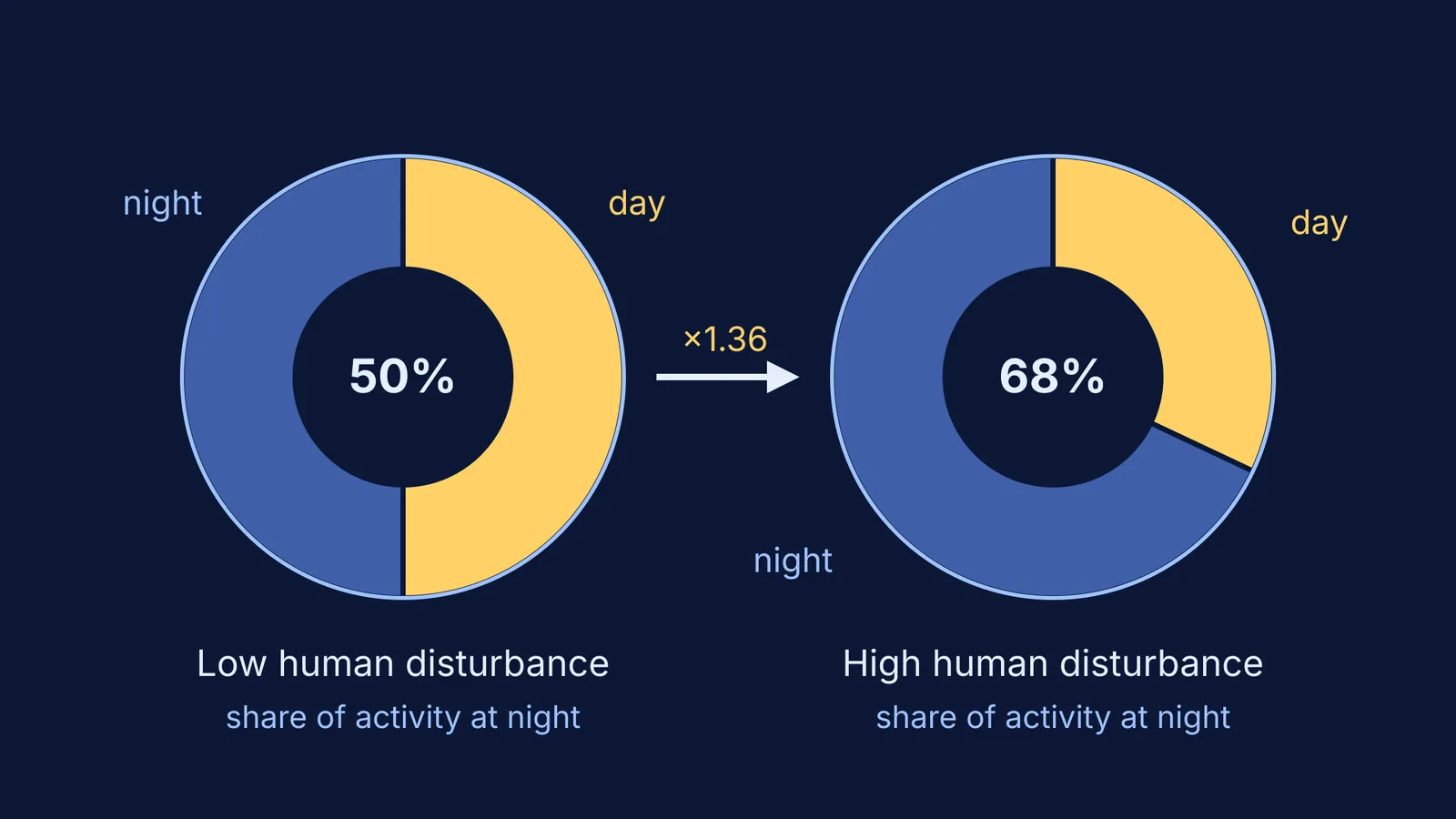
The team combined 76 studies of 62 mammal species from six continents. Nocturnality, the share of an animal's activity that happens at night, rose by an average factor of 1.36 in places or seasons with high human disturbance. In the paper's own example, an animal that splits its activity evenly between day and night would shift to doing 68% of it at night near people. Of the 141 comparisons in the dataset, 83% showed more night activity where humans were around.
Nonlethal activities such as hiking produced shifts similar to those from hunting, which suggests animals treat people as a threat even when they pose no direct risk. The authors argue that fear of humans is the main driver.
How do leopards in India live so close to people?
In 2014, Morten Odden, Vidya Athreya and colleagues reported on five GPS-collared leopards living outside protected areas in Maharashtra and Himachal Pradesh (Odden et al., 2014, PLoS ONE). Four were collared in Maharashtra, two of them in a densely populated irrigated valley in Akole, Ahmednagar district, where the overall density was 177 people per square kilometre.
Their movement was strongly nocturnal: hourly steps averaged 339 m at night and 60 m by day. The three leopards in the most crowded areas visited houses regularly at night, with 20% of night locations within 25 m of a house, against under 1% by day.
What were they eating? A diet study by members of the same team in croplands of western Maharashtra analysed 85 leopard scats and found that 87% of prey biomass was domestic animals, with dogs alone making up 39% (Athreya et al., 2016, Oryx). Being active at night may help a large cat feed in farmland while rarely meeting the people who own the dogs.
Why do elephants raid crops at night?
Elephants show the same timing. A two-year dataset of 380 crop-raiding events in North Bengal found that 89% happened between 10 PM and 6 AM (Naha et al., 2020, PeerJ). The authors describe this as risk avoidance: elephants keep away from settlements by day and raid mostly at night. Paddy made up 65% of the crops raided, and villages within 1.5 km of a forest patch were hit hardest.
For the longer story of elephants and farms in India, read what Raman Sukumar discovered about Asian elephants and crops.
What does the night shift cost animals?
Shifting to night may help people and wildlife share land, but the Science paper also lists costs, especially for daylight-adapted species (Gaynor et al., 2018):
Food: daytime-adapted animals may hunt and forage less efficiently in the dark, and predators may switch to prey that is easier to catch at night.
Safety: prey that become more nocturnal can become easier targets for nocturnal predators.
Body and breeding: poorer navigation, weaker defences against predators, disrupted social behaviour and higher metabolic costs can all reduce reproduction and survival.
Whole ecosystems: when top predators change their timing, the effects can ripple down food chains, a chain reaction explained in why predators matter in nature.
How do scientists measure nocturnality?
Many studies count camera-trap photos by time of day (see how camera traps learned to count tigers). You can redo the core calculation yourself.
Worked example (made-up numbers for practice): a deer species is photographed 40 times deep in a forest, 20 of them at night, and 25 times near a village, 17 of them at night.
Nocturnality far from people: 20 ÷ 40 = 0.50, or 50%.
Nocturnality near people: 17 ÷ 25 = 0.68, or 68%.
Ratio: 0.68 ÷ 0.50 = 1.36, so the deer is 1.36 times as nocturnal near people.
Effect size: the paper uses the natural log of that ratio, ln(1.36) ≈ 0.31. Positive means more nocturnal near humans; negative would mean less.
That matches the study's overall average effect size of 0.31 (Gaynor et al., 2018).
When a news story says an animal has become nocturnal, check three things:
Was activity compared between high and low human disturbance?
How many animals were tracked? Five collared leopards tell you most about those five.
Did the animals also move away, or only change their timing?
If ecology terms like predation or adaptation slow you down, the Fermi Concept Library gives every biology concept its own lesson and its place in the map.


