

On this page
Every dose given at an Indian health centre has travelled from the manufacturer through state and district stores to a vaccine carrier. The Ministry of Health and Family Welfare's Handbook for Vaccine and Cold Chain Handlers (2016) calls this series of storage and transport links the cold chain. Along the way the target is a narrow band: +2 °C to +8 °C. Here is the science behind it.
What does heat actually do to a vaccine?
Denaturation is the loss of a protein's structure and function when the network of noncovalent interactions holding its secondary, tertiary and quaternary structure breaks down, as defined in a 2017 Scientific Reports paper by Chen and colleagues. The same paper notes that protein-based products, vaccines included, typically degrade at room temperature over time as their proteins unfold. Egg white turning solid is the same process; see why boiled eggs and curdled milk change.
Live attenuated vaccines have a second problem: their weakened viruses or bacteria must still be able to multiply to train your immunity, as our guide to live attenuated, killed and toxoid vaccines explains. Heat inactivates them. Researchers who reformulated a live attenuated measles vaccine from the Serum Institute of India noted that the WHO requirement for heat stability is 1 week at 37 °C; their spray-dried version stayed stable for about 8 weeks at that temperature.
Why is the rule 2 to 8 degrees, and not colder?
The MoHFW handbook says vaccines lose potency through heat above +8 °C (all vaccines in the Universal Immunization Programme), cold below +2 °C (Hepatitis B, Pentavalent, IPV, DPT and TT) and light (BCG and measles). A break in the cold chain is recorded if an ice-lined refrigerator rises above +8 °C or falls below +2 °C.
Why not freeze everything? Many vaccines contain an aluminium salt adjuvant, and the WHO Vaccine Management Handbook on temperature monitoring (2015) explains that freezing makes it clump together and can irreversibly damage the vaccine. Oral polio vaccine is the exception: WHO advises storing it at -15 °C to -25 °C in primary and subnational stores to keep its potency as long as possible.
The Indian handbook adds that heat damage is cumulative, so warm spells add up, while a freeze-sensitive vial that has frozen once is of no use. India runs this system across about 29,000 cold chain points, according to a 2022 national supply chain study.
How does a vaccine vial monitor change colour?
A vaccine vial monitor (VVM) is a label on the vial that shows how much heat the vaccine has received, through a gradual and irreversible colour change, according to the WHO temperature monitoring handbook. Its inner square starts lighter than the outer circle and darkens with time and temperature. If the square matches the circle or is darker, the vaccine is discarded.
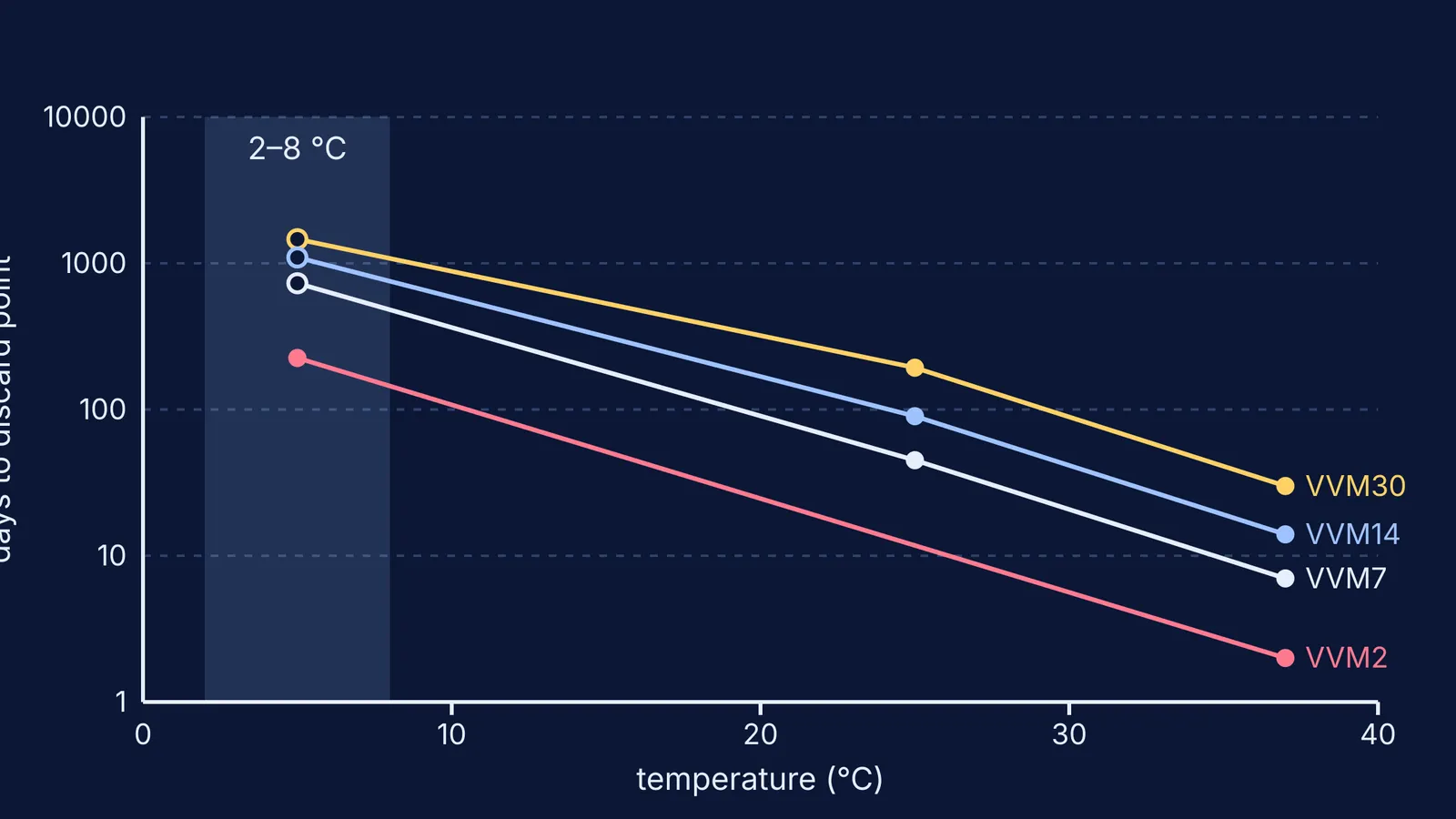
Days to the discard point for the four VVM types:
VVM30: 30 days at 37 °C, 193 days at 25 °C, more than 4 years at 5 °C
VVM14: 14 days at 37 °C, 90 days at 25 °C, more than 3 years at 5 °C
VVM7: 7 days at 37 °C, 45 days at 25 °C, more than 2 years at 5 °C
VVM2: 2 days at 37 °C and 225 days at 5 °C
A VVM does not record freezing, so freeze damage needs a separate check.
Worked example: how fast does the heat budget run out?
Treat the VVM as a heat budget. This is a rough classroom model, using the VVM7 figures from the WHO handbook.
At 25 °C the budget lasts 45 days, so each day uses about 1/45, or 2.2%.
At 37 °C it lasts 7 days, so each day uses about 1/7, or 14.3%.
A vial that spends 9 days at 25 °C and then 3 days at 37 °C has used about 9 × 2.2% + 3 × 14.3% = 20% + 43% = 63%.
In this model the square is still lighter than the circle. Another 3 days at 37 °C would take it past 100%.
A 12-degree rise made each day cost about six times more, the kind of steep temperature effect seen in reaction rates. Hotter still, proteins denature, which is why the enzyme activity versus temperature graph falls past its optimum. If denaturation still feels fuzzy, the Fermi Concept Library gives each concept its own lesson and its place in the map.
What can you notice at a vaccination session?
Good practice from the MoHFW cold chain handbook looks like this:
Vaccines reach the session site in a vaccine carrier kept at +2 °C to +8 °C.
The health worker checks the VVM before opening a vial.
Reconstituted BCG, measles, JE and rotavirus vaccines are kept at +2 °C to +8 °C and discarded after 4 hours.
For questions about a specific vaccine or your child's schedule, ask the health worker or your doctor.
To practise rate reasoning like the worked example, the Fermi Problem Library has a step-by-step solver that explains the reasoning.


