

On this page
A tiger reserve looks like a safe island on a map. For a tiger, an island is the problem. Young tigers have to leave where they were born, find empty territory and find mates who are not their relatives. If farms, towns and highways seal a reserve off, the tigers inside slowly become related to each other. Corridors are the strips of forest and scrub that let them walk out.
Why do tigers need to move between reserves?
Because a reserve fills up. A young tiger cannot share its mother's range for ever, and nearby ground is often held by older tigers.
One radio-collared young male from Tipeshwar Wildlife Sanctuary in Maharashtra, collared by a Wildlife Institute of India team, travelled about 1,300 km across Maharashtra and Telangana in roughly five months in 2019, Gulf News reported. On the way it crossed villages, agricultural fields and habitations in six districts across two states. The study concluded that Tipeshwar is a potential source area and that tigers need more space in the landscape.
That walk is what a corridor is for. A young tiger that reaches another population and breeds there carries new genes into it.
How does isolation cause inbreeding in tigers?
Inbreeding means mating between relatives, which makes it more likely that an offspring inherits two identical copies of a harmful recessive gene. In a small, closed population, more and more of the possible mates are relatives with each generation.
A 2021 study in PNAS by Anubhab Khan, Uma Ramakrishnan and colleagues used whole-genome sequences from 57 tigers in India. It compared a small, isolated population in north-western India (Ranthambore and Sariska) with two large, connected populations in central and southern India. The isolated tigers were the most inbred: on average 0.57 of their genome sat in long runs of homozygosity, stretches where both copies of the DNA are identical, against 0.35 and 0.46 in the connected populations. The authors note this population has fewer than 100 individuals and was connected to the central population until very recently.
Their advice: "Maximizing connectivity in the wild would require increasing population abundance since large populations are sources of dispersing individuals, but also planning for habitat corridors."
Our explainer on inbreeding, out-crossing and cross-breeding in animals covers the terms, and the maths of cousin marriage and recessive disorders shows the same risk worked out in humans.
Worked example: how fast does an isolated reserve lose diversity?
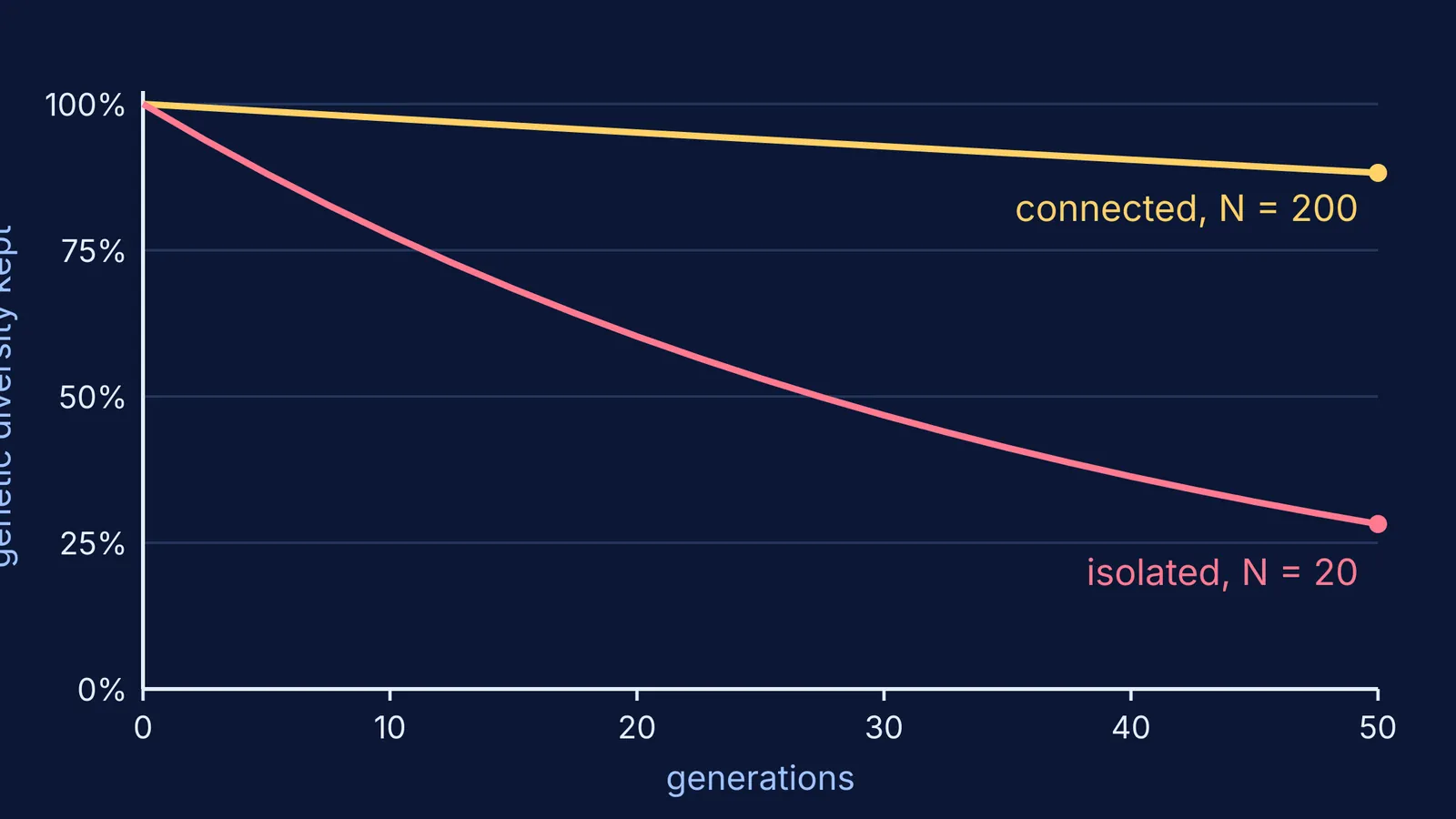
For an idealised population of N breeding adults, heterozygosity (genetic variety) after t generations is H_t = H_0 (1 - 1/2N)^t, as this evolutionary biology lecture on genetic drift sets out. Each generation loses a fraction 1/2N of its variety purely by chance.
Try two made-up populations (illustrative numbers, not real tiger counts):
Isolated reserve, N = 20. Each generation keeps 1 - 1/40 = 0.975 of its variety. After 10 generations: 0.975^10 = 0.78, so about 22% is gone.
Connected network, N = 200. Each generation keeps 0.9975. After 10 generations: 0.9975^10 = 0.975, so only about 2.5% is gone.
After 50 generations, the isolated reserve keeps about 28% of its starting variety; the connected one keeps about 88%. The hero chart above plots these two curves. In this simple model, a corridor acts like merging several small populations into one larger one.
If terms like homozygosity or genetic drift are new, the Fermi Concept Library has a lesson on each biology concept and shows its place in the map, so you can fill the gap before the next chapter.
How do roads and fields cut tiger corridors?
Tigers can cross farmland, as the Tipeshwar male showed, but some barriers matter more than others. A 2018 study in Biological Conservation by Prachi Thatte and colleagues used genetic data from tiger faecal samples in central India and simulated 86 future development scenarios. The preprint abstract says the team sampled 116 tigers across nine reserves, and puts the main finding plainly: "dense human settlements and roads with high traffic are detrimental to tiger movement."
Do highway underpasses actually help tigers cross?
One clear Indian example is National Highway 44 where it runs through Pench Tiger Reserve in Maharashtra, with stretches of road raised so animals can walk underneath. A Wildlife Institute of India report for the National Tiger Conservation Authority used camera traps under the nine crossing structures from March to December 2019.
18 species of wild animals used the structures.
Wild dogs used the structures most among carnivores, followed by tigers.
89 tiger crossings were recorded at six of the nine structures, by 11 individual tigers.
Do the arithmetic: 89 crossings by 11 tigers is about 8 per tiger on average over ten months. The summary does not say how evenly they were shared, but repeated use by 11 different tigers suggests the underpasses became part of how tigers move through the area.
For the vocabulary of that chapter, see our biodiversity and conservation key terms for Class 12. To practise problems like the drift calculation, the Fermi Problem Library has worked problems with a step-by-step solver that explains the reasoning rather than printing an answer.


