

On this page
You touch a faulty wire and, instead of jerking away, your fingers close tighter. That is what mains-frequency current does to your forearm muscles.
Why can't you let go of a live electric wire?
Your fingers are worked by two groups of forearm muscles: flexors, which close the hand, and extensors, which open it. Normally your brain fires one and relaxes the other. A current through the forearm fires both.
A US government report on worker electrocutions, NIOSH publication 98-131, puts it plainly: current above the let-go level "stimulates involuntary contraction of both flexor and extensor muscles", and "when the stronger flexors dominate, victims may be unable to release the energized object they have grasped as long as the current flows." The closing muscles win the tug-of-war, and the current itself holds your palm on the wire.
What is the let-go current, and how much is dangerous?
The let-go current is the largest current at which a person can still release a gripped conductor. The idea comes from Charles Dalziel's experiments, summarised in a literature review for NASA by H. Spencer Turner.
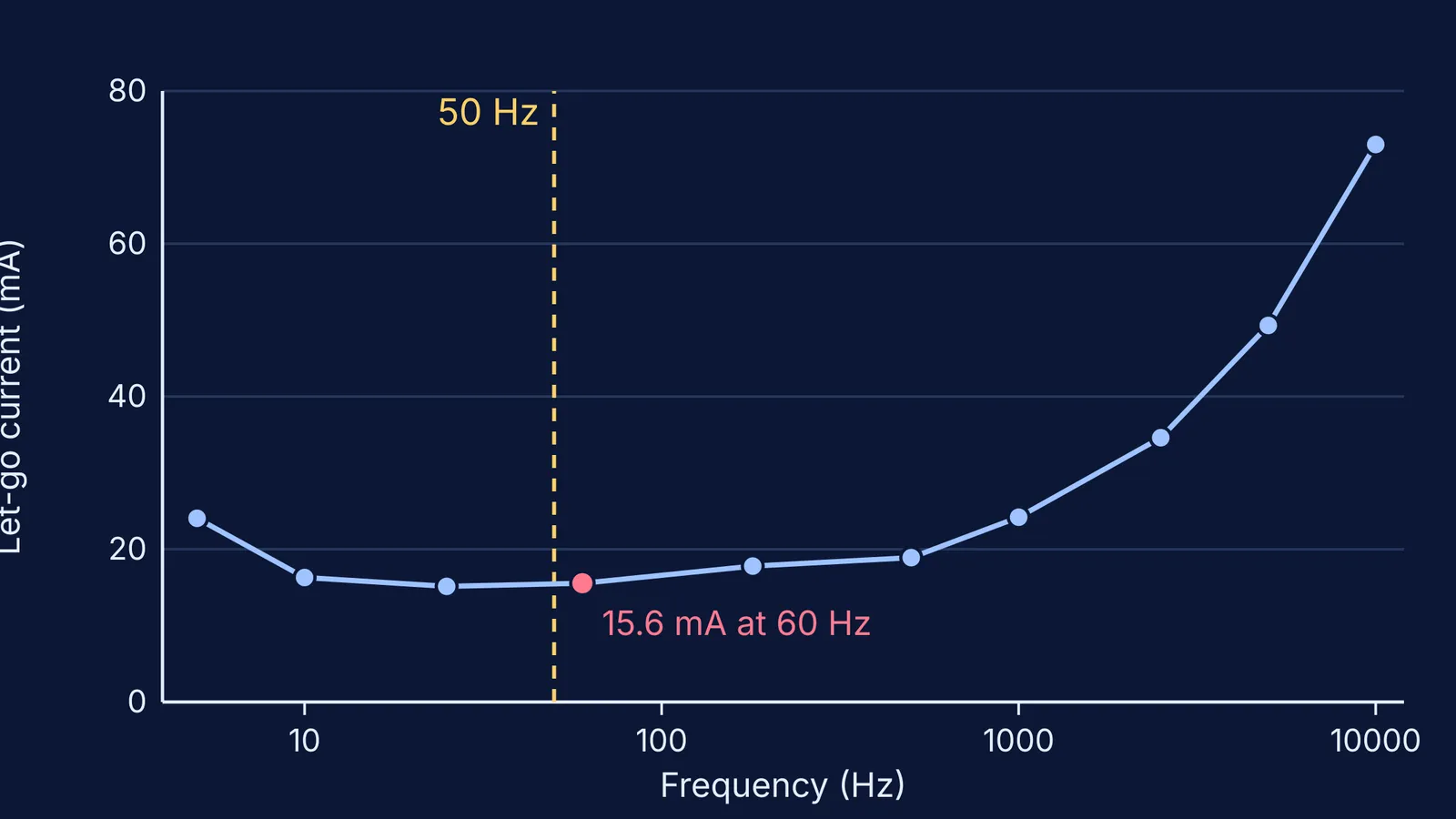
In Dalziel's 60 Hz tests on 114 subjects, the mean let-go current was 15.55 mA (Turner review, Table 11).
From tests on 134 men and 28 women, Dalziel's team judged about 9 mA reasonably safe at 60 Hz for adult men and about 6 mA for adult women, the current 99.5% of a large group could release (Turner review, page 34).
NIOSH's table of estimated effects of 60 Hz current through the chest, in publication 98-131, shows the ladder:
1 mA: barely perceptible
16 mA: the most an average man can grasp and still let go
20 mA: paralysis of the breathing muscles
100 mA: threshold for ventricular fibrillation, the uncoordinated heartbeat NIOSH calls probably the most common cause of death from electric shock
Why does 50 Hz AC lock your muscles in tetanus?
One nerve impulse gives a muscle one twitch, which OpenStax Anatomy and Physiology says can last from a few milliseconds to 100 milliseconds. If a second stimulus arrives before the twitch ends, the two add up (wave summation). If stimuli come so fast that relaxation disappears, the muscle goes into complete tetanus: one continuous contraction. Our explainer on twitch, summation and tetanus walks through the graph.
Now the physics. The Bureau of Indian Standards' IS 12360 says 50 Hz "is virtually the only frequency used in this country" (see why India uses 50 Hz power). One cycle lasts 20 ms and the current peaks twice per cycle, once each way: a fresh push on the nerves every 10 ms, quicker than many twitches can finish.
Dalziel's data, plotted in the chart at the top, show why mains frequency is a bad place to be. In the Turner review's Table 11, mean let-go current was 15.1 mA at 25 Hz and 15.6 mA at 60 Hz, but 24.2 mA at 1,000 Hz, 73 mA at 10,000 Hz and 74 mA for direct current. Power-line frequencies sit near the bottom of that curve, where the least current freezes your grip.
How much current can flow through you from a 230 V socket?
Ohm's law, I = V/R, does the work. NIOSH 98-131 gives the body's resistance as up to 100,000 ohms when dry and as low as 1,000 ohms when skin is wet or broken. The single-phase nominal voltage in the AC system table of IS 12360 is 230 V.
Dry hand: I = 230 / 100,000 = 0.0023 A, or 2.3 mA. You feel it, but it is below the 16 mA let-go level.
Wet hand: I = 230 / 1,000 = 0.23 A, or 230 mA. That is about 14 times the let-go current and above the 100 mA fibrillation threshold.
Real resistance varies with contact area and current path, so treat these as orders of magnitude, not predictions.
The physics-biology chain in one line each:
50 Hz AC: a current peak every 10 ms
each peak fires the forearm nerves
peaks outpace relaxation: complete tetanus
flexors beat extensors: the hand closes
the closed hand keeps contact: current keeps flowing
To practise I = V/R on numericals like this, the Fermi Problem Library has worked problems with a step-by-step solver that explains the reasoning rather than printing an answer. For the biology half, the Fermi Concept Library gives each concept its own lesson.
What should you do if someone is stuck to a live wire?
Do not grab them; you would join the circuit. NHS first-aid guidance gives this order:
Switch off the current at the mains to break the contact.
If you cannot, stand on dry insulating material such as a plastic mat and push their limb away with a broom handle.
Once contact is broken, call emergency services. In India, 112 is the pan-India single emergency number.
Tonight, show everyone at home where the main switch is, and ask a licensed electrician whether your board has a residual-current breaker; our explainer on how an RCCB trips shows how it senses leaking current.


