

On this page
An RCCB (residual current circuit breaker) sits in many Indian distribution boards, often rated at 30 mA. Its job is to switch off the supply when a small current leaks to earth, which is what happens when someone touches a live part. The way it notices that leak is a neat use of Ampère's law and Faraday's law: it never measures the leaking current directly. It measures the difference between the current going out on the live wire and the current coming back on the neutral.
Why the 30 mA rule exists and where RCCBs are required is covered in electrical safety at home. This post explains the physics only; it is not a guide to wiring or testing, which is a job for a licensed electrician.
What does an RCCB actually measure?
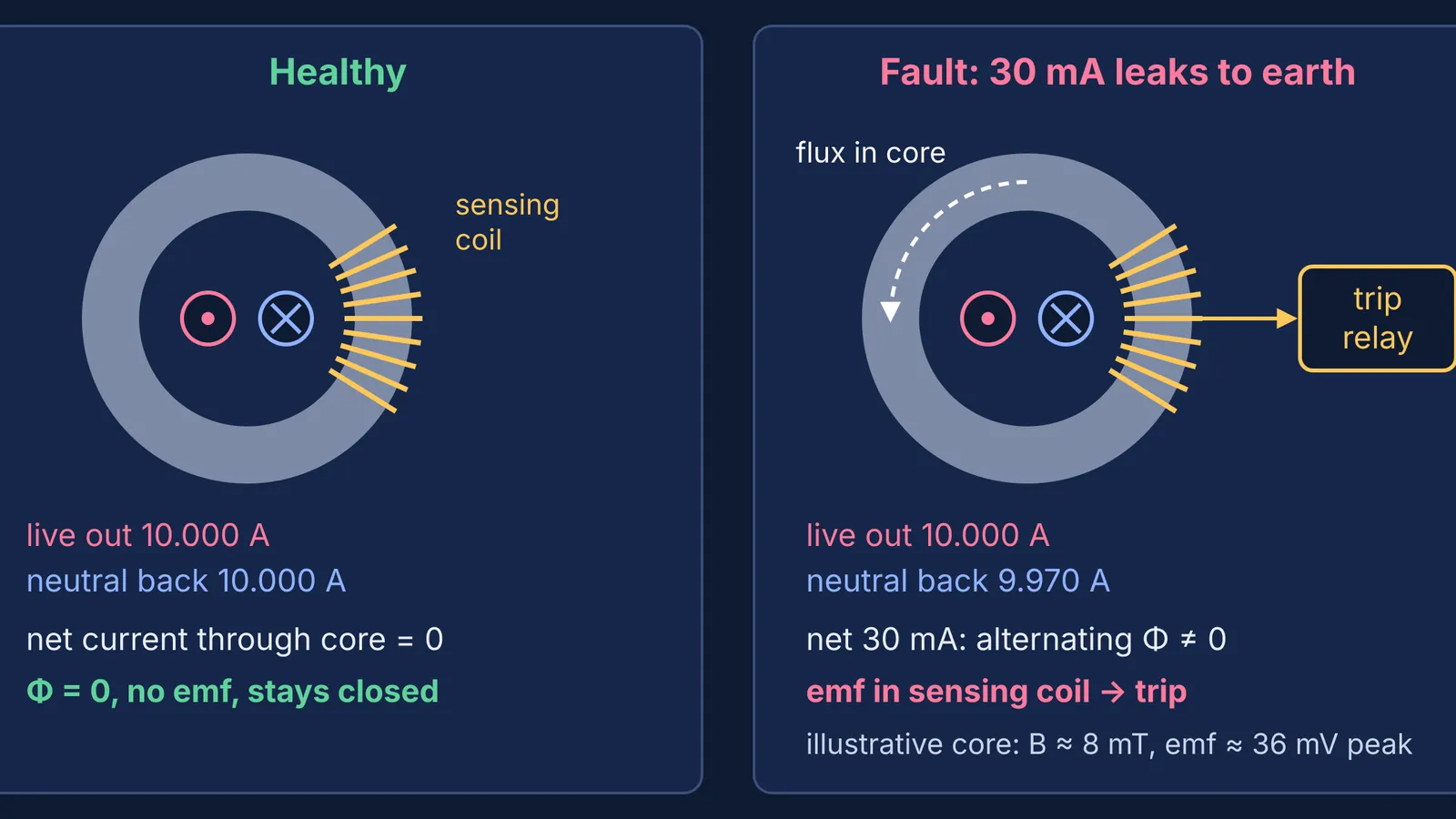
Inside the RCCB, the live wire and the neutral wire both pass through the middle of one ring-shaped iron core, called a toroid. A small sensing coil is wound on the ring.
Apply Ampère's law around a circle inside the core. The field around the loop depends only on the net current passing through the ring:
B × 2πr = μ₀μr × (I_live − I_neutral)
The two currents flow in opposite directions through the ring, so they subtract. That difference is the residual current; datasheets such as Terasaki's RCCB data define it as the vector sum of the currents in the main circuit.
Why is there no flux in a healthy circuit?
In a healthy circuit, all the current that goes out on live comes back on neutral. At each instant the two currents are equal and opposite, so the net current through the ring is zero, B is zero and the flux is zero. No flux means no changing flux, so Faraday's law gives no emf in the sensing coil, and the switch stays closed.
This holds for any load, which is the clever part. The core only ever sees the imbalance, so it can respond to milliamps while ordinary amperes flow straight through it.
Worked example: a heater fault and a 30 mA leak
A 10 A heater develops a fault that lets 30 mA leak from the live side to earth. The core values below are illustrative, chosen to show the size of the effect; real designs vary.
relative permeability μr = 2 × 10⁴,
mean radius of the ring r = 1.5 cm,
core cross-section A = 0.2 cm² = 2 × 10⁻⁵ m²,
sensing coil N = 500 turns, supply at 50 Hz.
Currents. Live out: 10.000 A. Neutral back: 10.000 − 0.030 = 9.970 A. Net through the ring: 30 mA (rms).
Field in the core. B = μ₀μr I/(2πr) = (4π × 10⁻⁷ × 2 × 10⁴ × 0.030)/(2π × 0.015) = 8.0 × 10⁻³ T = 8 mT (rms).
Flux. Φ = BA = 8.0 × 10⁻³ × 2 × 10⁻⁵ = 1.6 × 10⁻⁷ Wb (rms).
Induced emf. The flux is alternating at 50 Hz, so Φ = Φ₀ sin ωt with Φ₀ = √2 × 1.6 × 10⁻⁷ = 2.26 × 10⁻⁷ Wb. The peak emf is NωΦ₀ = 500 × 2π × 50 × 2.26 × 10⁻⁷ = 0.036 V, about 36 mV peak (25 mV rms).
A few tens of millivolts is enough for a sensitive trip relay to release a spring-loaded latch, which opens the contacts.
Now see why the cancellation matters. If only the live wire went through the same core, its full 10 A would try to produce B = 2.7 T, hundreds of times the fault field and far beyond what the iron can carry before it saturates. Passing both wires through the ring removes the 10 A and leaves only the 30 mA that matters.
How much current flows through a person, and how fast must it trip?
Suppose a person with wet hands, standing on a damp floor, touches the faulty heater's live part. NIOSH's report Worker Deaths by Electrocution says the body's resistance may be as high as 100,000 Ω when dry, but wet or broken skin may drop it to about 1,000 Ω. Body resistance depends strongly on moisture, contact area and the path, so treat these as round values.
Wet, 1,000 Ω: I = 230/1000 = 0.23 A = 230 mA, about 7.7 times the 30 mA rating.
Dry, 100,000 Ω: I = 230/100,000 = 2.3 mA, below the trip level.
The same NIOSH report puts the let-go current at about 16 mA and notes that currents of 100 mA or more can cause ventricular fibrillation. A 30 mA setting sits well below that range.
How fast is "fast"? The Indian standard IS 12640 (Part 1):2008, based on IEC 61008-1 (both have since been revised), gives maximum break times for a general-type RCCB in its Table 1:
at the rated residual current IΔn (30 mA): 0.3 s,
at 2IΔn (60 mA): 0.15 s,
at 5IΔn (150 mA), or 0.25 A as an allowed alternative for 30 mA devices: 0.04 s.
Manufacturers' data, such as the Terasaki table linked above, also show that at 0.5 IΔn (15 mA) the device must not trip, so small normal leakage does not cause nuisance tripping. At 50 Hz, 0.3 s is 15 cycles and 0.04 s is 2 cycles. The RCCB is fast, but it is not instant: a shock is shortened, not prevented.
What does an RCCB not protect against?
A shock between live and neutral. If a person touches both live and neutral while insulated from earth, the current enters through one hand and returns through the other into the neutral. Live and neutral still balance, the net current through the core is zero, and the RCCB does not trip.
Overload and short circuit. A short between live and neutral draws a huge current, but it is still balanced. Overcurrent protection is the MCB's job, explained in why a miniature circuit breaker trips.
A missing earth path. With a good earth wire, a leak from a metal body flows to earth and the RCCB trips before anyone touches it. How earthing does that is in why an earth wire keeps metal appliances safe.
What does the test button do?
IS 12640 requires every RCCB to have a test device that simulates a residual current passing through the detecting device. Inside, the button connects a small resistor so that a little current flows on one side of the core but returns by a path that bypasses it. The core then sees an imbalance, just as in a real fault. The standard notes this checks that the tripping mechanism works, not the exact current at which it trips.
To revisit Ampère's law and Faraday's law on their own, the Concept Library has each one explained from the ground up.
Quick checklist
Live and neutral pass through one toroidal core; it senses only I_live − I_neutral.
Healthy circuit: net current zero, flux zero, no emf, no trip, whatever the load.
Leak to earth: alternating flux, emf in the sensing coil, relay releases the latch.
Illustrative core: 30 mA gives about 8 mT and 36 mV peak.
IS 12640-1 limits: 0.3 s at IΔn, 0.15 s at 2IΔn, 0.04 s at 5IΔn; no trip required at 0.5 IΔn.
No protection against live-to-neutral shocks or overloads; that needs care and an MCB.


