On this page
Many electrical accidents at home start small: a warm plug, a multi-plug stacked onto another, a tripped switch pushed back up again and again. India's Central Electricity Authority (CEA) recorded 14,026 electrical accidents and 6,038 human deaths in 2022-23, according to a CEA presentation on the 2023 safety regulations. The NCRB report Accidental Deaths and Suicides in India 2023 lists electrocution as 3.2% of deaths from accidents due to "other causes" that year.
What are the warning signs of unsafe wiring at home?
Electrical Safety First, a UK electrical safety charity, lists the signs in its safety advice for students: burn marks, "arcing" (buzzing or crackling) sounds, fuses blowing, circuit breakers tripping, and plugs or leads that feel hot to touch. At home, also look for:
Scorch marks around a socket or switch
A loose plug that sparks when you push it in
Cracked or taped-up cables, or bare wire showing
Water near a socket, such as a geyser switch beside a dripping tap
If you notice any of these, stop using the appliance, unplug it with dry hands and tell an adult.
How do you know if a socket is overloaded?
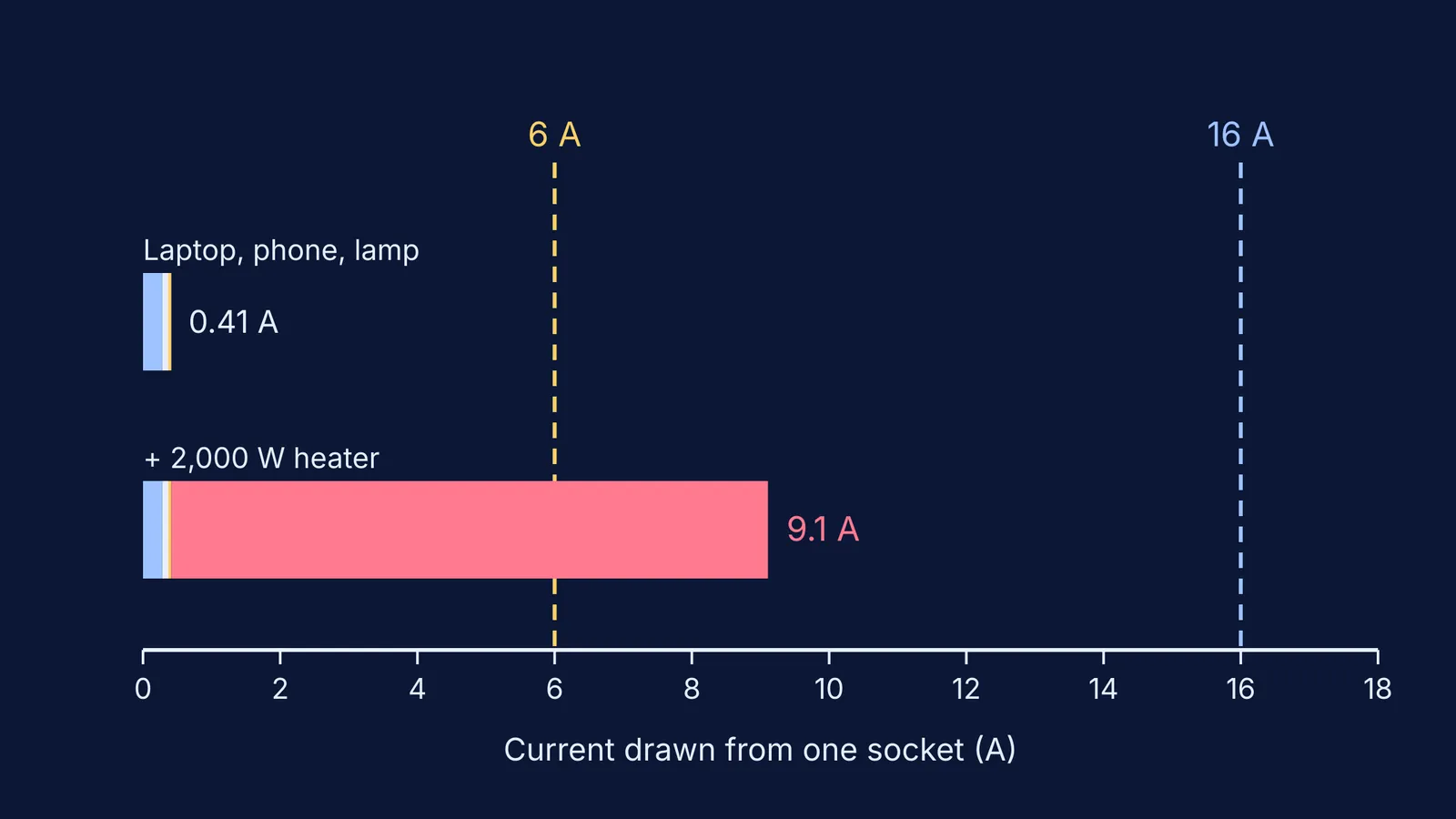
The Bureau of Indian Standards' IS 1293 covers household plugs and sockets rated up to 16 A, with 6 A and 16 A among the standard sizes; BIS certification has been mandatory since 1 December 2020 (BIS notice on IS 1293). Check the rating printed on the socket, the multi-plug or its box.
Electrical Safety First's rule: never plug in appliances that together exceed a lead's current rating, and never plug one extension lead into another (advice on overloading sockets).
How do you work out the current on one socket?
Household supply in India is 230 V (mains electricity by country). Since current = power ÷ voltage, you can read the watts on each label and add up the amps. Take a study desk:
Laptop charger, 65 W: 65 ÷ 230 = 0.28 A
Phone charger, 20 W: 20 ÷ 230 = 0.09 A
LED desk lamp, 10 W: 10 ÷ 230 = 0.04 A
Total: about 0.41 A, comfortably inside a 6 A rating
Now add a 2,000 W room heater to the same multi-plug. The heater alone draws 2,000 ÷ 230 = 8.7 A, so the total jumps to about 9.1 A. That is about 1.5 times a 6 A rating, so the plug and socket can overheat even if nothing trips. The fix: the heater gets its own 16 A socket.
Our explainer on what happens in a short circuit and why fuses blow covers why extra current heats a wire, and Fermi's Concept Library has a lesson on every concept in physics, from current to electric power.
How do you reset a tripped MCB or RCCB safely?
Your switchboard has MCBs (miniature circuit breakers) and often an RCCB, a type of residual current device (RCD). CEA safety regulations notified on 8 June 2023 say an RCD not exceeding 30 mA shall be used in domestic installations (CEA presentation, Regulation 44). Our post on why a small current through the body is dangerous explains why that limit is so low.
When a switch trips, follow these steps, adapted from Electrical Easy's guide to tripped breakers:
Stand on a dry floor with dry hands. If there is smoke, sparking or a burning smell at the board, do not touch it; call an adult.
Switch off the lights and unplug what you can.
Push the tripped switch fully OFF, then fully ON.
Plug appliances back in one at a time.
If it trips when one goes in, keep that appliance unplugged until it is checked.
If it trips again immediately after the reset, the same guide says it may be a wiring fault and a certified electrician should check it.
When should you call an electrician?
The family rule: reset once; if it trips again, stop. Call a licensed electrician when:
The MCB or RCCB will not stay on, or keeps tripping over days. Electrical Safety First says an RCD that keeps tripping likely means a fault with an appliance or the wiring (RCD tripping FAQ).
You need a new socket, a heavier appliance such as an AC, or any change to the wiring.
Under CEA Regulation 31, wiring additions, alterations and repairs, apart from a few exceptions at up to 250 V, must be done by a licensed electrical contractor or under the direct supervision of a person holding a certificate of competency (CEA presentation).
That is Electrical Safety First's first aid advice; see also why students should learn basic first aid and where to train.
For physics ideas that are easier to see than to read, the Fermi Simulation Lab has interactive simulations. Then do the desk check tonight: three labels, one division each.