

On this page
Have you ever wondered why we are so strictly warned against touching electrical switches with wet hands? The answer lies not just in the voltage, but in how our body's electrical resistance changes when wet.
The human body is essentially a bag of salty water, which makes our insides excellent conductors of electricity. However, we are protected by a vital shield: our skin. When dry, skin offers high resistance to electric current, but when it becomes wet, that protection vanishes, allowing potentially lethal amounts of current to pass through.
How much resistance does the human body have?
According to the National Institute for Occupational Safety and Health (NIOSH), the electrical resistance of the human body varies drastically depending on the condition of the skin NIOSH.
When your skin is completely dry, its resistance ranges from 100,000 to 600,000 ohms (Ω). This high resistance acts as an insulator, severely limiting the amount of current that can flow into your internal organs. However, when your skin is wet from water or sweat, its resistance drops precipitously to about 1,000 Ω.
If the skin is broken, cut or burned, the resistance is reduced even further to 500 Ω, meaning almost nothing stops the current from travelling through the highly conductive tissues inside.
What is the let-go threshold?
Electricity harms the body through the flow of current, measured in milliamperes (mA), rather than just the voltage. Even a very small current can disrupt the body's normal functions NIOSH.
When you touch a live circuit, the electrical current overrides the natural electrical signals from your nervous system. Your muscles respond by contracting violently.
The severity of a shock depends on how much current flows:
1 mA: You will feel a faint tingle, which is the threshold of perception.
5 mA: You will feel a slight shock; while disturbing, the average person can still let go of the wire.
9 mA to 30 mA: This is the range where you lose muscular control. The muscles in your hand clench involuntarily, freezing you to the circuit so you cannot release it.
50 mA to 150 mA: Current in this range causes extreme pain, severe muscular contractions, and respiratory arrest. Death is possible.
1,000 mA (1 Ampere) and above: This triggers ventricular fibrillation, where the heart's rhythmic pumping ceases. Death is most likely.
Does the path of the current matter?
Resistance and current alone do not tell the whole story. The path that the electricity takes as it travels through your body is just as critical.
If you touch a live wire with your right hand and the current exits through your right foot to the ground, it will travel through the right side of your torso. While this can cause severe burns and tissue damage, it is less likely to kill you instantly. However, if you touch a live wire with your left hand and the current exits through your right hand or right foot, the path directly crosses your chest. This sends the current straight through your heart and lungs, significantly increasing the risk of respiratory arrest or ventricular fibrillation.
Why does 240V mains power kill?
If a household electricity supply operates at 240 volts (V), we can use Ohm's Law (I = V / R) to calculate the current that would flow through the body. The thresholds for danger remain the same NIOSH.
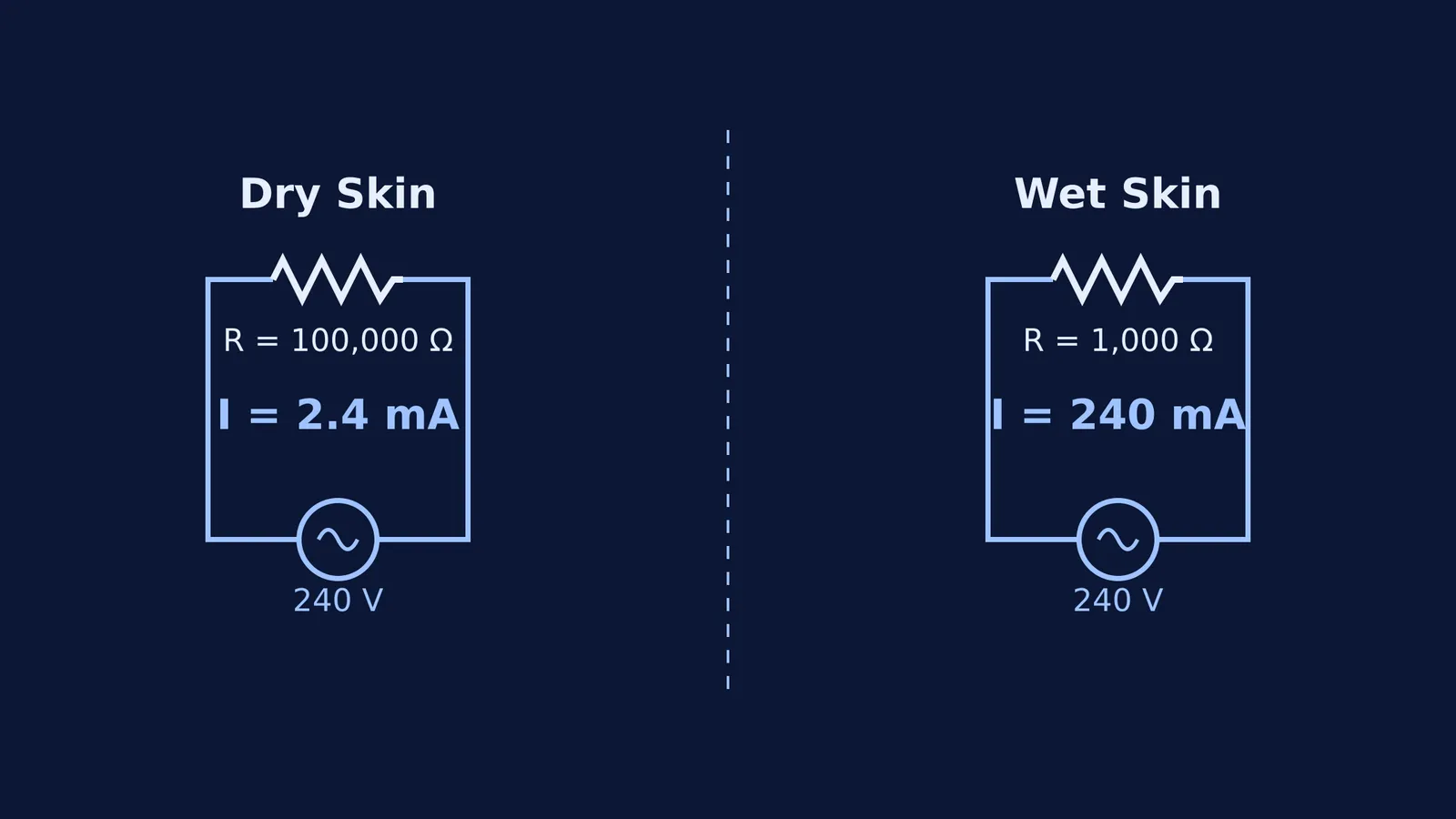
If you touch a live 240V wire with dry hands (100,000 Ω), the current is 240 / 100,000 = 0.0024 Amperes, or 2.4 mA. This is below the 5 mA threshold, meaning you will feel a tingle but can let go.
However, if you touch the same wire with wet hands (1,000 Ω), the current becomes 240 / 1,000 = 0.24 Amperes, or 240 mA. A current of 240 mA is well beyond the 50 to 150 mA threshold for extreme pain and respiratory arrest, making it a potentially lethal shock.
Learning how physics principles like Ohm's Law apply to real-world situations is crucial. If you are preparing for exams and want to test your understanding of electrical circuits, the Fermi Problem Library has worked problems with a step-by-step solver that explains the reasoning. You can also explore Why Is Touching Switches with Wet Hands Dangerous? for a deeper look into household safety, or review the Difference between resistance and resistivity to ensure your fundamentals are solid.
How can you stay safe at home?
To protect yourself from dangerous currents, make these habits non-negotiable:
Dry your hands thoroughly before touching any plug or switch.
Wear rubber-soled slippers when operating heavy appliances like washing machines or irons.
Keep electrical devices away from sinks, bathtubs, and wet bathroom floors.
Replace frayed cables immediately; exposed wires remove the appliance's built-in insulation.


