

On this page
Most of us know the routine: a scratchy throat, a runny nose, a week of tissues, and a few months later it happens again. If your body made antibodies last time, why doesn't it remember? The short answer is that "the cold" is not one virus.
Why do we get the common cold again and again?
Rhinoviruses cause one-half to two-thirds of common colds, according to a 2013 review in Clinical Microbiology Reviews (Jacobs et al., 2013). The US Centers for Disease Control and Prevention says more than 200 respiratory viruses can cause colds, with rhinoviruses the most frequent cause in the United States (CDC). The same page notes that US adults average two to three colds a year, and children often have more.
Two things work against you: rhinoviruses come in many types that look different to your immune system, and the antibodies guarding your nose do not stay high forever.
How many types of cold virus are there?
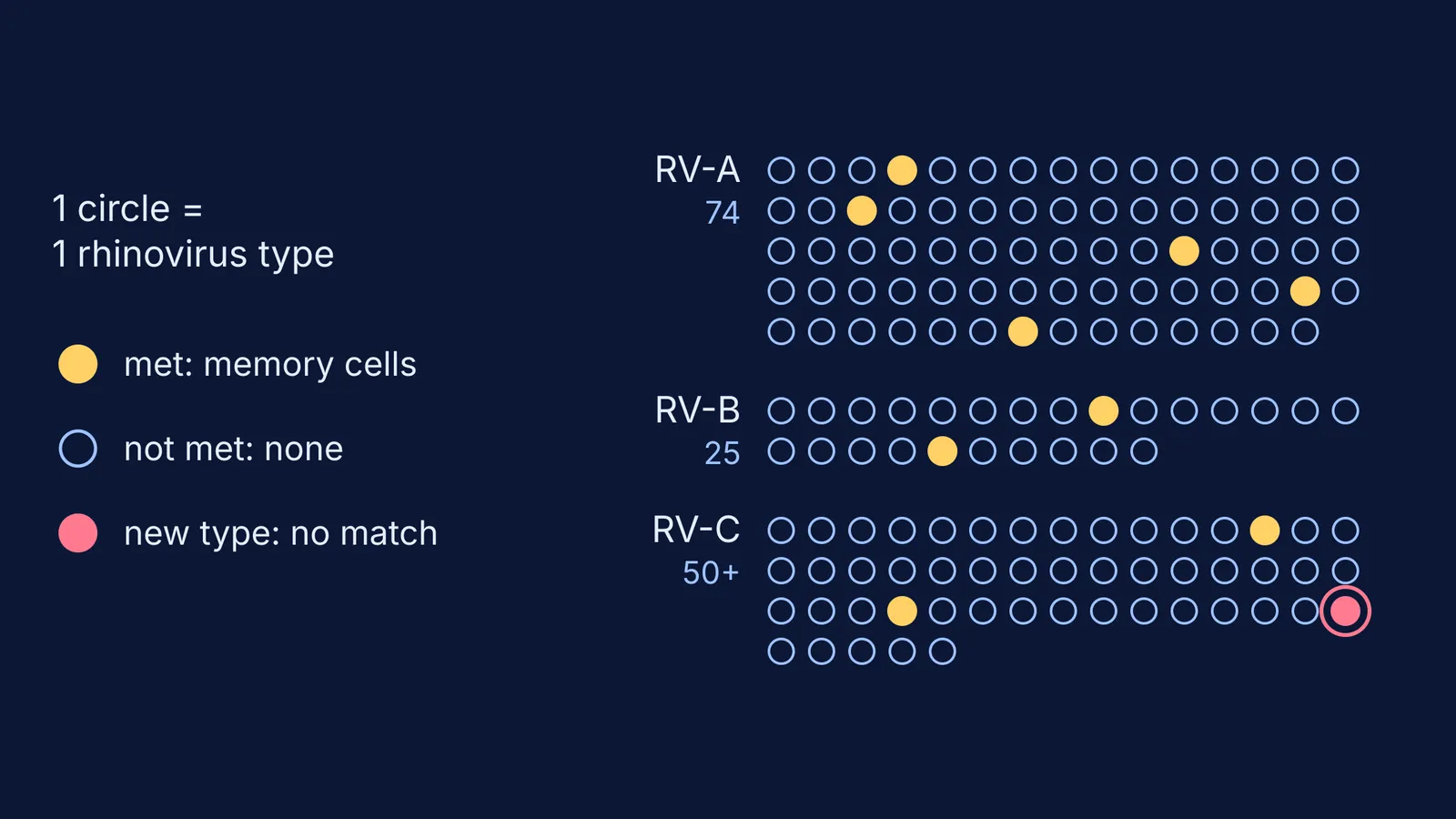
Rhinoviruses fall into three species: A, B and C. The 2013 review counts 74 serotypes of rhinovirus A, 25 of rhinovirus B and at least 50 types of rhinovirus C (Jacobs et al., 2013).
In 2009, Ann Palmenberg's team sequenced the complete genomes of all 99 serotypes then known and found recombination between them (Palmenberg et al., Science, 2009).
A serotype is a group of virus strains that the same antibodies neutralise. The 2013 review puts it plainly: "There is little cross-neutralization among serotypes." An antibody that grips one type usually misses the next.
Doesn't the immune system remember viruses?
It does, but memory is specific. After an infection, some B cells that made the matching antibody stay on as memory cells (see how B and T lymphocytes divide the work). They recognise the shapes they met, not the whole family.
A classic volunteer study shows both sides. W. S. Barclay and colleagues gave rhinovirus type 2 to 17 volunteers (Barclay et al., Epidemiology and Infection, 1989). Six who already had type 2 antibodies in serum or nasal secretions resisted infection. Ten of the other 11 became infected; their antibodies rose 1-2 weeks after infection and peaked at 5 weeks. All six resistant volunteers and eight of those infected kept their type 2 antibodies for at least a year, and at that point were protected against reinfection.
So you are rarely catching the same cold twice. In the diagram at the top, each circle is one rhinovirus type: yellow ones you have met, and the red one is the next cold, which your memory cells have never seen.
Why does immunity in the nose fade?
Your nose is guarded largely by IgA, the antibody class secreted onto mucous surfaces (our explainer on how IgA differs from IgG, IgM and IgE covers the structure). In the 1989 study, two volunteers whose type 2 antibodies fell in serum or nasal secretions became infected, though not ill, when given type 2 again a year later (Barclay et al., 1989).
One study of a different respiratory virus points the same way. In 446 adults hospitalised with COVID-19, researchers found nasal IgA stayed raised for nine months, while nasal and plasma IgG against the spike protein stayed raised for at least 12 months (Liew et al., eBioMedicine, 2023). That was a different virus, so treat it as a pattern, not a rhinovirus measurement.
How do you explain this in a biology answer?
Use this four-step chain, with the numbers from the 2013 review:
Name the cause: rhinoviruses cause one-half to two-thirds of colds.
State the variety: more than 100 serotypes, with little cross-neutralisation between them.
Link to memory: memory B cells are specific to the antigen they met, so a new serotype is met largely by a primary response rather than a fast secondary one.
Add the mucosal point: protection in the nose relies heavily on secretory IgA, which can wane.
Worked example: Riya catches three colds in one school year and asks why her antibodies did nothing. Step 3 answers it: each cold was most likely a different type, so each time her body started largely from scratch.
To see how antigen specificity, memory cells and IgA connect, the Fermi Concept Library gives each concept its own lesson and its place in the map. If the idea is clear but application questions still trip you up, the Fermi Problem Library has worked problems with a step-by-step solver that explains the reasoning.
What does this mean for your next cold?
The 2013 review notes there are no approved antiviral drugs for rhinoviruses and treatment is mainly supportive, and that vaccine work is held back by more than 100 serotypes with highly variable antigenic sites (Jacobs et al., 2013). Our post on how a common cold differs from pneumonia explains why the lungs are a different story.
Next time someone blames weak immunity for your cold, show them the circles.


