

On this page
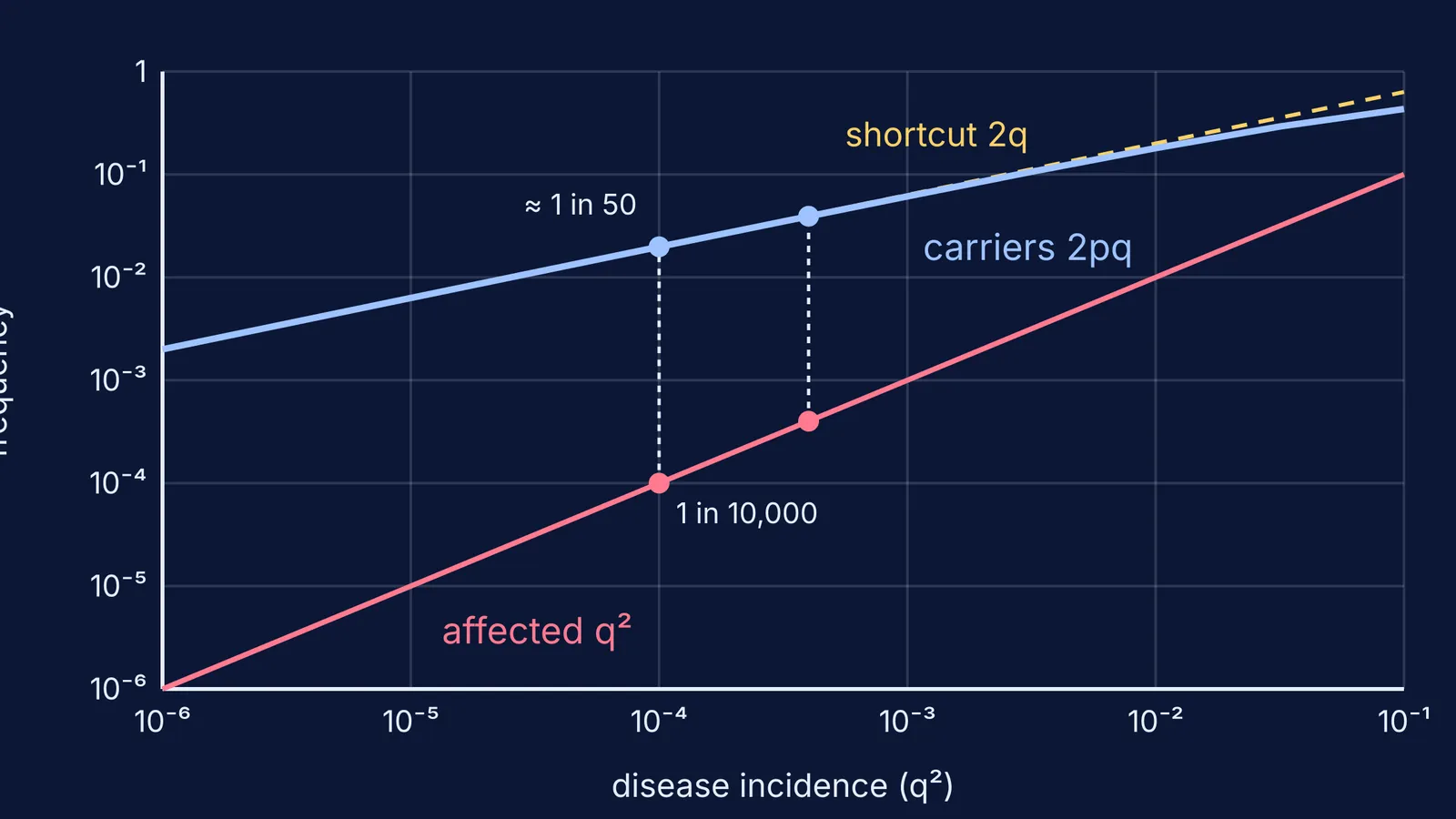
A question says a recessive disorder affects 1 in 10,000 births and asks how many people are carriers. Many students know p² + 2pq + q² = 1 but freeze on which term the 1 in 10,000 belongs to. Here is the route from that number to q, then to 2pq, with two worked examples and a shortcut.
What do p, q and 2pq mean in Hardy-Weinberg?
In a gene with two alleles, p is the frequency of the more common allele and q the frequency of the rarer one, and p + q is always 1, as Hanan Hamamy of Geneva University sets out in a population genetics teaching deck. The same deck gives the genotype frequencies:
AA (unaffected, not a carrier): p²
Aa (unaffected carrier): 2pq
aa (affected, for a recessive disorder): q²
These hold only in an ideal population: large and randomly mating, with no new mutations and no selection, according to the same Hamamy slides.
If the terms gene, allele and genotype still blur together, our Hardy-Weinberg numerical guide starts one step earlier.
How do you find carrier frequency from disease incidence?
The key move: for an autosomal recessive disorder, the disease incidence is q². Only aa people show the disease, so the number you are given is already a genotype frequency, not an allele frequency.
Write the incidence as a fraction: q² = affected ÷ total.
Take the square root to get q.
Find p = 1 − q.
Carrier frequency = 2pq. Turn it into "1 in N" by working out 1 ÷ 2pq.
Worked example 1: 1 in 10,000 births
This is the example in the Hamamy deck, which lists phenylketonuria at about 1 in 10,000.
q² = 1/10,000 = 0.0001
q = √0.0001 = 0.01
p = 1 − 0.01 = 0.99
2pq = 2 × 0.99 × 0.01 = 0.0198, which is about 1 in 50
Carriers outnumber affected people by about 198 to 1 (0.0198 ÷ 0.0001). That is why recessive alleles survive quietly in a population.
Worked example 2: cystic fibrosis at 1 in 2,500
MedlinePlus, the US National Library of Medicine's health site, says cystic fibrosis occurs in 1 in 2,500 to 3,500 white newborns and is autosomal recessive. Take the higher figure.
q² = 1/2,500 = 0.0004
q = 0.02
p = 0.98
2pq = 2 × 0.98 × 0.02 = 0.0392, about 1 in 25
Run the same steps with 1 in 3,500 and you get roughly 1 in 30, so carriers in that group sit between about 1 in 25 and 1 in 30.
Exam setters then add one more step. In the Hamamy deck's cystic fibrosis problem, a man who already has an affected child must be a carrier, and his partner with no family history has the population carrier chance of 1/25. Their risk of an affected child is 1 × 1/25 × 1/4 = 1/100. Our post on pedigree probability and carrier chance practises that last multiplication.
Why does 2pq ≈ 2q work for rare alleles?
When q is small, p is almost 1, so 2pq is almost 2q. The Hamamy deck puts it as a rule: a rough carrier frequency is double the square root of the disease incidence.
How wrong is the shortcut? 2q divided by 2pq is 1/p, so the shortcut overestimates by a fraction of roughly q.
Incidence 1 in 10,000: q = 0.01, shortcut 0.02 versus exact 0.0198, about 1% high
Incidence 1 in 2,500: q = 0.02, shortcut 0.04 versus exact 0.0392, about 2% high
Incidence 1 in 100: q = 0.1, shortcut 0.2 versus exact 0.18, about 11% high
Try one yourself: MedlinePlus gives phenylketonuria as 1 in 25,000 newborns in the United States. Square root, double, invert. You should land near 1 in 80.
When does this method give the wrong answer?
The square-root step assumes the population is in equilibrium. The Hamamy slides list non-random mating, mutation, selection, small population size and migration as factors that disturb it. Watch for these traps:
Cousin marriage. It raises the share of aa births above q², so working backwards overstates q. Our post on cousin marriage and recessive disorders shows the maths.
Small or isolated communities. A founder effect can make a rare disorder common in one group, so a national figure may not fit it.
X-linked traits. For these the frequency of affected males is q itself, not q², as the same deck notes. Do not take a square root.
Dominant disorders. One copy of the disease allele is enough, so with q as that allele, affected people are q² + 2pq, not q².
For more practice sums, the Fermi Problem Library has worked problems with a step-by-step solver that explains the reasoning rather than printing an answer.
These are textbook estimates for exams. A real family's carrier risk depends on its own history and testing, which is a question for a doctor or genetic counsellor.


