

On this page
Antibiotics kill bacteria but not you because each one aims at a part of the bacterial cell that your cells lack or build in a different shape. Learn the three main targets and most exam questions on this topic become one line of reasoning.
How do antibiotics kill bacteria without killing us?
The key idea has a name. Selective toxicity means a drug kills or stops the growth of a microbe while causing minimal or no harm to the host, as defined in OpenStax Microbiology, section 14.3.
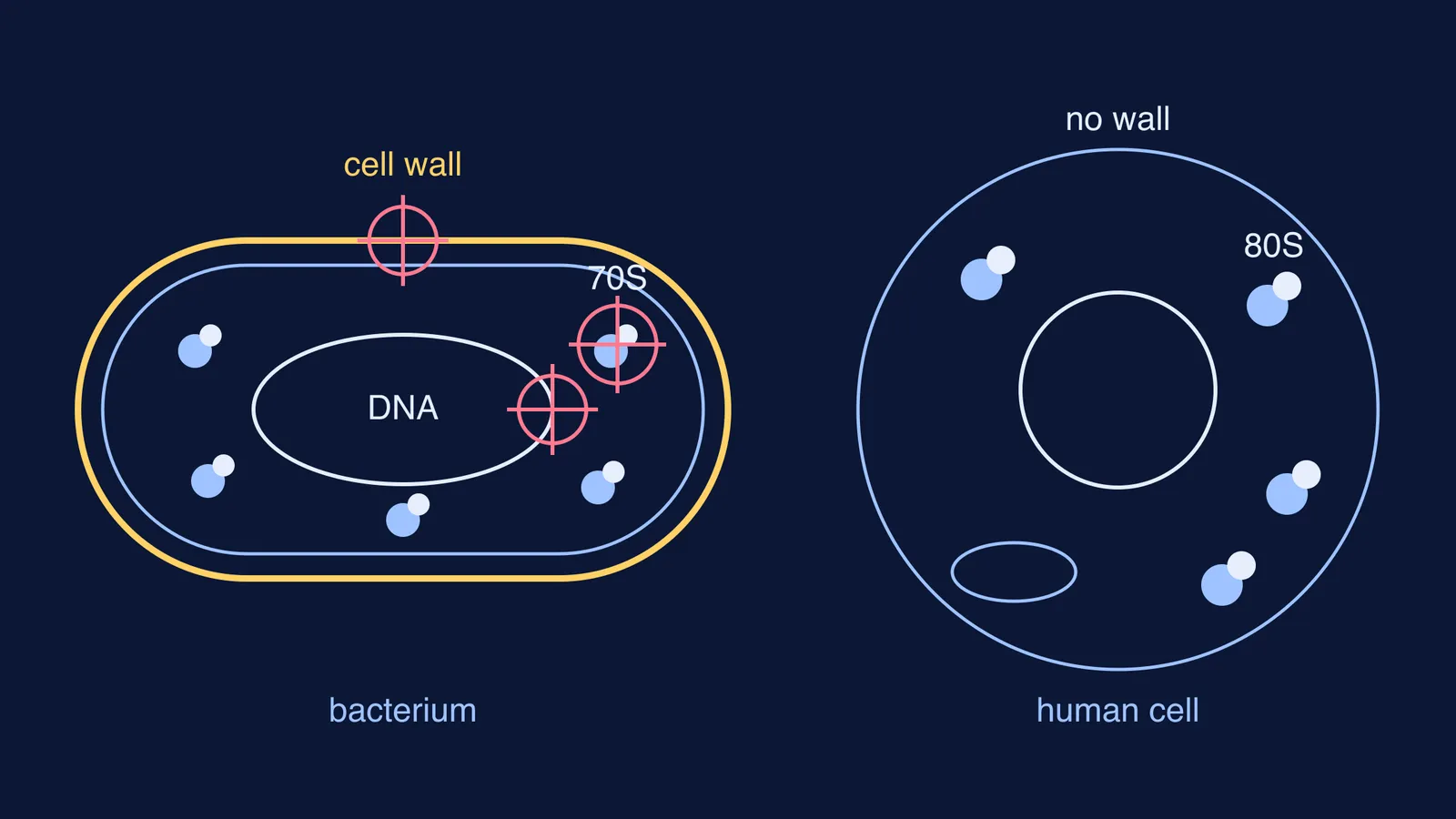
Most antibacterial drugs hit one of three jobs a bacterium must do to survive and divide:
build and repair its peptidoglycan cell wall
make proteins on its 70S ribosomes
copy and untangle its DNA
How do antibiotics break the bacterial cell wall?
The wall is a mesh of sugar chains joined by short peptide cross-links. A review in Nature Reviews Microbiology by Kohanski, Dwyer and Collins (2010) explains that beta-lactams, including penicillins, carbapenems and cephalosporins, block this cross-linking by inhibiting transpeptidases, also called penicillin-binding proteins.
Vancomycin works on the same wall in a different way: it binds the end of the peptide chain of wall precursors and creates a structural blockage that stops wall subunits being added, according to OpenStax. Drugs that block wall building make cells more susceptible to osmotic lysis, OpenStax notes: water rushes in and the cell can burst.
Why are you safe? Human cells do not make peptidoglycan, which OpenStax calls an excellent example of selective toxicity. If you want the chemistry of the wall itself, our explainer on what bacterial, plant and fungal cell walls are made of goes layer by layer.
How do antibiotics block the 70S ribosome?
The bacterial 70S ribosome is built from a small 30S subunit and a large 50S subunit, as described in a review by Kapoor, Saigal and Elongavan (2017). The same review lists aminoglycosides and tetracyclines as drugs that bind the 30S subunit, while chloramphenicol, macrolides and lincosamides bind the 50S subunit.
Aminoglycosides do more than pause the machine. They impair the ribosome's proofreading, the faulty proteins that result damage the cell membrane, and the bacterium dies, OpenStax explains.
Your own cytoplasmic ribosomes are 80S and structurally distinct from bacterial 70S ones, which is why protein synthesis is a good selective target (OpenStax). Puzzled that 30 plus 50 makes 70 and not 80? Read why Svedberg values of ribosome subunits do not add up.
How do antibiotics stop bacteria copying DNA?
Bacterial DNA is a long loop packed into a tiny cell, so it twists as it is copied. Enzymes called DNA gyrase and topoisomerase IV cut the strands, relieve the twist and rejoin them. Quinolones trap these enzymes at the cutting stage and prevent the strands from rejoining, according to Kohanski and colleagues. In Gram-negative bacteria gyrase is the main target, and in Gram-positive bacteria it is topoisomerase IV (Kapoor and colleagues).
Humans have related enzymes, so the safety margin comes from differences between the enzymes. A review by Idowu and Schweizer (2017) notes that clinically relevant fluoroquinolones such as ciprofloxacin show very little activity against human type 2 topoisomerases. It reports that fluoroquinolones were found to be 1000-fold more selective for bacterial topoisomerases than for human ones, though why is still largely unexplained.
How do you answer an antibiotic question in an exam?
Use this three-question test on any drug you meet in a question:
Which structure or process does it hit: wall, ribosome subunit, DNA enzyme or a metabolic pathway?
Does a human cell have that structure? If not (peptidoglycan), selectivity is built in.
If humans have a look-alike (80S ribosomes, mitochondrial ribosomes, human topoisomerases), what is different, and where could side effects come from?
Worked example: "Penicillin kills growing bacteria but does not harm human cells. Why?" Step 1: it blocks the penicillin-binding proteins that cross-link peptidoglycan. Step 2: human cells make no peptidoglycan. Step 3: no human look-alike exists, so the answer is about the wall alone.
If you cannot recall what a structure does, the Fermi Concept Library has a lesson for every biology concept with its place in the map. To practise the reasoning on fresh questions, the Fermi Problem Library has worked problems with a step-by-step solver that explains the reasoning rather than printing an answer.
The WHO's antimicrobial resistance fact sheet says bacterial resistance was estimated to be associated with more than 4.7 million deaths worldwide in 2021. For the viral side of the story, see why antibiotics do not work against viruses. Questions about your own medicines belong with a doctor or pharmacist, not a textbook.


