

On this page
When you have a lingering cough, a high fever or a sore throat, it is tempting to ask a doctor for a round of antibiotics. But if a virus is causing your illness, antibiotics will not help you feel better, and they will not cure the infection.
This is not because the virus is too strong or because your immune system is weak, but because of a fundamental difference in biology. Antibiotics are highly specialised chemical tools designed to break apart specific parts of a bacterium. When they meet a virus, they simply cannot find their target.
Bacteria vs viruses: what is the difference?
To understand why antibiotics fail against viruses, you first have to look at how these two types of microscopic agents are built.
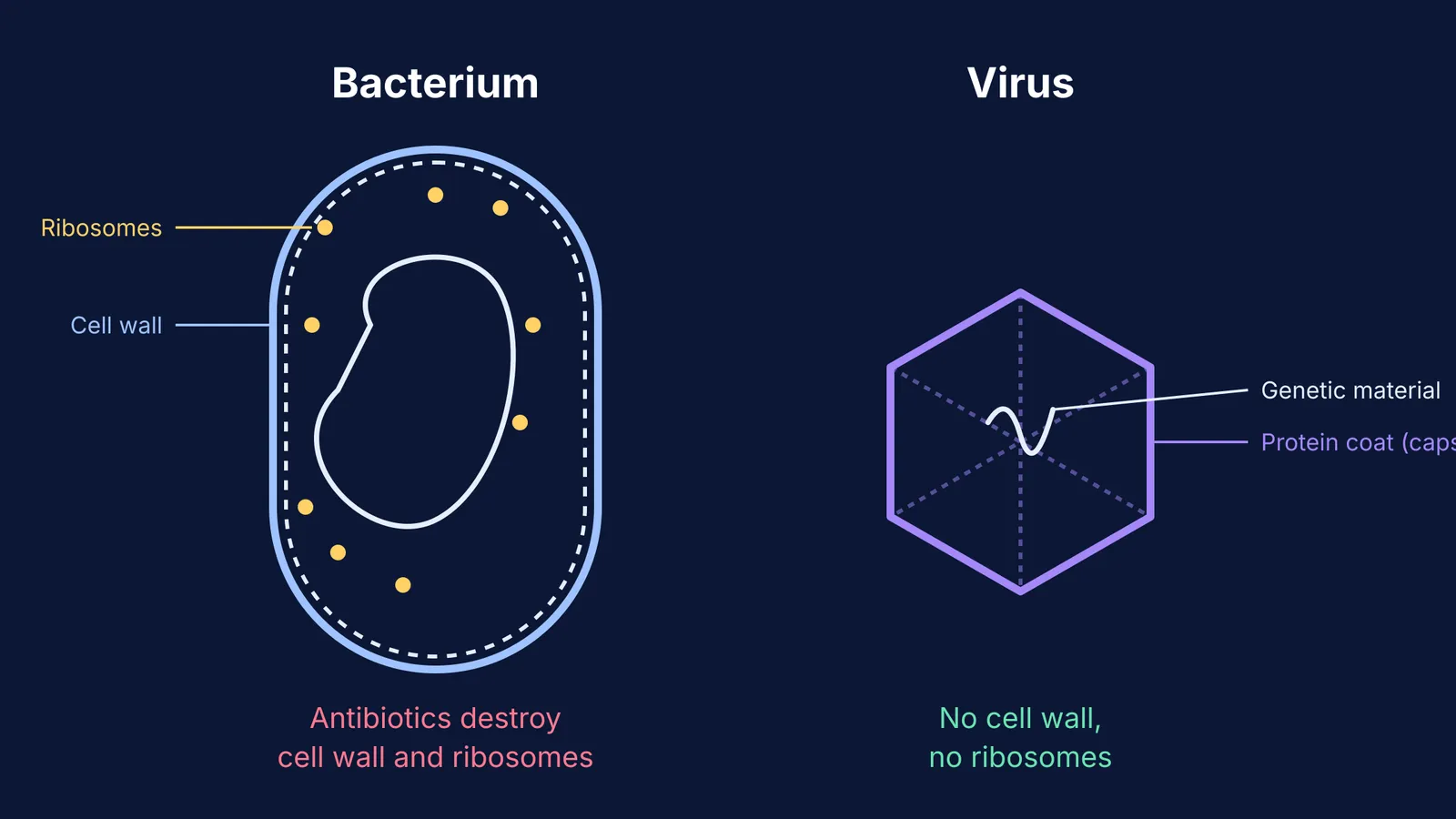
A bacterium is a complete, living, single-celled organism. As you might learn when studying cell structure and functions in science class, bacteria have their own independent machinery to survive and reproduce. They have a delicate cell membrane surrounded by a tough, protective outer layer called a cell wall. Inside, they have ribosomes, which act as tiny protein factories to build everything the bacterium needs to grow.
Viruses, on the other hand, are much smaller and drastically simpler. In fact, they are so simple that biologists often debate whether they are even alive (putting them among the misfits of five-kingdom biology). A virus is essentially just a string of genetic material—either DNA or RNA—wrapped in a geometrical protein coat called a capsid.
Crucially, viruses do not have cell walls, and they do not have their own ribosomes. Because they lack this machinery, they cannot reproduce on their own. Instead, a virus must invade a living host cell—like one of the cells lining your respiratory tract—and hijack your own cellular machinery to make copies of itself.
You can explore interactive simulations for ideas that are easier to see than to read in the Fermi Simulation Lab.
How do antibiotics actually work?
Antibiotics are chemicals that seek out and destroy specific parts of a bacterial cell. Because human cells are built differently from bacterial cells—for example, human cells do not have cell walls—antibiotics can kill the invading bacteria without harming your own body's tissues.
They generally work in one of two distinct ways:
Destroying the cell wall: Many common antibiotics, such as penicillin and amoxicillin, work by preventing bacteria from building or repairing their cell walls. Without a strong cell wall to hold it together, the internal pressure of the bacterium causes it to burst and die.
Blocking ribosomes: Other types of antibiotics attach themselves specifically to bacterial ribosomes. This stops the bacteria from manufacturing the proteins they need to survive and multiply, effectively starving the infection out.
Why do antibiotics not work against viruses?
Because viruses do not have cell walls or their own ribosomes, antibiotics have absolutely nothing to target.
If you take a dose of penicillin for a viral cold, the drug circulates through your bloodstream, searching for bacterial cell walls to break down. Since the cold virus is just genetic material wrapped in a protein coat, the antibiotic floats past it harmlessly. The virus continues to multiply inside your cells unaffected.
Furthermore, because viruses hide inside your own cells to replicate, a drug designed to stop viral replication must be incredibly precise. If a generic drug just shut down the ribosomes the virus was using to multiply, it would be shutting down your own human ribosomes, harming your healthy cells in the process. (This is exactly why antiviral drugs, which are designed to fight specific viruses, are much harder to develop than antibiotics).
If you are studying human health and immunity, it helps to remember this core rule: antibiotics cure bacterial diseases (like strep throat, urinary tract infections or tuberculosis) but are completely useless against viral diseases (like the common cold, influenza or COVID-19).
What are the risks of taking unnecessary antibiotics?
Taking an antibiotic when you have a viral infection will not cure your illness, but it can still cause significant harm to your body and to the wider community.
According to the US Centers for Disease Control and Prevention (CDC), taking antibiotics when you do not need them will not help you, and their side effects can still cause harm. In fact, side effects from antibiotics are the most common cause of medication-related emergency department visits in children.
More importantly, using antibiotics when they are not needed is a major driver of antimicrobial resistance. Your body is naturally full of harmless, helpful bacteria that aid in digestion and immunity. When you take an antibiotic for a viral cold, the drug attacks these good bacteria. The few bacteria that survive are the ones that happen to have naturally mutated to resist the drug.
When these surviving bacteria multiply, they pass on their drug resistance. Over time, this process creates "superbugs" that are much harder—or sometimes impossible—to treat if you ever do get a serious bacterial infection.
What questions should you ask your doctor?
If you are feeling unwell and your healthcare provider says you have a viral infection, do not pressure them for an antibiotic prescription. Instead, you can ask a few simple questions to manage your symptoms safely while your immune system does its work:
How long should I expect these specific symptoms to last?
Are there over-the-counter medicines that can help relieve my cough, fever or sore throat?
What warning signs should I watch out for that mean I need to come back for a follow-up?
What steps can I take to keep from spreading this virus to my family or classmates?


