

On this page
Walk into any gym and you will see runners set the treadmill to a 1% incline before they start. On a treadmill you never move through the air, so you skip the work of pushing it aside. A small slope adds that work back, and two lines of Newton's laws show how much.
Why is running on a treadmill easier than running outdoors?
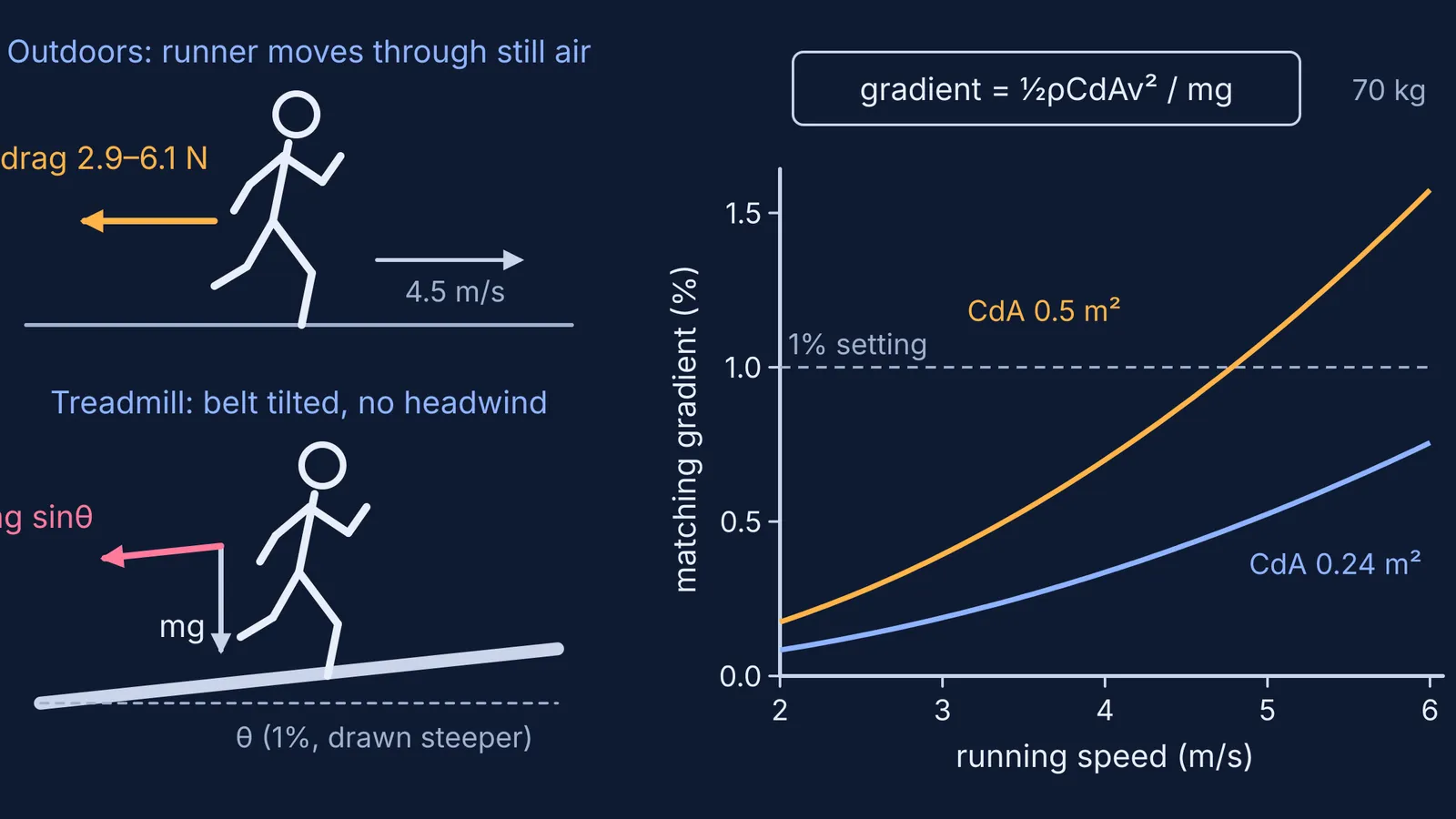
Outdoors, you move forward at your running speed through air that is (on a calm day) standing still. Relative to you, the air rushes past at that speed, and it pushes back on you with a drag force.
On a treadmill, the belt moves backwards under your feet while your body stays in one place in the room. The air around you is still, and so are you. There is no relative wind, so there is no drag. The rest of the cost of running, swinging your legs and bouncing up and down, is roughly the same. So a treadmill at 0% is a little too easy compared with a level road at the same speed.
How big is the air drag on a runner?
For a body moving fast through air, the drag force is
F = ½ ρ C_d A v²
where ρ is the density of air (about 1.2 kg/m³ near sea level at room temperature), A is your frontal area, C_d is the drag coefficient, which depends on shape, and v is your speed relative to the air. For a person, C_d and A are hard to separate, so they are quoted together as C_dA, in m².
Published estimates of C_dA for a runner vary with body size, clothing and method, so in this post we use two illustrative round values: 0.24 m² for a small, lean runner and 0.5 m² for a larger one. Why the force grows as v², and why the power to beat it grows as v³, is worked out in why the power to beat air drag grows with the cube of speed. What streamlining does to C_d is in fluid friction and why fish, birds and planes are streamlined.
How much does drag matter overall? In wind-tunnel and treadmill experiments, the physiologist Griffith Pugh estimated that beating air resistance may take about 7.5% of the total energy cost of running at middle-distance speed and 13% at sprint speed (Pugh 1971, Journal of Physiology). That is small, but not zero.
What slope replaces the missing drag?
On a slope of angle θ, gravity has a component mg sinθ along the belt, pointing downhill. To keep running at a steady speed up the belt, you must push against it with an extra force of the same size.
Treadmill slope is set as a gradient in per cent: rise per 100 units of horizontal distance, which is tanθ × 100. For small angles, sinθ ≈ tanθ ≈ gradient/100. So the extra force is about mg × (gradient/100).
Set this equal to the drag you would have felt outdoors:
mg × (gradient/100) = ½ρC_dAv²
gradient (%) = 100 × ½ρC_dAv² / mg
The extra power is the force times the belt speed, so matching the force at the same speed also matches the power.
Worked example: a 70 kg runner at 4.5 m/s
Take a 70 kg runner at 4.5 m/s (16.2 km/h, a pace of about 3 minutes 42 seconds per km). Use ρ = 1.2 kg/m³ and g = 9.8 m/s².
Weight. mg = 70 × 9.8 = 686 N.
Dynamic pressure. ½ρv² = 0.5 × 1.2 × 4.5² = 0.5 × 1.2 × 20.25 = 12.15 N/m² (that is, Pa).
Drag, small runner (C_dA = 0.24 m²). F = 12.15 × 0.24 = 2.92 N.
Drag, larger runner (C_dA = 0.5 m²). F = 12.15 × 0.5 = 6.08 N.
Matching gradient. 2.92/686 = 0.0043, so 0.43%. And 6.08/686 = 0.0089, so 0.89%.
Power lost to drag outdoors. P = Fv = 2.92 × 4.5 = 13 W, and 6.08 × 4.5 = 27 W.
Check units. kg/m³ × m² × m²/s² = kg·m/s² = N. Dividing N by N gives a pure number, as a gradient should be.
For comparison, a 1% slope at the same speed asks for 686 × 0.01 = 6.9 N, or 31 W. So 1% is close to the drag on the larger runner and a bit more than that on the smaller one.
Because the drag grows as v², the matching gradient does too. With C_dA = 0.5 m², the gradient formula gives exactly 1% at about 4.8 m/s. At 3 m/s it is only about 0.39%.
Why did experiments settle on exactly 1%?
The 1% rule comes from a measurement, not from the formula. Andrew Jones and Jonathan Doust had nine trained male runners run for 6 minutes at six speeds between 2.92 and 5.0 m/s, once on a level road and several times on a treadmill at 0%, 1%, 2% and 3%. They measured the oxygen each runner used. Their conclusion was that a 1% treadmill grade matched the energy cost of outdoor running across 2.92 to 5.0 m/s, for runs of about 5 minutes (Jones and Doust 1996, Journal of Sports Sciences).
The detail is worth knowing. At the two slowest speeds, road running did not differ significantly from either 0% or 1% on the treadmill. At 3.75 m/s only 1% matched. At the fastest speed the road value fell between the 1% and 2% values. That fits the v² physics: at low speed the drag is so small that 0% is about as good as 1%, and at high speed the drag starts to call for more than 1%.
The experiment measured oxygen, not force. So the 1% figure also absorbs anything else that differs between treadmill and road, not just drag.
What does a 1% slope not fix?
Leg mechanics. On a slope you push against gravity, not against air on your chest. The total energy can match while the way your muscles work differs a little.
Cooling. Outdoors, the relative wind cools you. Indoors, without a fan, you may heat up faster even when the energy cost matches.
Speed. The match was tested between about 2.9 and 5.0 m/s. A sprinter far above that loses much more to drag, and a walker far below loses almost nothing. How wind changes a sprinter's time is in why a 2 m/s tailwind voids a sprint record.
The belt display. Belt speeds on gym machines are not always calibrated, so the speed on the screen may not be the true speed.
To see how a force that grows with v² compares with a constant force like mg sinθ, try the Simulation Lab, which has interactive simulations for ideas that are easier to see than read.
Quick checklist
On a treadmill you are at rest relative to the air, so there is no drag.
Drag: F = ½ρC_dAv², growing as v².
A slope adds mg sinθ ≈ mg × gradient along the belt.
Matching gradient = ½ρC_dAv²/mg: about 0.4% to 0.9% at 4.5 m/s for a 70 kg runner.
1% is the value measured to match outdoor energy cost between 2.92 and 5.0 m/s.
Always check units: N/N leaves a pure number.


