

On this page
In a 100 m final, a sprinter can win the race and still miss out on a record because the wind behind them was a little too strong. The limit is 2.0 m/s. Drag depends on the square of the air speed past the body, so a small wind changes it a lot. Here is how much a 2 m/s wind is worth, from Newton's second law and a simple drag model, checked against real race data.
What is the 2.0 m/s wind rule in sprinting?
The rule is in the World Athletics Competition and Technical Rules. For outdoor races up to and including 200 m, wind data must be submitted with a record claim, and if the wind measured in the direction of running averages more than 2 metres per second, the performance is not ratified. Long jump and triple jump have the same 2 m/s limit, measured in the direction of jumping. Headwinds do not block a record.
The same rule book says how the wind is measured:
The gauge stands beside the straight, next to lane 1, 50 m from the finish for the 100 m, 110 m and 200 m, with its measuring plane 1.22 m high.
For the 100 m it averages the wind for 10 s from the flash or smoke of the starter's gun. For the 100 m and 110 m hurdles the window is 13 s. In the 200 m it is 10 s from the moment the first athlete enters the straight.
The reading is rounded up to the next tenth in the positive direction, so +2.03 m/s is recorded as +2.1 and does not count, while +2.0 does.
Why does a tailwind reduce air drag on a sprinter?
Air drag depends on how fast the body moves relative to the air, not relative to the ground. How the ½ρC_dAv² formula comes about, and why the power needed grows as the cube of speed, is worked in why the power to beat air drag grows with the cube of speed, so here we only change one thing in it. If the runner moves at v and the air moves the same way at w, the air speed past the body is v − w, and
F_drag = ½ρC_dA(v − w)²
Here ρ is the air density and C_dA is the drag coefficient times frontal area. Published C_dA values for runners vary, so the 0.24 m² used below is an assumed model value, not a measurement.
A headwind is just a negative w, so the relative speed becomes v + |w|.
How much time does a 2 m/s tailwind save?
Here is a worked example. Take a 75 kg sprinter, C_dA = 0.24 m² and air density ρ = 1.2 kg/m³. These are illustrative values.
Find the drag constant. k = ½ρC_dA = 0.5 × 1.2 × 0.24 = 0.144 kg/m. Check units: kg/m³ × m² = kg/m, and kg/m × (m/s)² = kg·m/s² = N.
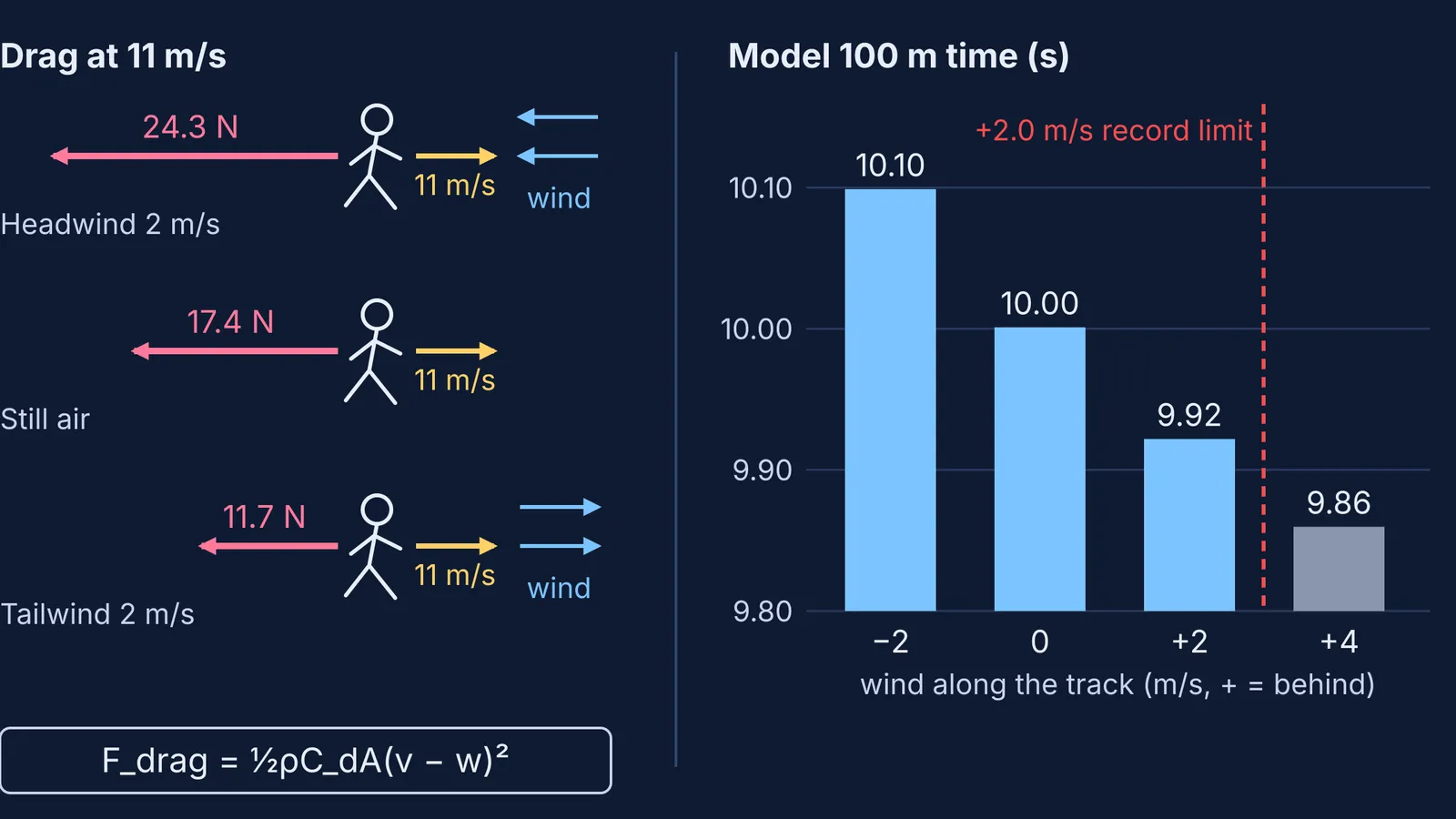
Drag at 11 m/s in still air. F = 0.144 × 11² = 17.4 N.
With a 2 m/s tailwind. The air speed past the body is 11 − 2 = 9 m/s, so F = 0.144 × 9² = 11.7 N, a drop of 5.8 N.
With a 2 m/s headwind. The air speed is 11 + 2 = 13 m/s, so F = 0.144 × 13² = 24.3 N, a rise of 6.9 N.
Add a driving force. A runner's forward push falls as they speed up. A simple model makes it fall in a straight line: F_push = F₀(1 − v/v_max). With F₀ = 500 N and v_max = 12.71 m/s, the model runs 100 m in 10.00 s in still air. Newton's second law gives m·dv/dt = F_push − F_drag.
Step through the race. A short python loop updates the speed and distance every 0.1 ms until the distance reaches 100 m. The results are 9.92 s with a 2 m/s tailwind, 10.10 s with a 2 m/s headwind, 9.86 s with 4 m/s behind and 10.22 s with 4 m/s in front.
Sanity check. In the model, top speed rises from 12.17 to 12.32 m/s with the tailwind, about 1.2%. If the whole race were 1.2% faster, it would save about 0.12 s. The real saving is smaller, 0.08 s, because during the first second or two the runner is slow and drag hardly matters.
So the model says a legal-limit tailwind is worth about 0.08 s. Real races agree in size. From competition results, Linthorne (1994) found that a 2 m/s following wind was worth 0.10 ± 0.01 s for men and 0.12 ± 0.02 s for women. At about 12 m/s, 0.1 s is a little over a metre at the finish line.
Why does a headwind cost more than a tailwind gives?
Expand the square. With a tailwind, drag falls by k(2vw − w²). With a headwind, it rises by k(2vw + w²). The w² term subtracts in one case and adds in the other, so the same wind costs more going against you than it gives going with you. In the numbers above, 6.9 N against 5.8 N, and 0.10 s against 0.08 s.
Linthorne saw the same pattern in real race data: the benefit grows more slowly as the tailwind gets stronger, so a headwind's disadvantage is larger than a tailwind's benefit of the same size. A different reason gives a similar result for a trip out and back, worked in why a round trip with wind takes longer.
Does thin air at altitude help sprinters as well?
Yes, because drag is proportional to ρ. At about 2.2 km above sea level the standard atmosphere gives a density near 0.98 kg/m³, about 18% less than 1.2 kg/m³. In the same model the still-air time falls from 10.00 s to 9.96 s, and with a 2 m/s tailwind as well, to 9.89 s.
Real data suggest a bigger altitude effect than this simple model. Analysing Olympic 100 m results, Linthorne (2016) found that an altitude of 1000 m gives about the same advantage as a 2 m/s assisting wind, about 0.10 s. The record rules quoted above limit the wind but set no altitude limit.
To see how a speed-squared force shapes a speed–time curve, try the Simulation Lab. The start, where drag barely matters, is covered in why sprinters use starting blocks.
What should you remember for exam questions?
Drag depends on speed relative to the air: F = ½ρC_dA(v − w)².
A 2 m/s tailwind cuts drag at 11 m/s from 17.4 N to 11.7 N; a 2 m/s headwind raises it to 24.3 N.
The square makes a headwind cost more than the same tailwind gives.
A simple model gives about 0.08 s per 2 m/s of tailwind over 100 m; race data give about 0.10 s for men.
Records need a following wind of 2.0 m/s or less, measured beside the straight over a fixed window.
Lower air density at altitude also reduces drag, and the record rules set no limit on it.


