

On this page
When the gun fires for a 100-metre sprint, the athletes don't just stand up and run. They explode out of crouched positions, pushing backward against angled metal pedals. Starting blocks are standard equipment in modern sprinting, but their purpose is pure physics. They exist to solve a mechanical problem: how to get a stationary human body moving forward as fast as possible.
The answer lies in Newton's third law, the concept of impulse, and the geometry of forces.
How do starting blocks use Newton's third law?
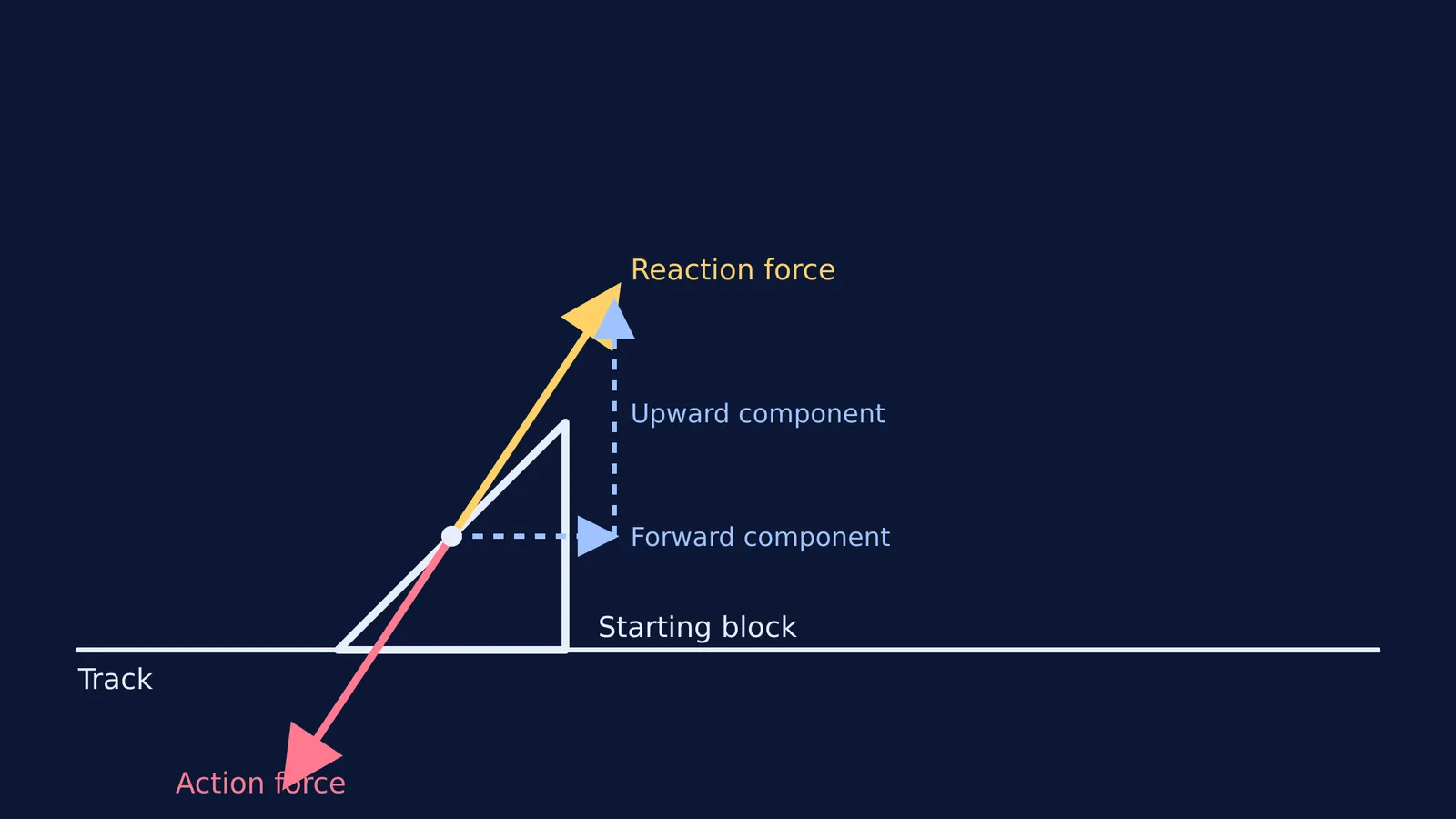
To move forward, a sprinter has to push backward. This is Newton's third law in action: for every action force, there is an equal and opposite reaction force.
When you run on flat ground, your foot pushes backward and downward against the track. The track pushes back upward and forward. However, if you push too hard horizontally on a flat track, your foot will simply slip. The friction between your spikes and the track has a limit.
Starting blocks solve this. They provide a solid, angled surface that cannot slip backwards. When the sprinter drives their feet into the blocks, the action force is met by a massive reaction force directed straight into the runner's body. Newton's second law with free-body diagrams tells us that this net forward force is what creates acceleration. The blocks essentially act as an extension of the Earth, allowing the runner to push horizontally with their full lower-body strength.
Why does the angle of the block matter?
You might think the fastest sprinters simply push the hardest. However, sports biomechanics research highlights how blocks change the orientation and duration of force.
A 2022 systematic review of sprint start biomechanics concluded that greater force production during the push-off, and greater propulsive forces after exiting the blocks, are main features of the best sprinters (PMID 35409757). Without blocks, a standing start forces a runner to push mostly downward to overcome gravity and lift their body. The blocks allow the sprinter to lean forward and push back. Instead of wasting energy jumping up, the reaction force drives them horizontally like a projectile motion on level ground.
Furthermore, higher performance levels are associated with greater average force production while pushing against the blocks (PMID 31209732). The review notes that generating force from the rear leg and the hip is particularly important for this performance.
How does impulse change the sprint start?
In physics, momentum is mass times velocity (p = mv). To change your momentum quickly, you need a large impulse (J = F × Δt). This means you either need to apply more force (F), or apply that force for a longer time (Δt).
Starting blocks increase both:
Force: Bracing against a rigid block allows the quadriceps and glutes to fire at maximum capacity without slipping.
Time: Because the runner is coiled and pushing against a stable surface, their feet stay in contact with the blocks for longer than a standing start would allow.
By maximising both F and Δt, the sprinter generates a massive change in momentum, launching them down the track with a higher initial velocity than they could ever achieve from a standing start. You can explore how these variables trade off in our Impulse and force-time graphs explainer.
How can you use this in your physics problems?
Exam questions often test these mechanics by asking you to find the exit velocity of a sprinter. Here is a framework for solving them:
Find the horizontal impulse: Multiply the average horizontal force by the time the runner spends pushing the blocks. (e.g., 800 N × 0.35 s = 280 N s).
Equate impulse to momentum change: J = m(v - u). Since the initial velocity u is zero, J = mv.
Solve for velocity: Divide the impulse by the runner's mass (e.g., 280 N s / 70 kg = 4.0 m/s).
If you want to play with the forces of a sprint start yourself, the Simulation Lab has interactive simulations for the ideas that are easier to see than to read. You can adjust the block angle, change the force vector, and watch how the reaction force alters the sprinter's exit velocity.


