

On this page
Fresh urine from a healthy person typically has a pH of around 6, according to a 2026 review of urine as a fertiliser in Frontiers in Soil Science. The same review links the typical odour of hydrolysed urine to ammonia escaping as gas. Leave urine standing in a urinal for a day or two and that sharp smell arrives. Nothing has been added: the urine's own urea has been taken apart.
What turns urea in urine into ammonia?
Your liver makes urea and the kidneys filter it into urine (see is urea made in the liver or the kidney). The change after that comes from microbes.
Microbial ureases hydrolyse urea to ammonia and carbon dioxide, and every urease contains tightly bound nickel that appears to take part in the reaction, as Harry Mobley and Robert Hausinger summarised in Microbiological Reviews.
Studying a urine-collecting system, Kai Udert and colleagues at the Swiss institute Eawag found that urease-active bacteria grow mainly in the pipes and are flushed into the collection tank, where only a few days were needed to use up all the urea (Water Research, 200300065-4)). With plenty of urease present, stored urine at 25 °C was fully hydrolysed in about 20 hours in a 2019 study (Journal of Environmental Management).
What is the balanced equation for urea breaking down?
Urease first splits urea and water into ammonia and carbamate, and the carbamate then falls apart on its own into a second ammonia and carbonic acid (urease, Wikipedia). Add the steps and the overall reaction is:
CO(NH₂)₂ + H₂O → CO₂ + 2NH₃
Check it atom by atom:
Carbon: 1 on the left (urea), 1 on the right (CO₂).
Nitrogen: 2 on the left, 2 on the right (2NH₃).
Hydrogen: 4 in urea + 2 in water = 6; 2 × 3 in ammonia = 6.
Oxygen: 1 in urea + 1 in water = 2; 2 in CO₂.
The ammonia then reacts with water as a weak base: NH₃ + H₂O ⇌ NH₄⁺ + OH⁻. Those hydroxide ions push the pH up. In a study of stale urine, the final pH was around 9.0 after hydrolysis (Liu et al., Journal of Environmental Sciences, 200862202-0)).
Why does stale urine smell of ammonia but fresh urine does not?
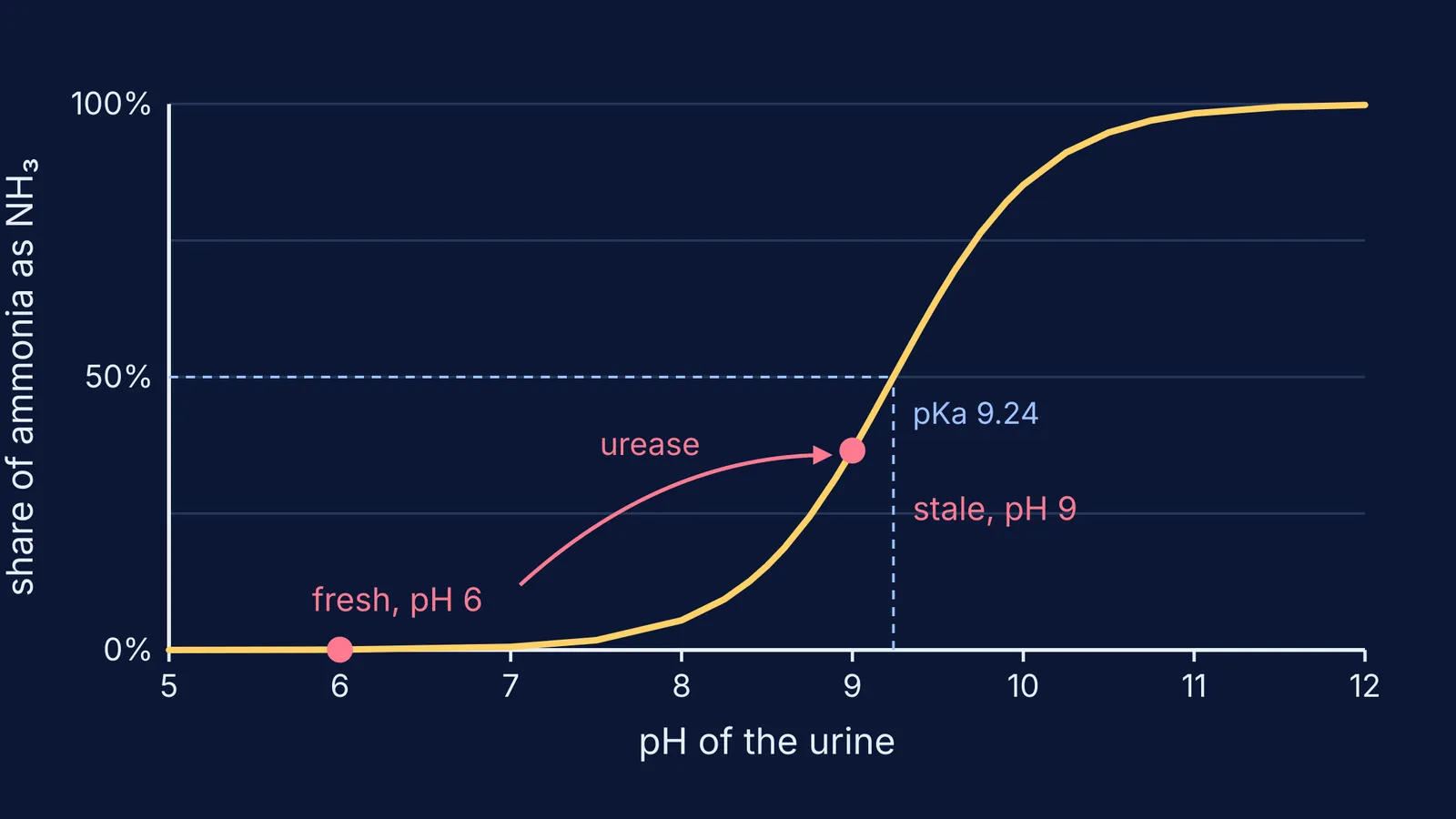
Your nose detects NH₃ gas, not dissolved NH₄⁺ ions, and pH decides which form wins. The pKa of ammonium is 9.24 (McKinley et al., Applied and Environmental Microbiology, 2012), and the Henderson–Hasselbalch equation gives the share present as NH₃:
share of NH₃ = 1 ÷ (1 + 10^(pKa − pH))
Fresh urine, pH 6: 1 ÷ (1 + 10^3.24) ≈ 0.06%.
Stale urine, pH 9: 1 ÷ (1 + 10^0.24) ≈ 36%.
That share is more than 600 times larger, and there is plenty to share: fully hydrolysed urine in the 2019 study held 9.0 to 11.6 g of ammonia nitrogen per litre (Tao et al.). The ammonia raises the very pH that lets it escape.
If the curve from pH 6 to pH 9 is hard to picture, the Fermi Simulation Lab has interactive simulations for ideas that are easier to see than to read.
Why do public toilets smell worse in hot weather?
Three effects stack up on a hot afternoon.
Urea breaks down faster. Liu and colleagues found that at 20 °C or more, with stale urine making up more than 10% of the mix, urea hydrolysis could be completed in two days (Journal of Environmental Sciences62202-0)). Enzyme rates rise with warmth up to an optimum, as we show in how to read the enzyme activity vs temperature graph.
Warm water holds less ammonia. The NIST Chemistry WebBook lists a temperature coefficient of about 4,100 K for ammonia's Henry's law constant. Worked example: from 25 °C to 40 °C the constant falls by a factor of e^(−4100 × (1/298 − 1/313)) ≈ 0.52, so at the same dissolved NH₃ the water pushes roughly twice as much into the air.
More of the ammonia is in the NH₃ form. The share of un-ionised ammonia depends strongly on both pH and temperature, as Emerson and colleagues showed in their classic 1975 evaluation.
In a crowded, rarely flushed toilet in an Indian May, all three point the same way.
How do you stop a toilet smelling of ammonia?
The chemistry gives you a checklist:
Flush or rinse soon. Urea removed before urease reaches it never becomes ammonia.
Clean the pipes, where Udert's team found the urease-active bacteria mainly grow (Water Research00065-4)).
Use an acidic flush. Tao's team found acetic acid dosed at 0.05 to 0.07 N could flush urine-diverting toilets and urinals for hygiene and to prevent scaling (Journal of Environmental Management); low pH keeps ammonia as odourless NH₄⁺.
Ventilate, especially in summer.
The same urease reaction runs in farm soil after urea fertiliser goes on; see why urea makes soil acidic. To revise enzymes, equilibrium and pKa as connected ideas, the Fermi Concept Library gives every concept in chemistry and biology its own lesson and its place in the map.


