

On this page
Many Class 11 students say urea is made in the kidney. It sounds right, because urea ends up in urine. But it is wrong, and it costs marks in board exams and NEET-UG assertion-reason questions.
The short version: the liver makes urea, the blood carries it, and the kidneys remove it.
Where is urea formed in the human body?
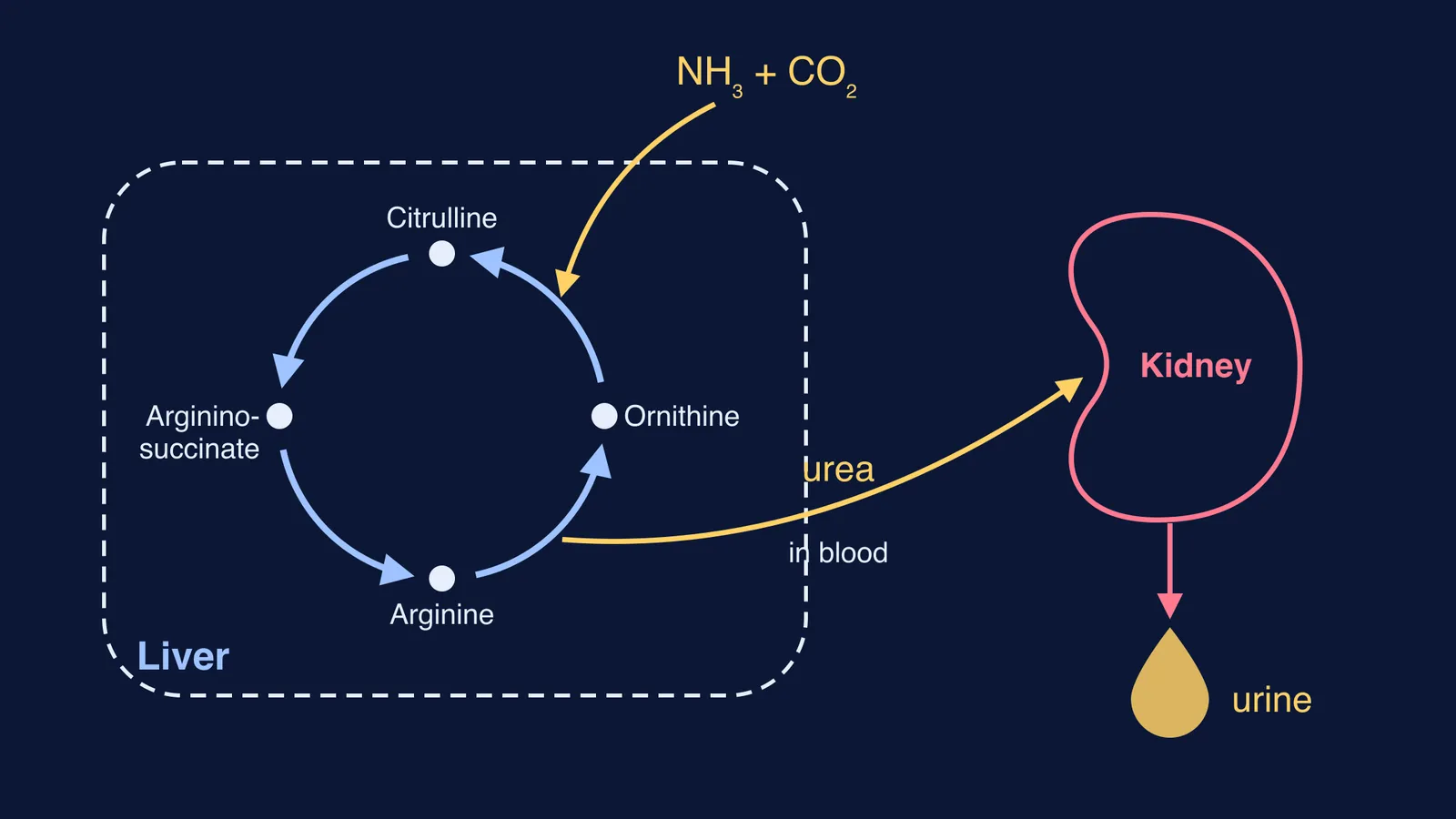
Urea is formed in the liver. The NCERT Class 11 Biology chapter Excretory Products and their Elimination states that in ureotelic animals, ammonia produced by metabolism "is converted into urea in the liver of these animals and released into the blood which is filtered and excreted out by the kidneys". Learn that sentence word for word.
The same chapter explains why the body bothers. Ammonia is the most toxic nitrogenous waste and needs a large amount of water to remove, so land animals such as mammals convert it to the less toxic urea (NCERT, Chapter 16). If you want the full comparison with fish and birds, our post on ammonotelic, ureotelic and uricotelic animals walks through it.
What happens in the ornithine cycle?
The ornithine cycle is also called the urea cycle or the Krebs-Henseleit cycle. Hans Krebs and Kurt Henseleit described it in a 1932 paper, "Untersuchungen über die Harnstoffbildung im Tierkörper" ("Studies on urea formation in the animal body"). The story of how they worked it out is in our piece on Hans Krebs and the urea cycle.
A 2021 review of the enzyme ornithine transcarbamylase by Couchet and colleagues in Frontiers in Physiology describes where each step happens:
The complete cycle runs in periportal hepatocytes, the liver cells around the vessels where blood enters each lobule.
Two enzymes work inside the mitochondria: carbamoyl phosphate synthetase 1 (CPS1), which joins ammonia and bicarbonate into carbamoyl phosphate using 2 ATP, and ornithine transcarbamylase (OTC), which adds that to ornithine to make citrulline.
Three enzymes work in the cytosol: argininosuccinate synthase, argininosuccinate lyase and arginase 1.
Arginase splits arginine into urea and ornithine, so ornithine is ready to go round again. That is why it is called a cycle.
The same review notes that OTC is also found in the intestine, but there it makes citrulline for export rather than running the full cycle. So when an exam asks for the site of urea formation, the answer is the liver.
So what does the kidney do with urea?
The kidney removes urea from the blood. In the nephron, the glomerulus filters blood, and NCERT says 1100-1200 ml of blood is filtered by the kidneys per minute (NCERT, Chapter 16). Urea passes into the filtrate and leaves in urine.
The kidney does use urea, which is where much of the confusion starts. NCERT says some urea may be retained in the kidney matrix to maintain osmolarity, and that electrolytes and urea are held in the medullary interstitium by the counter-current mechanism (NCERT, Chapter 16). Using urea to concentrate urine is not the same as making it.
An adult excretes on average 1 to 1.5 litres of urine and 25-30 g of urea a day (NCERT, Chapter 16); our post on daily urine and urea output has more on these figures.
A flow chart from ammonia to urine
One line per step for your notes:
Amino acids are broken down in cells, releasing ammonia (toxic).
Liver, mitochondria: ammonia and bicarbonate become carbamoyl phosphate (CPS1), which joins ornithine to give citrulline (OTC).
Liver, cytosol: citrulline becomes argininosuccinate, then arginine.
Liver, cytosol: arginase splits arginine into urea and ornithine. Ornithine goes back to step 2.
Urea enters the blood.
Kidney: the glomerulus filters urea into the nephron.
Urea leaves the body in urine.
Steps 2 to 4 are the making. Steps 6 and 7 are the removing. If an answer puts any of steps 2 to 4 in the kidney, it is wrong.
How do exam questions try to trick you?
A typical assertion-reason item:
Assertion: Urea is synthesised in the kidney. Reason: Urea is the main nitrogenous waste in human urine.
The reason is true, but the assertion is false, because urea is made in the liver and only excreted by the kidney. Watch for two other traps:
"Patients with kidney failure stop making urea." False. NCERT describes uremia as urea building up in the blood when the kidneys malfunction (NCERT, Chapter 16). The liver keeps making it; it is the removal that fails.
"Ornithine is used up in the cycle." False. It is regenerated each turn.
If the cycle still feels like a list of names, look up each idea on its own. The Fermi Concept Library covers every concept in physics, chemistry, biology, mathematics and computing, each with its own lesson and its place in the map. For practice questions, the Fermi Problem Library has worked problems with a step-by-step solver that explains the reasoning rather than printing an answer.


