

On this page
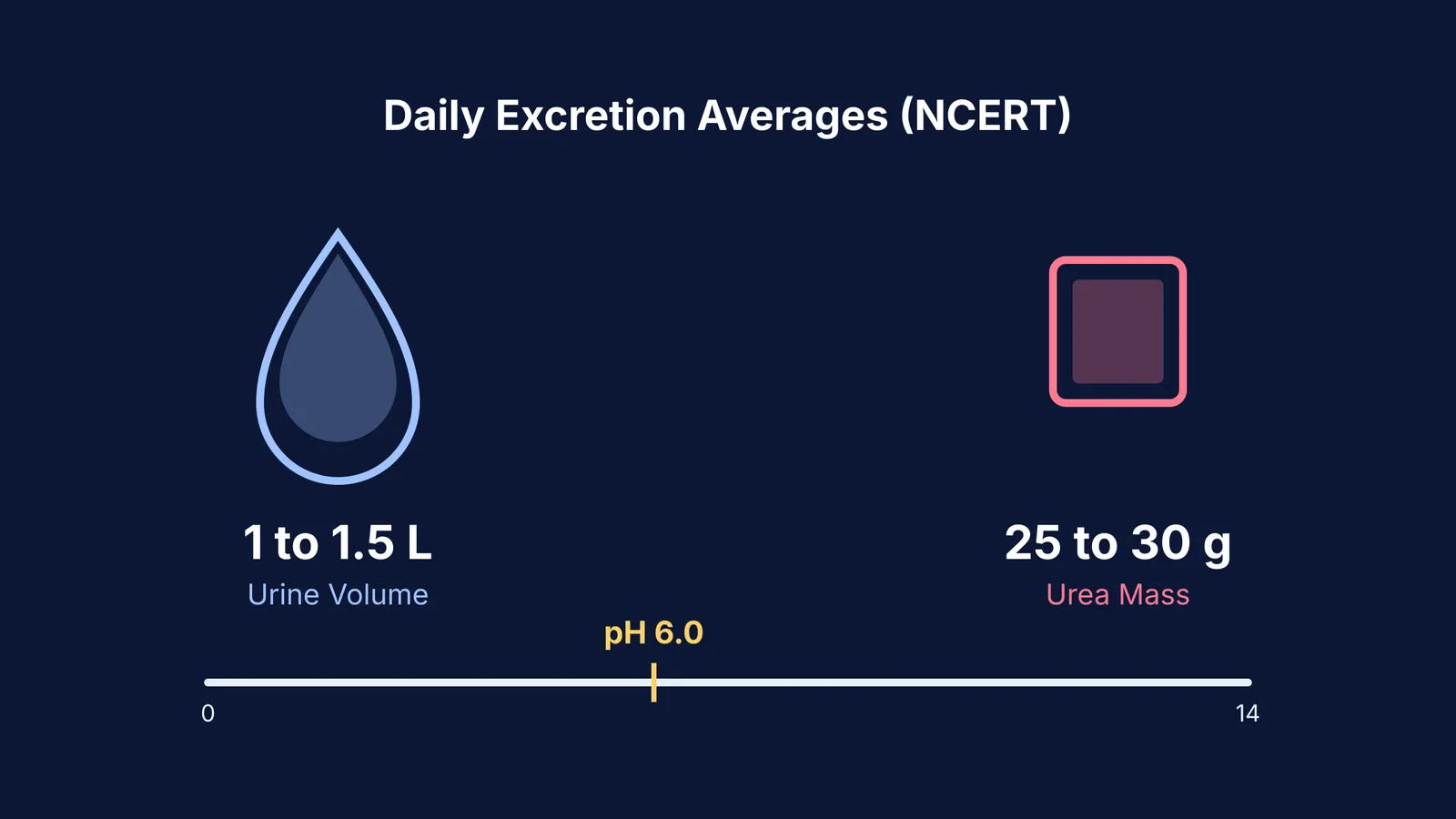
An adult human excretes on an average 1 to 1.5 litres of urine per day, according to the NCERT biology textbook. Within this daily volume, about 25 to 30 gm of urea is excreted out per day. Normal urine is a light yellow fluid with an average pH of 6.0, though diet and hydration can shift these values.
These textbook averages are benchmarks for healthy kidney function. They show up frequently in exams like NEET, but they are also useful numbers to know for your own health.
How much urine and urea is excreted per day NCERT?
The human excretory system filters blood to remove nitrogenous waste and maintain water balance. According to the NCERT biology textbook, an adult human excretes, on an average, 1 to 1.5 litres of urine per day. The exact volume depends on fluid intake, ambient temperature, and physical activity. To see how this volume is controlled by the body's hormones, read about regulating kidney function: ADH, the RAAS and ANF explained.
Alongside water, the kidneys remove metabolic waste. NCERT states that on an average, 25 to 30 gm of urea is excreted out per day. Urea is produced in the liver from the breakdown of proteins. The liver converts highly toxic ammonia into less toxic urea through a series of reactions called the urea cycle (or ornithine cycle). This urea is then safely transported by the blood to the kidneys, where it is filtered into the urine.
NCERT also points out the clinical significance of this fluid. A routine analysis of urine helps in the clinical diagnosis of many metabolic disorders. For example, the presence of glucose (glycosuria) and the presence of ketone bodies (ketonuria) in the urine are both indicative of diabetes mellitus, as the kidneys attempt to clear excess sugars and metabolic byproducts from the blood.
If these facts from human physiology feel disconnected, the Fermi Concept Library connects the anatomy of the nephron to the chemistry of its output. You can also explore the history of how we understand this anatomy by reading about Jacob Henle and the loop that concentrates urine.
Why does urine colour vary?
While NCERT describes normal urine as a light yellow coloured watery fluid, the exact shade can change rapidly throughout the day.
According to the Mayo Clinic, the most common reason for color change is hydration. Clear urine indicates high fluid intake, while a stronger yellow or orange colour points to dehydration as the pigments become more concentrated.
Diet and medications also play a large role in altering this appearance:
Red or pink: Eating foods like beets, blackberries, or rhubarb can tint urine pink, as can some medications.
Dark brown: Rhubarb or certain medications like chloroquine and metronidazole can cause this colour.
Orange or yellow-orange: Dehydration can cause this, but so can vitamin B-12 and certain medications like sulfasalazine.
What affects urine pH?
Urine pH measures how acidic or alkaline the fluid is. The NCERT benchmark is a slightly acidic pH of 6.0. However, the normal range in healthy individuals actually spans from 4.6 to 8.0, according to MedlinePlus.
The kidneys help regulate the body's acid-base balance by excreting excess acid or base. MedlinePlus notes that everyday diet choices push the pH up or down:
More acidic: A diet high in meat products, fish, or cheese tends to lower the pH, making the urine more acidic.
More alkaline: Conversely, a diet rich in fruits, vegetables, and non-cheese dairy products can raise the pH, making it more alkaline.
You can see how concentration gradients and selective secretion act on the filtrate to control these values by running the interactive models in the Fermi Simulation Lab.
A practical checklist: observing hydration and health
You do not need to measure your urine output with a beaker to know if your kidneys are functioning well. You can use this simple framework to monitor your hydration during study sessions or sports:
Check the colour first: Aim for pale yellow. If it is completely clear, you might be drinking more water than necessary. If it is orange or dark yellow, you need to drink a glass of water soon.
Note the frequency: Excreting 1 to 1.5 litres of urine a day generally means urinating every few hours.
Consider what you ate: Before worrying about a sudden colour change, ask yourself if you recently had beets, berries, or a B-vitamin supplement.
Keep water visible: When studying for exams, keep a water bottle on your desk. Small, frequent sips are better for continuous hydration than waiting until you are very thirsty and drinking a litre at once.
Understanding the baseline numbers helps you appreciate the continuous work your kidneys perform to keep your internal environment stable, a process that determines whether an organism is among the ammonotelic, ureotelic and uricotelic animals.


