On this page
In 1932, at the Medical Clinic of the University of Freiburg in Germany, the physician Hans Krebs and his research student Kurt Henseleit worked out how the liver gets rid of ammonia (Hans Krebs, Wikipedia)). Their full paper, "Untersuchungen über die Harnstoffbildung im Tierkörper" (investigations on urea formation in the animal body), appeared in Hoppe-Seyler's Zeitschrift für physiologische Chemie, volume 210, pages 33 to 66 (Crossref record).
What does NCERT Class 11 say about urea and the liver?
Chapter 16 of the NCERT Class 11 Biology book, Excretory Products and their Elimination, says ammonia is the most toxic nitrogenous waste and needs a large amount of water to remove (NCERT Chapter 16). Mammals are ureotelic, and the same page says: "Ammonia produced by metabolism is converted into urea in the liver of these animals and released into the blood which is filtered and excreted out by the kidneys."
That tells you where urea is made, not how. For why mammals make urea at all, compare ammonotelic, ureotelic and uricotelic animals.
How did Krebs and Henseleit discover the urea cycle?
From 1926 Krebs had worked for four years as a research assistant to Otto Warburg in Berlin. In Freiburg he used a Warburg manometer on thin slices of liver, mixing them with substances such as ornithine and citrulline to see which raised urea output (Hans Krebs, Wikipedia)).
A 2024 history review in the Journal of Inherited Metabolic Disease lists what the 1932 papers found (Häberle, Siri and Dionisi-Vici, 2024):
Making urea from ammonia needed intact cells; ground-up cells could not do it.
Ornithine increased urea production twofold to fourfold, but was not consumed.
In mammals, the liver was the only organ able to make urea.
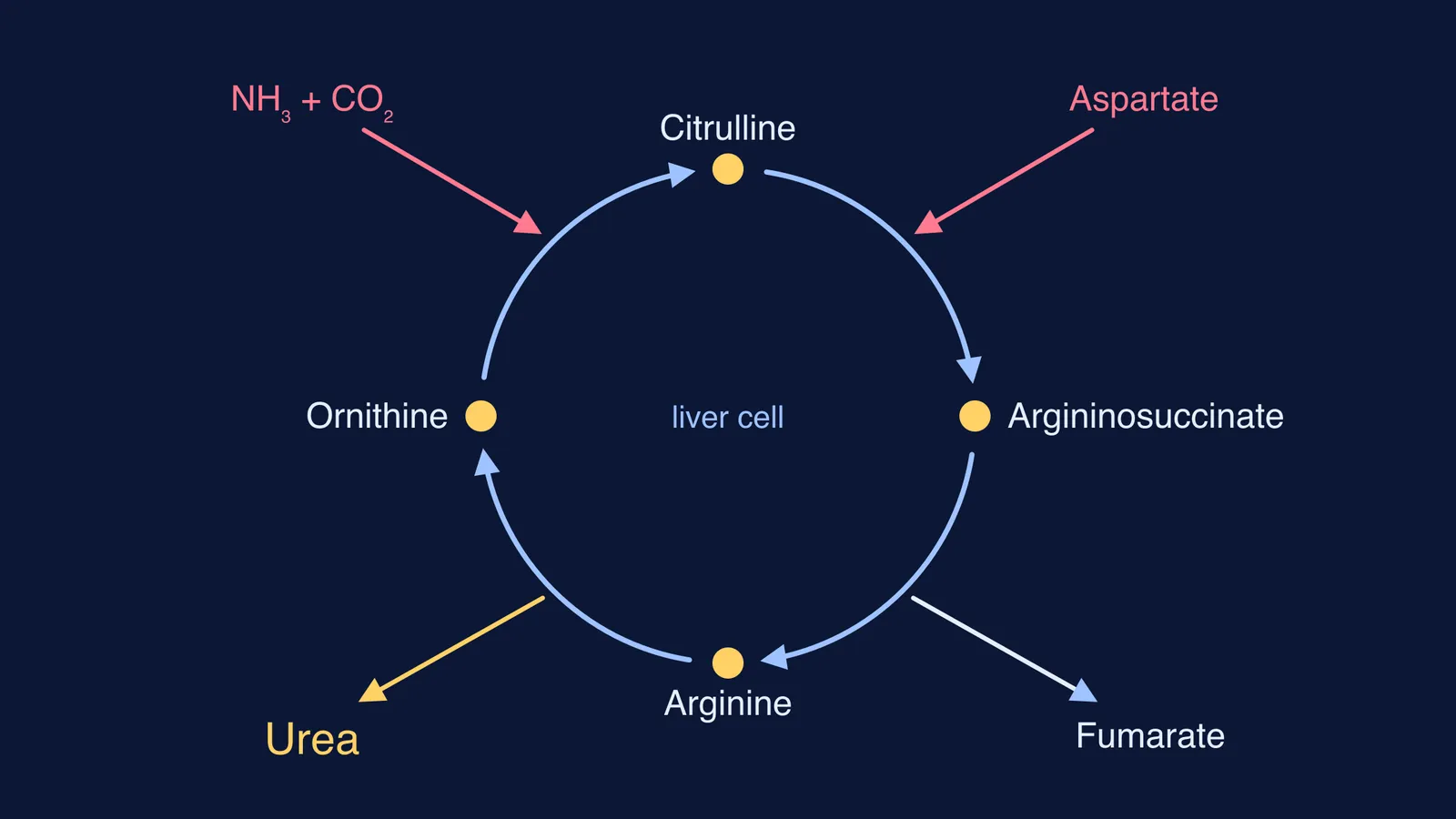
The second finding was the puzzle: ornithine behaved like a catalyst, yet it is a simple amino acid, not an enzyme. Their answer was a loop: ornithine picks up carbon and nitrogen, becomes citrulline and then arginine, and the enzyme arginase splits arginine into urea and ornithine again. Citrulline also acted as a catalyst, which fitted the idea that it sits inside the loop (Hans Krebs, Wikipedia)).
The complete laboratory notebooks of both men survive (Max Planck Institute for the History of Science). The urea cycle was the first metabolic cycle to be discovered, five years before the citric acid cycle (Urea cycle, Wikipedia).
What happens in each step of the urea cycle?
Today the cycle is written as five enzyme steps; the first two happen in the mitochondria and the last three in the cytosol (Urea cycle, Wikipedia).
Ammonia and bicarbonate join to form carbamoyl phosphate, using 2 ATP (carbamoyl phosphate synthetase I).
Carbamoyl phosphate joins ornithine to make citrulline (ornithine transcarbamylase).
Citrulline joins aspartate to make argininosuccinate, using 1 ATP (argininosuccinate synthetase).
Argininosuccinate splits into arginine and fumarate (argininosuccinate lyase).
Arginine reacts with water to give urea and ornithine (arginase).
The overall reaction is 2 NH3 + CO2 + 3 ATP + 3 H2O giving urea + 2 ADP + AMP + 4 Pi (Urea cycle, Wikipedia).
Worked example: where does each atom of urea come from?
Urea is CO(NH2)2. Track its atoms through the five steps above.
First nitrogen: from ammonia, in step 1.
Carbon: from bicarbonate (dissolved CO2), in step 1.
Second nitrogen: from aspartate, in step 3; the rest of aspartate leaves as fumarate in step 4.
Ornithine: enters in step 2 and comes back in step 5, so none of its atoms end up in urea.
That last line solves the 1932 puzzle: ornithine gives no atoms to urea, so a little of it keeps the loop turning. Urea is also a compact way to carry nitrogen: 28 g of nitrogen in 60 g of urea, about 46.7% by mass, worked through in our post on nitrogen percentage in urea and ammonium sulphate.
How do you remember the urea cycle for exams?
Draw a ring with four names in order: ornithine, citrulline, argininosuccinate, arginine. A memory hook: Our Cat Always Arrives, with the long A (argininosuccinate) before the short A (arginine).
Add what goes in: ammonia and CO2 before citrulline, aspartate before argininosuccinate.
Add what comes out: fumarate after argininosuccinate, urea after arginine.
Shade the first two steps as mitochondria and the rest as cytosol.
Underneath, write: liver makes urea, blood carries it, kidneys filter it.
If a step still feels like a list of words, the Fermi Concept Library gives every concept in biology and chemistry its own lesson and its place in the map, so you see how the cycle links excretion to amino acids.
What did Krebs do after the urea cycle?
Dismissed from his post in April 1933, Krebs moved to Cambridge, then Sheffield, where in 1937 he and William Arthur Johnson worked out the citric acid cycle. He received the 1953 Nobel Prize in Physiology or Medicine for that second cycle (Hans Krebs, Wikipedia)). Read that story in Hans Krebs and the citric acid cycle.
If the two cycles blur together, Fermi's AI tutor can work out what you already know and build a plan for the session.