

On this page
A sponge spends its adult life stuck to one rock, with no head, no legs and often no regular shape. So why do biologists put it in the animal kingdom? The answer lies in its cells, its feeding and how it starts life, not in how it looks.
Why are sponges animals and not plants?
The NCERT Class 11 chapter on biological classification explains that R.H. Whittaker's 1969 five-kingdom system uses cell structure, body organisation, mode of nutrition, reproduction and evolutionary relationships. In the same chapter, Table 2.1 lists Plantae as having a cellulose cell wall and autotrophic, photosynthetic nutrition, and Animalia as having no cell wall and heterotrophic, holozoic nutrition.
Check a sponge against the cell wall and nutrition rows and it matches Animalia, not Plantae. It only misses on body organisation: sponges stay at a cellular level, without the tissues and organs the table gives animals.
What are the five clues that a sponge is an animal?
No cell walls. Plant cells sit inside a cellulose wall. Sponge cells do not have one. The firmness you feel in a sponge comes from a skeleton of spicules or spongin fibres, which the NCERT Animal Kingdom chapter describes under Phylum Porifera.
No chlorophyll, no photosynthesis. A plant makes its own food from light. A sponge cannot, so it has to take in food made by other organisms. That makes it heterotrophic, like every other animal in NCERT's Table 2.1.
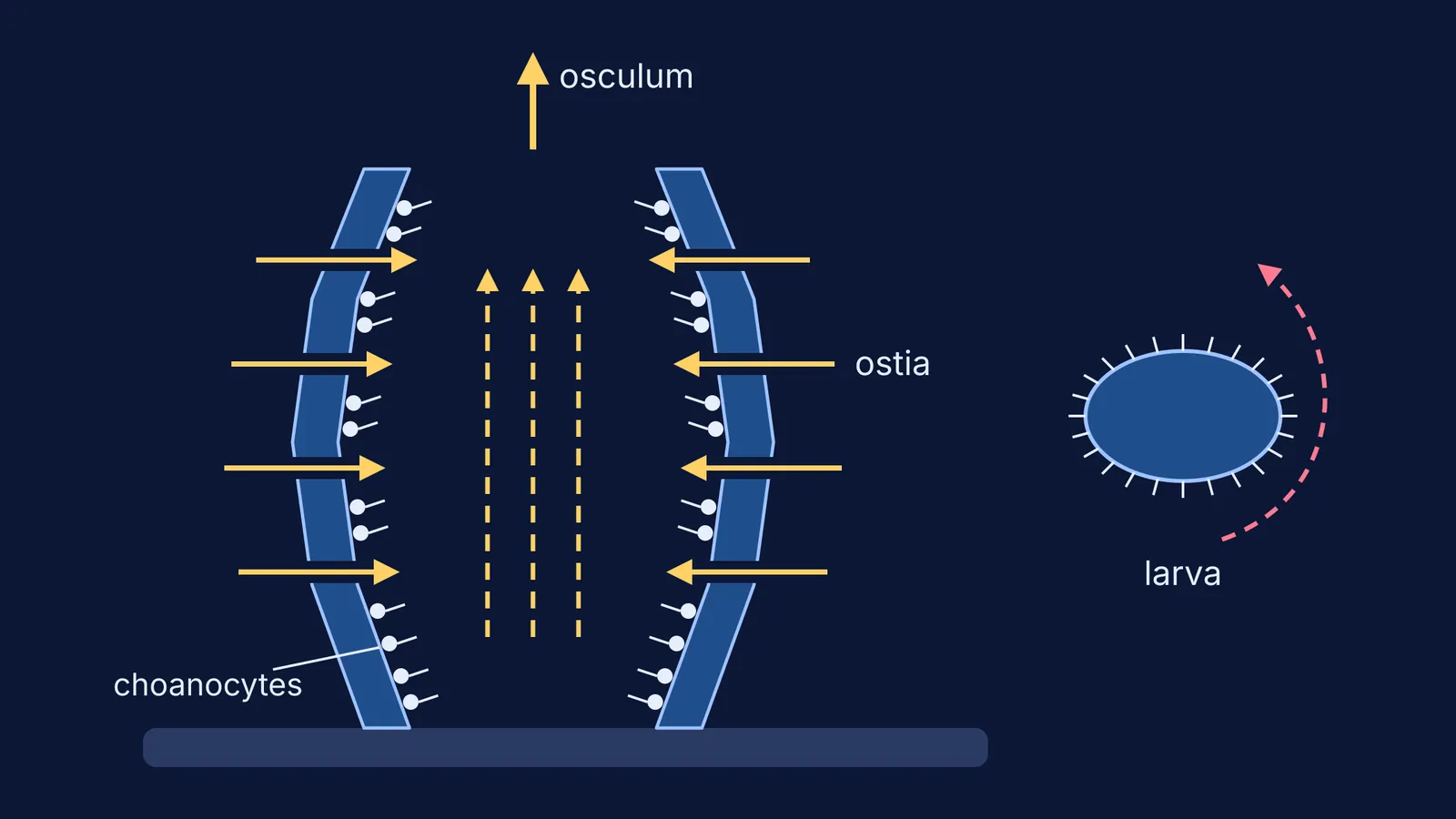
Holozoic feeding. Water enters through tiny pores called ostia, flows into a central cavity called the spongocoel and leaves through the osculum. Collar cells called choanocytes line the cavity and canals, and digestion is intracellular, according to the NCERT Porifera section. A 2004 paper in Invertebrate Biology by Manuel Maldonado notes that some sponges have even swapped filter feeding for carnivory.
A swimming larva. Sponges reproduce sexually, with eggs and sperm, and their development includes a larval stage that looks different from the adult (NCERT). In a 2025 study of two calcareous sponges, Emilio Lanna and Michelle Klautau watched newly released larvae swim towards the water surface (each larva has a layer of ciliated cells at its front end) before settling, turning into juveniles and attaching to the substrate.
Animal genes. The draft genome of the reef sponge *Amphimedon queenslandica*, published in Nature in 2010, was “remarkably similar to other animal genomes in content, structure and organization” (Srivastava et al., 2010). The same paper says sponges split from other animals over 600 million years ago.
The source for that callout is a review of cyanobacterial symbionts in sponges by Kayley Usher (2008), which says these associations are common in all areas of the world.
Why do sponges look like plants, then?
Adult sponges are sessile, meaning they stay fixed in one place. The NCERT Porifera section describes them as mostly asymmetrical, with a cellular level of organisation: their cells form loose groups rather than true tissues or organs.
But staying in one place is a lifestyle, not a kingdom. NCERT gives the sea anemone *Adamsia* as an example of the sessile polyp form, yet still lists it as an animal under Cnidaria. The sea lily is another animal that fools students; see our post on why Antedon, the sea lily, is an animal.
How do you answer “plant or animal?” in an exam?
Use this four-question test on any confusing organism.
Do its cells have a cell wall? Cellulose wall points to plant; no wall points to animal.
Does it make its own food by photosynthesis? Yes points to plant; no points to animal.
How does it get food? Taking in food and digesting it (holozoic) points to animal.
Does any stage of its life move on its own? A swimming larva is a strong animal clue.
Worked example: a 3-mark answer. “Sponges are animals, though they are sessile. (1) Their cells lack cell walls, unlike plant cells, which have cellulose walls. (2) They cannot photosynthesise; they are heterotrophic and holozoic, drawing water in through ostia past a lining of choanocytes, with intracellular digestion. (3) Their development is indirect, with a free-swimming larva that settles and grows into the adult.”
Pair every plant-like feature with the animal fact that beats it; the contrast is what convinces an examiner.
What should you revise next?
Revise how the Porifera canal system moves water next. Then learn how skeletons split sponges into calcareous, siliceous and horny sponges.
If terms like holozoic, cellular level of organisation or indirect development still feel shaky, the Fermi Concept Library has a lesson for every concept in biology, each placed in a map so you can see what it connects to. When you would rather test yourself, the Fermi Problem Library has worked problems with a step-by-step solver that explains the reasoning rather than printing an answer.


