

On this page
Picture a pink, feathery thing on a rock under the sea, arms open like petals. Its common name is "sea lily". That name is exactly why it shows up in biology MCQs: the examiner is betting you will judge by the name and the shape. Here is why Antedon belongs in the animal kingdom, and a four-question test you can use on any organism that looks like a plant.
Is Antedon a plant or an animal?
Antedon is an animal. NCERT's Class 11 Biology chapter Animal Kingdom, section 4.2.9, lists "Antedon (Sea lily)" as an example of Phylum Echinodermata, alongside Asterias (star fish), Echinus (sea urchin), Cucumaria (sea cucumber) and Ophiura (brittle star).
The World Register of Marine Species gives its full classification: kingdom Animalia, phylum Echinodermata, class Crinoidea, order Comatulida, family Antedonidae.
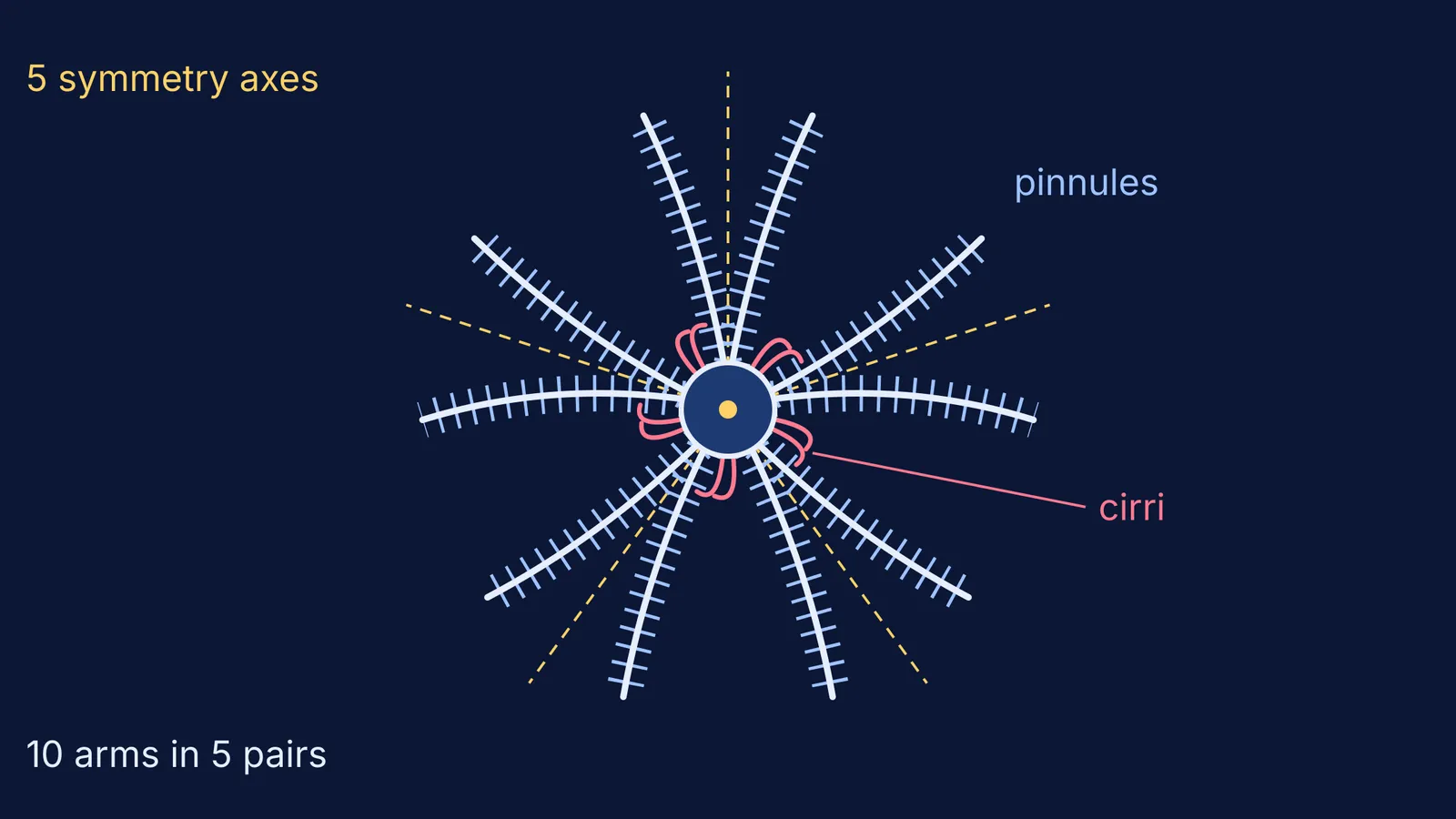
The flower look comes from how it eats. All crinoids are suspension feeders that hold their feathery arms out to catch food particles drifting in the water. The rosy feather star, Antedon bifida, has five pairs of feathery arms 5-10 cm long and feeds on detritus and plankton, according to the Marine Life Information Network. A plant makes its own food by photosynthesis. Antedon catches its food, which is what animals do.
Is Antedon a sea lily or a feather star?
Both names are used, and the difference is the stalk. Crinoids with a stalk are called sea lilies, while feather stars have lost the stalk as adults, though it is still present in their larval stages, as the Digital Atlas of Ancient Life explains. The same source counts more than 660 living crinoid species.
Antedon is a feather star. Instead of a stalk, it has up to about 25 claw-like cirri under its central disc to hold on, and it can crawl or swim short distances by moving its arms up and down, as MarLIN describes. Sea lilies, by contrast, are attached to the sea floor by a flexible stalk.
What four features make an animal an echinoderm?
NCERT's Animal Kingdom chapter gives the features. Four of them do most of the work in MCQs:
A spiny endoskeleton of calcareous ossicles. This is where the name Echinodermata, "spiny bodied", comes from.
A water vascular system. NCERT calls it the most distinctive feature of echinoderms; it helps in locomotion, capture and transport of food, and respiration. In crinoids, each arm has a groove containing tube feet, according to the University of Hawaii's Exploring Our Fluid Earth.
Radial adults, bilateral larvae. Adult echinoderms are radially symmetrical, but their larvae are bilaterally symmetrical. In the rosy feather star, the ten arms sit in five pairs around the disc, as MarLIN describes.
Marine, triploblastic and coelomate. All echinoderms live in the sea, have three germ layers and a true coelom, with organ-system level of organisation.
NCERT adds supporting points that make good statement-type questions: there is no excretory system, sexes are separate, fertilisation is usually external, and development is indirect with a free-swimming larva. For more on feature 2, read our explainer on how the echinoderm water vascular system powers tube feet. The same four features explain why a starfish is not a fish.
How do you answer an "is it a plant" MCQ?
Use this four-question test whenever a name or shape suggests a plant:
How does it get food? Photosynthesis points to a plant or alga. Catching or eating food points to an animal.
Does it move at any stage? A swimming larva, or an adult that crawls or swims, is a strong animal clue.
What is its skeleton made of? Calcareous ossicles mean echinoderm; plant cells have cell walls instead.
Is there a phylum-specific organ? Tube feet and a water vascular system mean echinoderm; stinging cnidoblasts mean cnidarian.
Here is a worked example. *Which one of these is an echinoderm: Adamsia (sea anemone), Pennatula (sea-pen), Gorgonia (sea-fan) or Antedon (sea lily)?*
Every option has a name that sounds like a plant or an object, and every option is an animal. NCERT's section 4.2.2 lists Adamsia, Pennatula and Gorgonia as Coelenterata (Cnidaria): diploblastic, with cnidoblasts. Only Antedon is triploblastic and coelomate, with a water vascular system and an endoskeleton of calcareous ossicles, so the answer is Antedon.
The same trick appears in reverse with single-celled organisms; see why Euglena is a protist, not a plant or an animal.
How to make this stick before the exam
Make a three-column list from the NCERT examples: name as printed, phylum, and one deciding feature. Then cover the last two columns and test yourself. If the deciding features blur together, the Fermi Concept Library has a lesson for each concept in biology, each with its place in the map. When you want practice, the Fermi Problem Library has worked problems with a step-by-step solver that explains the reasoning rather than printing an answer.


