On this page
Euglena is the classic trick question in Class 11 biology. It is green and photosynthesises, yet it also swims and eats. Once you can explain where it belongs, you understand how the five-kingdom system sorts any organism.
Is Euglena a plant or an animal?
Neither. Euglena is a unicellular eukaryote, and the NCERT Class 11 Biology chapter on biological classification places all single-celled eukaryotes in Kingdom Protista, with euglenoids listed as one of its groups and Euglena as the example.
The same chapter admits the line is blurry: "What may be 'a photosynthetic protistan' to one biologist may be 'a plant' to another." Kingdoms are human categories built on chosen criteria, and Euglena sits on a boundary.
Here is how its traits sort out, using NCERT's descriptions:
Plant-like: it photosynthesises in sunlight, and its pigments are identical to those in higher plants.
Animal-like: it has no cell wall, it moves with flagella, and it can take in food from outside.
Protist-like: it is a single eukaryotic cell, lives mostly in fresh water, and uses a pellicle instead of a wall.
What does Euglena do in light and in the dark?
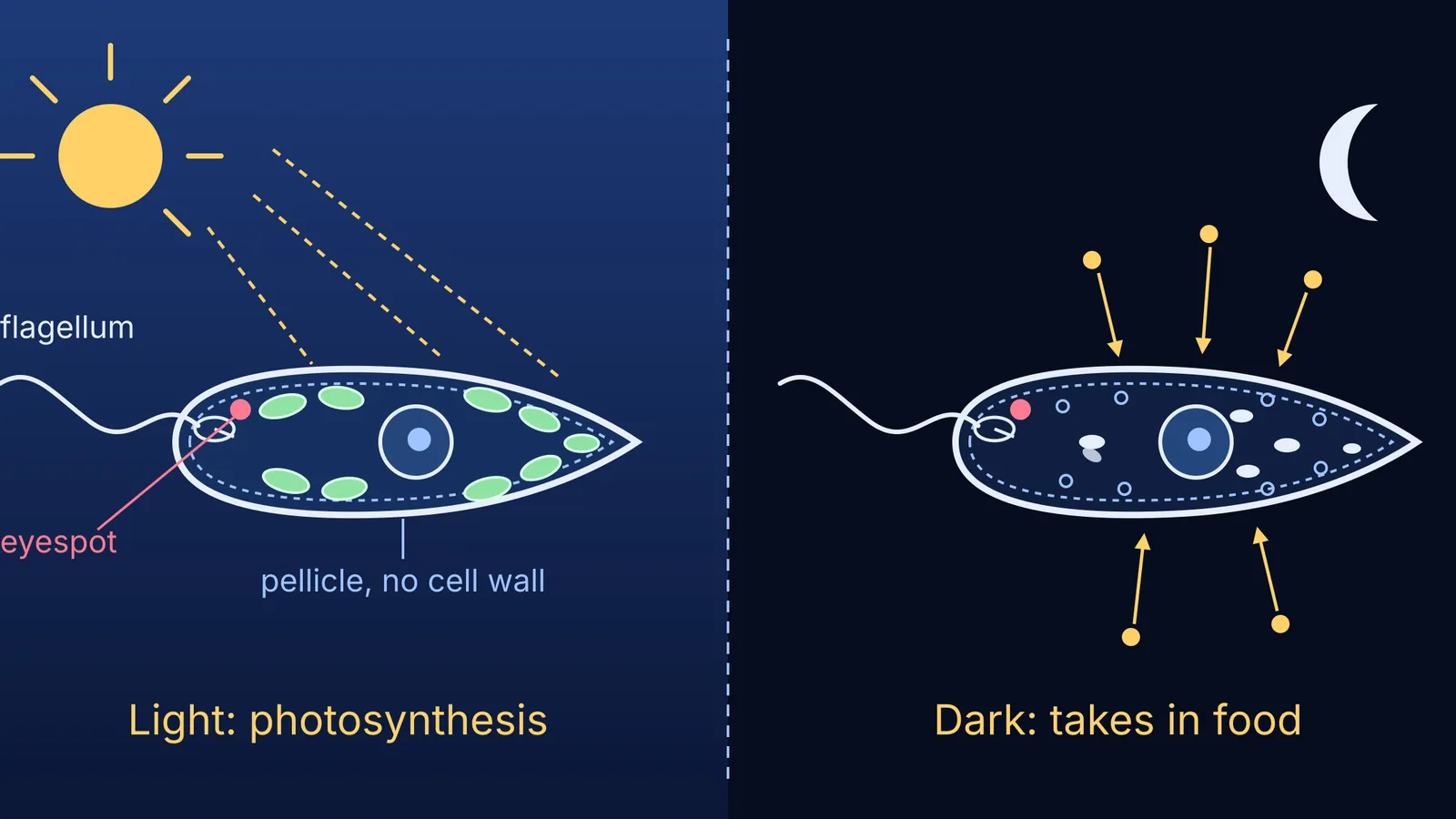
This is the heart of the question. NCERT states that euglenoids are photosynthetic in the presence of sunlight, but when deprived of sunlight they behave like heterotrophs by preying on smaller organisms (NCERT, section 2.2.3).
An organism that can feed both ways is called a mixotroph. A 2019 review in Metabolites puts it plainly: "Euglena can harness energy heterotrophically, mixotrophically, and photo-autotrophically" (Inwongwan and colleagues, 2019).
Lab studies show how far the switch goes. In Euglena gracilis kept in the dark, the cells hold only undeveloped proplastids, which mature into chloroplasts after 3 days of light exposure, and the cells store a carbohydrate called paramylon in the dark (Chen and colleagues, Frontiers in Bioengineering and Biotechnology, 2022). The same paper describes bleached mutants that lose most of their chloroplast genome yet keep growing heterotrophically.
The Metabolites review explains why that is possible: other than photosynthesis, all the major pathways present in Euglena's chloroplast are also present elsewhere in the cell. The authors note that Euglena is one of the very few plastid-containing organisms for which losing the chloroplast completely is not lethal (Inwongwan and colleagues, 2019).
If the difference between these two feeding modes is still fuzzy, our explainer on autotrophic vs heterotrophic nutrition walks through both with examples.
Why does Euglena have a pellicle instead of a cell wall?
Plants have a rigid cellulose cell wall, and NCERT's five-kingdom table lists the cell wall as absent in Animalia and present only in some protists (NCERT, Table 2.1).
Euglena has no cell wall; instead it has a protein-rich layer called the pellicle, which makes its body flexible (NCERT, section 2.2.3). That flexibility suits a cell that swims using two flagella, one short and one long. A wall-less, swimming cell looks animal-like, which is one more reason it cannot be called a plant.
Why is Euglena placed in Kingdom Protista?
NCERT records that R.H. Whittaker proposed the five-kingdom classification in 1969, using cell structure, body organisation, mode of nutrition, reproduction and phylogenetic relationships as criteria (NCERT, chapter 2). The story of how he arrived there is in our profile of Robert Whittaker and the five kingdoms.
Run Euglena through those criteria and it lands in Protista: eukaryotic cell, single-celled body, and nutrition that is autotrophic and heterotrophic, which is exactly how Table 2.1 describes Protista.
Evolution backs this up. Euglena's chloroplast is surrounded by three membranes because it came from a green alga swallowed by a heterotrophic ancestor, a process called secondary endosymbiosis (Inwongwan and colleagues, 2019; Chen and colleagues, 2022). The Metabolites review adds that euglenids are closely related to the kinetoplastids. So Euglena is not a plant that learned to eat; it comes from a heterotroph that acquired a chloroplast.
To compare Euglena with the other protist groups in the syllabus, see chrysophytes, dinoflagellates and euglenoids compared.
How do you write the answer in an exam?
For a 3-mark question such as "Euglena is called a connecting link between plants and animals. Justify", use this four-line plan:
Classify: Euglena is a unicellular eukaryote placed in Kingdom Protista, group euglenoids.
Plant-like trait: chloroplasts with pigments identical to higher plants, so it photosynthesises in sunlight.
Animal-like traits: no cell wall but a flexible protein-rich pellicle, two flagella, and heterotrophic feeding in the dark.
Conclude: it is a single-celled mixotroph that switches between modes, so it fits neither Plantae nor Animalia and sits in Protista.
If the five kingdoms still feel like a list rather than a system, the Fermi Concept Library gives each biology concept its own lesson and its place in the map. When you want to practise, the Fermi Problem Library has worked problems with a step-by-step solver that explains the reasoning rather than printing an answer.