

On this page
You eat a roti, and your body runs on it. The neem tree outside your window has never eaten anything, yet it keeps growing. That difference is the whole topic: some organisms make their own food from simple substances, and the rest depend on others. It comes up in Class 10 "Life Processes" and again in Class 11 "Biological Classification", and exam questions tend to test the edge cases more than the definitions.
What is the difference between autotrophic and heterotrophic nutrition?
NCERT's Class 10 chapter Life Processes gives the cleanest version:
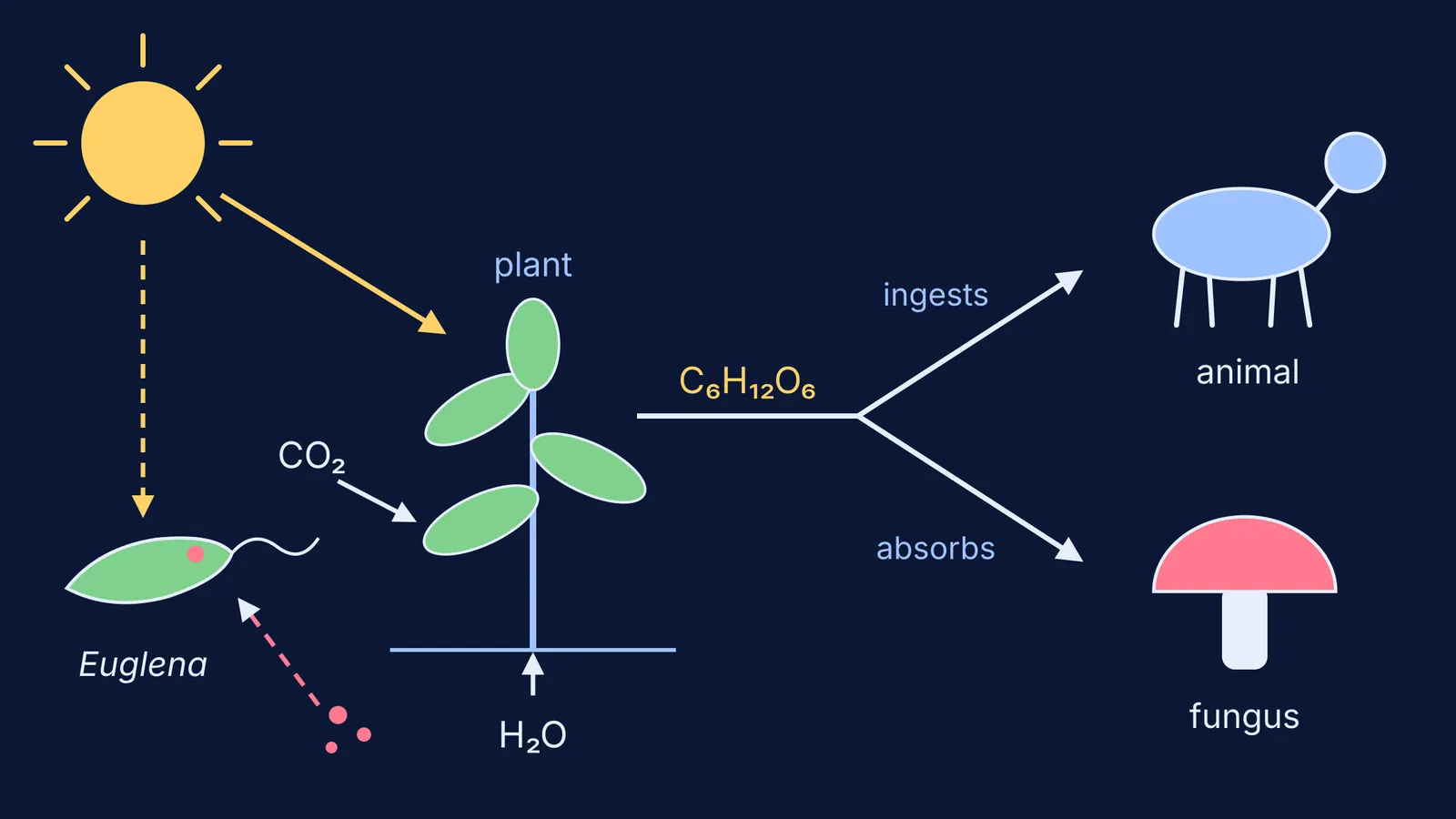
Autotrophic nutrition: the organism builds food from simple inorganic sources, carbon dioxide and water. Green plants and some bacteria are autotrophs.
Heterotrophic nutrition: the organism uses complex substances, which enzymes must break down into simpler ones before the body can use them. Animals and fungi are heterotrophs.
The same chapter adds the line that ties the two together: heterotrophs survive because of autotrophs, directly or indirectly. A tiger never eats grass, but the deer it eats did.
In plants, autotrophy runs on photosynthesis. The textbook writes it as 6CO₂ + 12H₂O → C₆H₁₂O₆ + 6O₂ + 6H₂O, in the presence of chlorophyll and sunlight (NCERT Class 10, Life Processes). It lists three events: chlorophyll absorbs light, light energy becomes chemical energy as water is split, and carbon dioxide is reduced to carbohydrate.
What are examples of autotrophs and heterotrophs?
Autotrophs, from NCERT's Class 11 chapter Biological Classification and the Class 10 chapter:
Green plants, such as the money plant and crotons in NCERT's starch test, which make food by photosynthesis.
Cyanobacteria such as *Nostoc* and *Anabaena*; cyanobacteria have chlorophyll a and are photosynthetic autotrophs.
Chemosynthetic bacteria, which get energy by oxidising inorganic substances such as nitrates, nitrites and ammonia instead of using light.
Heterotrophs, sorted by the three feeding strategies the Class 10 chapter describes:
Take in whole food and break it down inside the body: animals such as cows, lions and humans, and single cells such as *Amoeba* and *Paramecium*. Our post on how Amoeba feeds with pseudopodia walks through the food vacuole step by step.
Break food down outside the body and then absorb it: fungi such as bread mould, yeast and mushrooms.
Take nutrition from a living plant or animal without killing it: parasites such as *Cuscuta* (amar-bel), ticks, lice, leeches and tapeworms.
The Class 11 chapter adds that most fungi absorb soluble organic matter from dead substrates and are called saprophytes (NCERT Class 11). If parasite, saprophyte and epiphyte still blur together, our explainer on epiphytes, parasites and saprophytes sorts them out.
Why is Euglena both autotrophic and heterotrophic?
*Euglena* is the classic edge case. NCERT's Class 11 textbook says euglenoids are photosynthetic in sunlight, but when deprived of sunlight they behave like heterotrophs by preying on smaller organisms (NCERT Class 11, Biological Classification). The same page notes that their pigments are identical to those of higher plants.
Researchers grow *Euglena gracilis* under phototrophic, mixotrophic and heterotrophic conditions on purpose, which is why the word "mixotrophic" turns up in papers such as Hasan and colleagues, 2019, in Algal Research. A 2024 study in Protist found that the feeding mode changed what the cells produced: heterotrophic conditions favoured proteins and polyphenol compounds, while photoheterotrophic cells made more carbohydrates and alkaloids (Farjallah, Fillion and Guéguen, 2024).
Two more edge cases worth knowing. *Cuscuta* is a plant, yet NCERT lists it with the parasites. And bacteria sit on both sides: some are autotrophic, but the vast majority are heterotrophs (NCERT Class 11). Our post on nutrition types in Monera goes further.
How do you classify any organism in three questions?
Run this test on any organism an MCQ throws at you:
Does it make carbohydrate from carbon dioxide and water, or get energy from inorganic chemicals? If yes, it is autotrophic. For photosynthesisers, look for chlorophyll, not for soil or leaves.
If not, where does its food come from? A living host it does not kill means parasite. Dead matter, digested outside and absorbed, means saprophyte. Food taken in and digested inside means it ingests.
Does it switch with conditions? If it photosynthesises in light and feeds on others in the dark, it is mixotrophic. Name both modes in your answer.
Worked through on four common examples:
*Nostoc*: has chlorophyll a and photosynthesises, so it is an autotroph.
Yeast: no photosynthesis, breaks food down outside and absorbs it, so it is a heterotroph.
*Cuscuta*: a plant that takes nutrition from a living host, so it is a heterotroph (parasite).
*Euglena* in a dark flask: heterotroph. The same cell on a sunny windowsill: photosynthetic.
If one of these terms keeps tripping you up, the Fermi Concept Library gives every biology concept its own lesson and its place in the map, so you can see how nutrition links to photosynthesis and respiration. For practice, the Fermi Problem Library has worked problems with a step-by-step solver that explains the reasoning rather than printing an answer.
Next time you spot a mushroom on a monsoon lawn, ask the first question: does it make its own food?


