

On this page
Many students confuse epiphytes, parasites and saprophytes because they all grow on or near other organisms, often appearing very similar at a quick glance in their natural habitats. However, these organisms play distinct ecological roles and have different biochemical ways of getting their food. If you are preparing for NEET or reviewing Class 11 and 12 biology, deeply understanding these three modes of nutrition will help you confidently solve ecology and biological classification questions in your examinations.
What is an epiphyte?
An epiphyte is a plant that grows on the surface of another plant—usually a tall tree—but makes its own food. It is an autotroph. In ecological terms, this is an example of commensalism (+/0): the epiphyte benefits by getting a high perch closer to sunlight, while the host tree is neither harmed nor helped by its presence.
Epiphytes do not have haustoria (sucking roots). Instead, they use specialised aerial roots to absorb moisture and essential minerals from the rain and the air around them. An example in the NCERT syllabus is an orchid growing on a mango branch.
What is a parasite?
A parasitic plant lives on or inside a host plant and steals its nutrients to survive. This is a +/- interaction (parasitism) because the parasite benefits at the host's expense.
Parasites use specialised roots called haustoria to penetrate the host's vascular system (the xylem and phloem) and siphon off water and food (Britannica). They are generally divided into two main groups based on their photosynthetic ability:
Holoparasites: These plants lack chlorophyll entirely and cannot photosynthesise. *Cuscuta* (dodder or Amarbel) is a leafless, yellow vine that entirely depends on its host for all its carbon and energy.
Hemiparasites: These plants possess chlorophyll and can photosynthesise to some extent, but they still steal water and mineral nutrients from the host. Mistletoe is a familiar example.
What is a saprophyte?
Saprophytes (or saprotrophs) are organisms that obtain their nutrition from dead and decaying organic matter. They act as decomposers in an ecosystem. They secrete digestive enzymes outside their bodies to break down complex organic substances, then absorb the simpler forms (BYJU'S).
Most fungi (like bread mould or *Mucor* and mushrooms) and some protists (like slime moulds) are classed as saprophytic. While we often hear the term "saprophytic plants," true saprophytic plants are incredibly rare. Plants such as the Indian pipe (*Monotropa uniflora*) are actually myco-heterotrophs: they lack chlorophyll and get their food by parasitising fungi that are actively decomposing dead matter.
If you are struggling to keep the different biological kingdoms straight, the Fermi Concept Library covers every concept in biology, each with its own lesson and its place in the map.
Epiphyte vs parasite vs saprophyte: a quick comparison
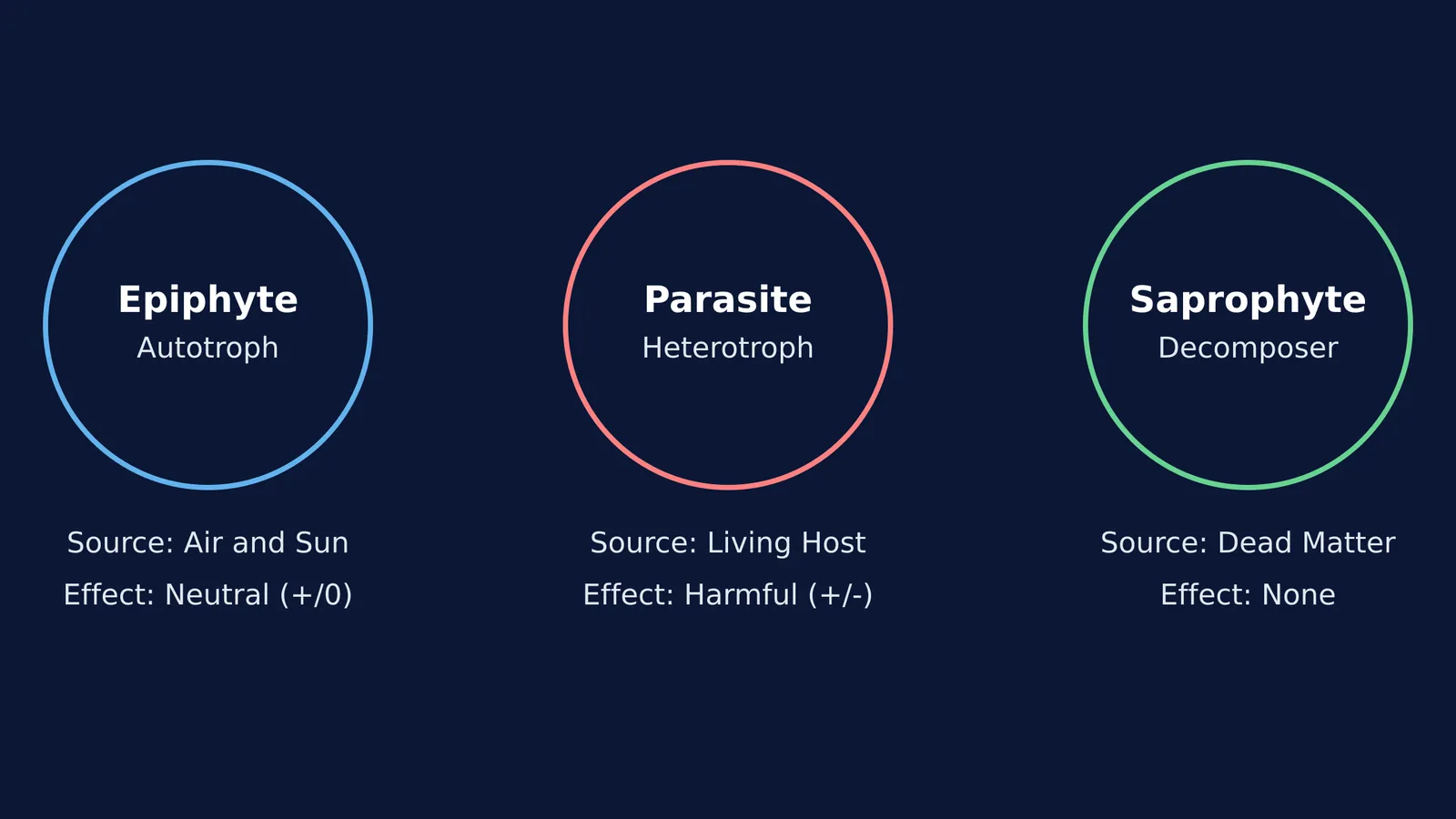
When revising these concepts, compare them by their primary nutrient source and their ultimate effect on the host organism:
Source of food: Epiphytes make their own food via photosynthesis, parasites steal nutrients from a living host, and saprophytes absorb nutrients from dead organic matter.
Effect on host: Epiphytes have a neutral effect on the tree they live on, parasites harm their living host, and saprophytes do not have a living host to affect.
Examples: Orchids are epiphytes, *Cuscuta* is a parasite, and fungi are saprophytes.
You can see how these categories cross over into different kingdoms by reading our guide to how viruses, viroids and lichens fit into the five-kingdom system, or compare other distinct groups such as the three algae classes.


