

On this page
Is a mushroom a plant? Is Euglena, which photosynthesises and also swims, a plant or an animal? For two centuries biology forced every living thing into one of two boxes. Robert Whittaker's five kingdoms, the scheme you learn in Class 11, was a way out. This post covers who he was, why he proposed it, how to use it on any organism, and where it has since been revised.
Who was Robert Whittaker?
The Cornell University faculty memorial statement gives his life: born in Wichita, Kansas, on 21 December 1920, he graduated from Washburn Municipal University in 1942, served in the Army Air Corps, and earned his PhD in zoology from the University of Illinois in 1948. His thesis work on insect communities in the Smoky Mountains of Tennessee pushed him towards plants, and he became a plant ecologist. He worked at Washington State College, Brooklyn College and the University of California, Irvine, before Cornell recruited him in 1968. He died on 20 October 1980.
Classification was not his main field. The memorial statement calls him "the world's foremost authority on plant communities" and notes he produced benchmark work in areas from community ordination to niche theory to phylogeny. He was elected to the US National Academy of Sciences in 1975.
What was wrong with two kingdoms?
NCERT's Class 11 Biological Classification chapter explains the problem. The two-kingdom system of Linnaeus' time did not distinguish between prokaryotes and eukaryotes, unicellular and multicellular organisms, or photosynthetic green algae and non-photosynthetic fungi. The single feature that united the old plant kingdom was a cell wall, which put bacteria and blue-green algae next to ferns and flowering plants, and grouped fungi with plants even though fungal walls contain chitin and plant walls contain cellulose.
Whittaker's 1969 paper in Science, New concepts of kingdoms of organisms, carries a subtitle that states his argument: evolutionary relations are better represented by new classifications than by the traditional two kingdoms.
What are the five kingdoms and the criteria?
NCERT lists the kingdoms as Monera, Protista, Fungi, Plantae and Animalia, and Whittaker's main criteria as cell structure, body organisation, mode of nutrition, reproduction and phylogenetic relationships.
From NCERT's comparison table, the quickest checks are:
Monera: prokaryotic, no nuclear membrane. Bacteria are the sole members.
Protista: eukaryotic and unicellular.
Fungi: eukaryotic, cell wall with chitin, heterotrophic (saprophytic or parasitic).
Plantae: eukaryotic, cellulose wall, autotrophic, tissue or organ level.
Animalia: eukaryotic, no cell wall, heterotrophic, tissue, organ or organ system level.
The boundaries are not perfectly sharp. NCERT itself says the boundaries of Protista are not well defined, and its next chapter, Plant Kingdom, lists Chlamydomonas among the common green algae. If an exam asks, follow the chapter the question comes from.
How do you classify an organism with the five-kingdom scheme?
Use three questions, in order. This is a worked example on four organisms from your syllabus.
Does it have a nuclear membrane? If no, it is Monera.
If yes, is it unicellular? If yes, it is Protista.
If multicellular, how does it feed? Absorbs food and has chitin walls: Fungi. Photosynthesises with cellulose walls: Plantae. Ingests food and has no walls: Animalia.
Nostoc (a cyanobacterium): no nuclear membrane, so Monera. NCERT says blue-green algae are not "algae" any more.
Amoeba: nucleus present, single cell, no wall, so Protista.
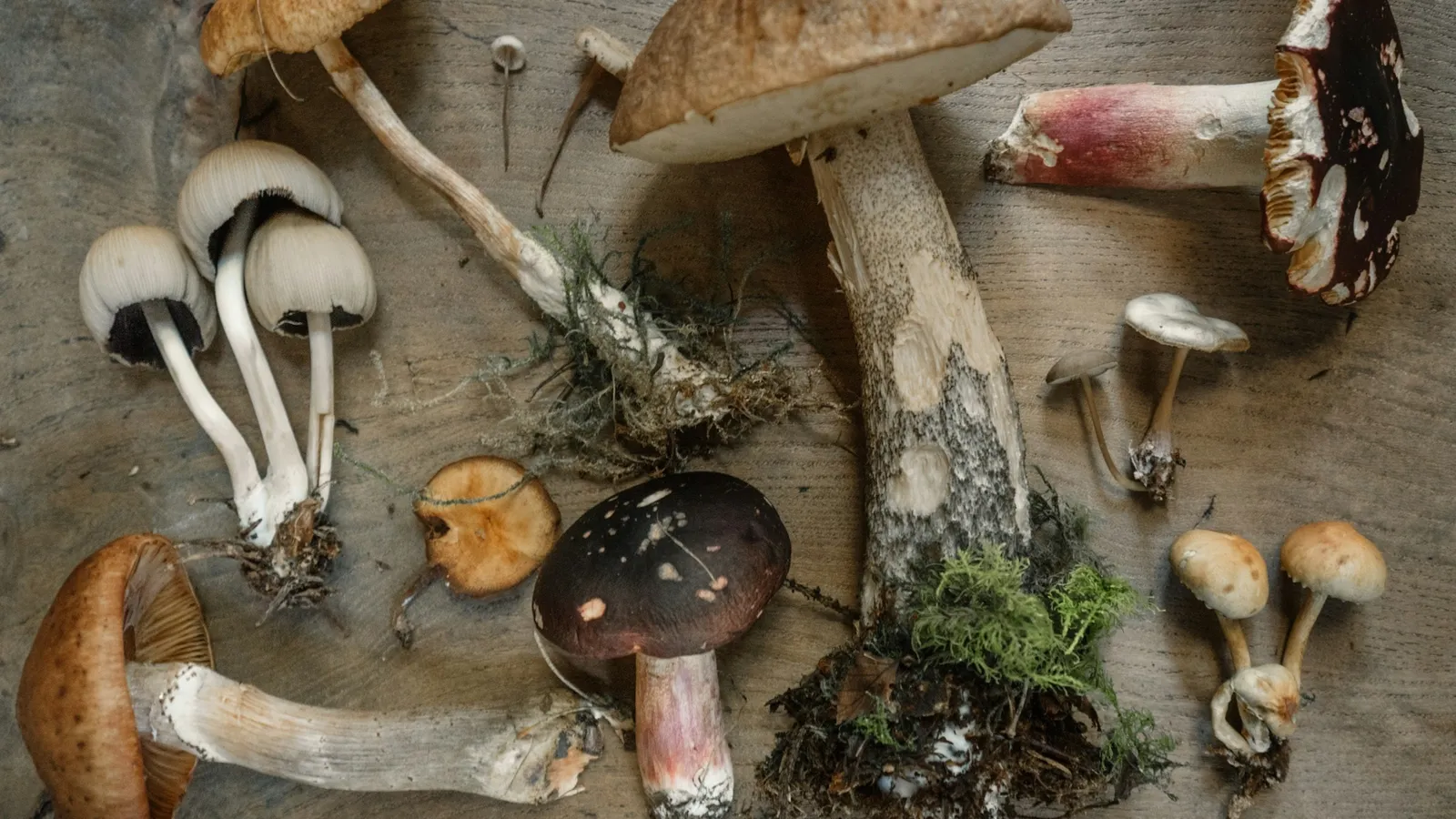
Agaricus (a mushroom): nucleus present, multicellular, absorbs food, chitin walls, so Fungi.
Spirogyra: nucleus present, multicellular filament, photosynthetic, so Plantae.
What mistakes do students make here?
Using nutrition first. Photosynthesis does not make something a plant: Nostoc photosynthesises and sits in Monera, not Plantae.
Forgetting the wall chemistry. Fungi and plants both have walls; chitin versus cellulose is the test.
Treating the three questions as a law. They are a study shortcut. Yeast is the classic exception: NCERT notes that fungi are filamentous except yeasts, which are unicellular, yet yeast sits in Fungi because of its wall and its absorptive nutrition.
Trying to fit viruses in. NCERT notes that the five-kingdom scheme does not mention lichens, viruses, viroids or prions.
Is the five-kingdom system still correct?
It is still the system your syllabus uses, but science has moved on. In 1990, Carl Woese, Otto Kandler and Mark Wheelis proposed three domains, Bacteria, Archaea and Eucarya, above the level of kingdom. Molecular comparisons showed that life divides into three primary groups, and that the differences between them are deeper than those between typical kingdoms such as animals and plants. They argued that neither the five-kingdom taxonomy nor a simple prokaryote-eukaryote split reflected this.
NCERT mentions the three-domain system briefly and says you will meet it in higher classes. For exams, answer in Whittaker's terms unless a question asks otherwise.
What can a student take from Whittaker's way of working?
Change the criteria, and the groups change. Classification is a choice of questions, not a fact of nature.
Let evidence about relationships guide you. His own subtitle puts evolutionary relations first.
Expect your scheme to be revised. A good classification is the best current summary, not the final word.
If you need a quick reminder of what separates Protista from Monera, the Fermi Concept Library explains every biology concept, with the definitions side by side. For practice questions on each kingdom, use our guide to biological classification for NEET, and for the two-kingdom story read our post on Carl Linnaeus.
Next step: pick ten organisms from your NCERT chapter and run each through the three questions above.


