

On this page
What makes diatoms, dinoflagellates, and euglenoids easy to confuse?
In Kingdom Protista, chrysophytes (including diatoms), dinoflagellates, and euglenoids often blur together. All three groups are microscopic, single-celled photosynthetic eukaryotes taught in NCERT Class 11 Biology. When Robert Whittaker's five-kingdom classification system grouped unicellular eukaryotes into Protista, it placed distinct evolutionary lineages under one convenient heading.
Exam questions frequently exploit this overlap by swapping cell walls, flagellar plans, or nutritional modes. Diatoms drift passively in water, dinoflagellates spin with perpendicular flagella, and euglenoids swim actively through freshwater pools. Distinguishing them requires checking three markers: cell covering, flagellar arrangement, and carbon source.
How do cell coverings separate these three protists?
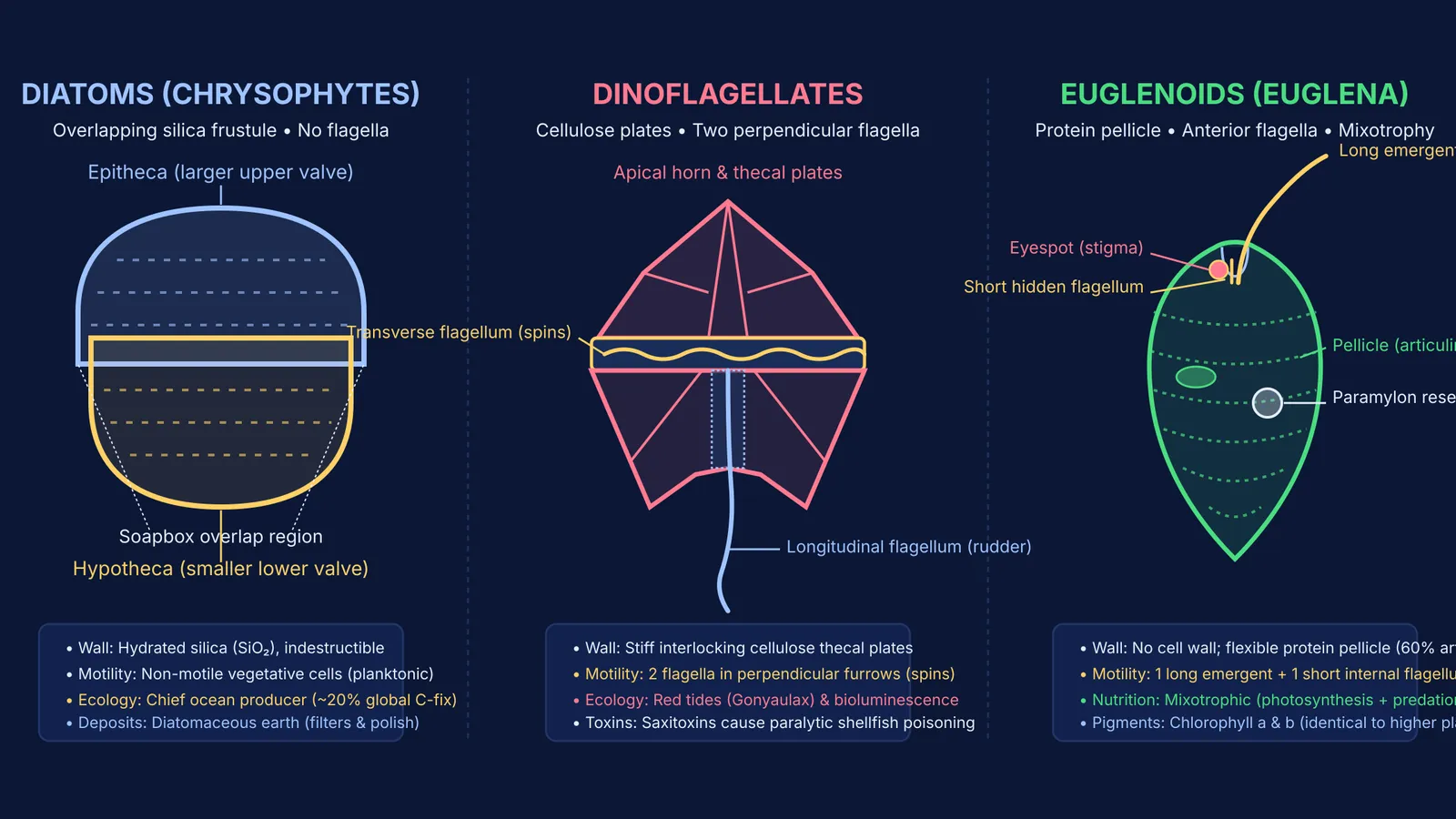
Cell coverings provide the fastest diagnostic test. Diatoms have a rigid wall of hydrated silica embedded in an organic matrix, forming two overlapping valves like a soapbox: a larger upper epitheca fitting over a smaller hypotheca. In Nature, oceanographer E. Virginia Armbrust explains that these silica frustules are virtually indestructible. Sinking after cell death, they form diatomaceous earth used to filter syrups and polish metals.
Dinoflagellates take a different route. Instead of silica, their outer theca consists of stiff cellulose plates, as noted in NCERT Class 11 Biology. These interlocking plates give armoured dinoflagellates a sculptured appearance. Unlike diatoms, their walls decompose and leave no mineral deposits.
Euglenoids lack a cell wall entirely. Instead, they wrap their cytoplasm in a protein-rich pellicle beneath the plasma membrane. J. A. Marrs and G. B. Bouck reported in The Journal of Cell Biology that articulin proteins make up roughly 60% of the peripheral membrane skeleton in *Euglena gracilis*. These articulins form flexible, sliding strips that enable dynamic shape changes called euglenoid movement, or metaboly.
Why do flagella and locomotion matter for classification?
Locomotion is the second diagnostic checkpoint. Vegetative cells of chrysophytes (diatoms) lack flagella entirely, floating passively on water currents as plankton.
Dinoflagellates derive their name from the Greek *dinos*, meaning whirling. They bear two perpendicular flagella housed in surface grooves: a transverse flagellum in the cingulum (waist groove) that spins the cell, and a longitudinal flagellum in the sulcus (axial furrow) providing forward drive. This perpendicular beat creates their distinctive whirling motion.
Euglenoids also have two flagella, but both emerge from an anterior reservoir. Only one long flagellum extends outward to pull the cell forward; the second remains short and non-emergent within the reservoir. A pigmented eyespot (stigma) near the reservoir base helps steer the organism toward light.
How do their ecological roles and nutrition differ?
Although all three groups carry out photosynthesis, their ecological roles diverge. Diatoms are the chief primary producers of the oceans. Armbrust notes in Nature that diatoms generate roughly 20% of Earth's total net primary production and 40% of marine primary production—fixing as much carbon as all tropical rainforests combined.
Dinoflagellates are infamous for harmful algal blooms, or red tides. As Patricia M. Glibert, Donald M. Anderson, and colleagues documented in Oceanography, when coastal nutrients and temperatures rise, red dinoflagellates like *Gonyaulax* multiply explosively, colouring the sea. Dense blooms release lethal neurotoxins, including saxitoxins, that kill fish and accumulate in shellfish.
Euglenoids thrive in stagnant fresh water as mixotrophs. In sunlight, they photosynthesise with chlorophyll a and b—pigments identical to higher plants, as discussed in our comparison of algae classes. Deprived of light, they act as heterotrophic predators, storing food as paramylon rather than starch.
How can you identify these protists step by step?
When solving classification questions, apply this diagnostic key:
Check for a cell wall: If absent and replaced by a flexible protein pellicle, it is a euglenoid. If a rigid wall is present, proceed to step 2.
Check wall composition: If two overlapping silica valves fit like a soapbox, it is a diatom. If stiff cellulose plates enclose the cell, it is a dinoflagellate.
Check flagellar plan: If two perpendicular flagella lie in waist and axial grooves, it is a dinoflagellate. If one long flagellum emerges from an anterior pocket, it is a euglenoid. If vegetative cells drift without flagella, it is a diatom.
Check ecological hallmark: Diatomaceous earth and oceanic primary production identify diatoms; toxic red tides identify dinoflagellates (*Gonyaulax*); mixotrophy with higher-plant pigments identifies *Euglena*.
Mastering these features is easier when reading NCERT lines closely for NEET biology. When working through classification problems with tricky cell coverings, the Fermi Problem Library offers worked problems with a step-by-step solver that explains the reasoning rather than printing an answer. To see how these single-celled organisms connect across the tree of life, the Fermi Concept Library covers every concept in physics, chemistry, biology, mathematics and computing, each with its own lesson and its place in the map.


