

On this page
A classmate swaying at morning assembly and a soldier toppling on parade share the same cause. It is not weakness. It is gravity, plus a pump in your legs that stops when you stop moving.
What happens to your blood when you stand still?
Standing upright pools about 500 to 1000 mL of blood in the legs, the belly organs and the lungs, according to a 2018 review of orthostatic hypotension in Cureus. As a result, less blood returns to the heart, the heart fills less, and blood pressure drops.
Reflexes normally correct this by tightening blood vessels and raising the heart rate. If they fall behind, the brain gets too little blood for a moment and you faint. For the head-to-feet pressure physics, see why blood pressure is higher in your feet than your head.
How do leg muscles and vein valves pump blood upward?
Veins run at much lower pressure than arteries, which is also why a cut vein oozes while an artery spurts. To climb back up from your feet, venous blood needs help.
When your calf muscles contract, they squeeze the deep veins running through them and push blood towards the heart. One-way valves inside the veins stop it sliding back when the muscle relaxes.
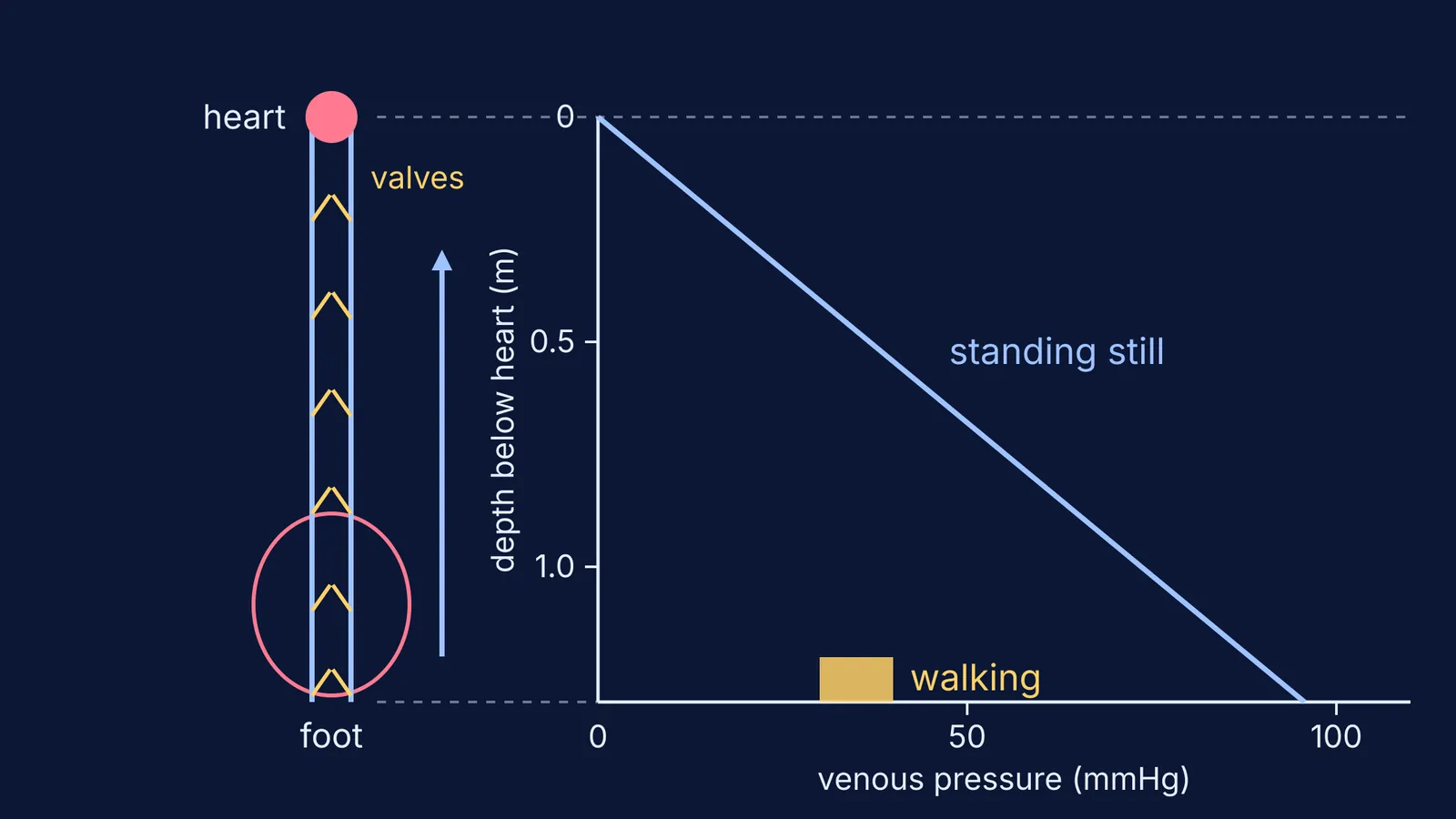
In a person standing still, venous pressure at the lower leg and foot averages 60 to 90 mmHg, according to the background of a 2024 paper in the Journal of Vascular Surgery: Venous and Lymphatic Disorders. In healthy people, it adds, walking or tiptoe movements drop pressure in the surface leg veins by more than 60%, to an average low of 30 to 40 mmHg. Stand motionless and the pump stops, so blood stays in the legs. Lymph uses the same muscles-plus-valves trick: see how lymph flows without a heart.
Why do soldiers faint on parade?
A 2026 study in Autonomic Neuroscience by researchers at Simon Fraser University in Canada and the UK's Royal Centre for Defence Medicine followed 41 soldiers through three 2.5-hour ceremonial parades that alternated motionless standing with marching.
During one stand of about 63 minutes, 50% of the 30 soldiers wearing sensors under their uniforms had blood pressure drops that met the clinical criteria for orthostatic hypotension. Estimated core temperature reached 38.6 °C, so heat stress added to the problem. Soldiers with larger leg mass tended to have lower pressure during the stand. A hot school assembly has the same ingredients: upright, still and warm.
Does wiggling your toes really help?
Moving your legs restarts the pump. The NHS advice on fainting says you can try to prevent a faint by crossing your legs while standing, rocking up and down on your toes, or clenching your fists.
In the PC-Trial, published in the Journal of the American College of Cardiology in 2006, 223 patients with repeated fainting spells and warning symptoms were randomised, and 106 of them were trained in muscle-tensing manoeuvres. Over a mean 14 months, 31.6% of the trained group fainted again, against 50.9% of the group without training. That was a relative risk reduction of 39%.
Try it: a quick ankle-pump demonstration
Step 1: see gravity. Hang one hand by your thigh and raise the other above your head for 30 seconds. Compare them: the lowered hand's veins bulge, the raised hand's flatten.
Step 2: do the maths. Pressure from a fluid column is height × density × g. Your feet sit roughly 1.2 m below your heart. Treating blood as water, 1.2 × 1000 × 9.8 is about 11,800 Pa, or about 88 mmHg (133 Pa per mmHg). That sits inside the measured 60 to 90 mmHg range.
Step 3: run the pump.
Stand with your feet hip-width apart.
Rise slowly onto your toes, hold for two seconds, lower. Repeat 10 times.
Curl and spread your toes inside your shoes 10 times.
Tense your calves, thighs and buttocks for five seconds, then relax.
If fluid pressure is hard to picture, the Fermi Simulation Lab has interactive simulations for ideas easier to see than to read, and the Fermi Concept Library gives each biology and physics concept its own lesson.
What should you do if you feel faint at assembly?
The NHS fainting page lists not eating or drinking enough and being too hot among the causes. If you feel faint, it suggests lying down with your legs raised, or sitting with your head lowered between your knees. Tell a teacher: "Ma'am, I feel dizzy. I need to sit down."
If a friend faints, the NHS says to check they are breathing and, if they are, lay them on their back and raise their legs; people usually wake within 30 seconds. It says to call 999 (in the UK) if they are not breathing, cannot be woken within a minute, have chest pain or a pounding heartbeat, fainted while exercising or are having a seizure.
Next assembly, keep your toes busy.


