

On this page
Your heart pushes blood round a closed loop, but lymph has no heart of its own. Three ordinary forces do the pushing, and one-way valves make sure every push counts.
Why does lymph need to move at all?
Each day about 20 litres of plasma leaks out of blood capillaries into the spaces around your cells, and about 17 litres is reabsorbed directly, leaving roughly 3 litres for the lymphatic system to return, according to the OpenStax Anatomy and Physiology textbook.
Lymph is the name for interstitial (tissue) fluid once it has entered the lymphatic system (OpenStax). For where lymph fits alongside blood and plasma, see our guide to body fluids and circulation for Class 11.
The same textbook says plainly that lymph "is not actively pumped by the heart". So something else has to move it.
What pushes lymph if there is no heart?
A review by physiologist David Zawieja splits the forces into two kinds: extrinsic pumps, where surrounding tissues squeeze and release the lymph vessels, and intrinsic pumps, where the muscle in the lymph vessel wall contracts in rapid pulses (Zawieja, 2009).
The vessel's own muscle. Larger lymph vessels contract by themselves, and more lymph stretching the wall tends to switch this pumping on (Zawieja, 2009).
Skeletal muscles. When you walk, climb stairs or flex your calf, contracting muscles press on nearby lymph vessels (OpenStax).
Breathing. When you breathe in, the diaphragm moves down, pressure in the chest falls below pressure in the abdomen, and fluid is drawn upward; this is the respiratory pump OpenStax describes for veins (OpenStax). The thoracic duct starts just below the diaphragm and runs up through the chest, so it spans that pressure difference.
One-way valves. Valves sit close together in lymph vessels, each making a small bulge that gives the vessels a beaded look (OpenStax). They do not push. They stop lymph going backwards.
How strong is the breathing effect? A 2026 systematic review of 23 human and animal studies found that breathing influenced thoracic duct flow or pressure in 5 of 6 human studies and 12 of 17 animal studies, and that the duct's own contractions, where studies described them, were an independent contributor (Moazzam and colleagues, 2026). The authors call the evidence inconsistent, so treat breathing as a helper, not the whole story.
What is the route of lymph from tissue to the subclavian vein?
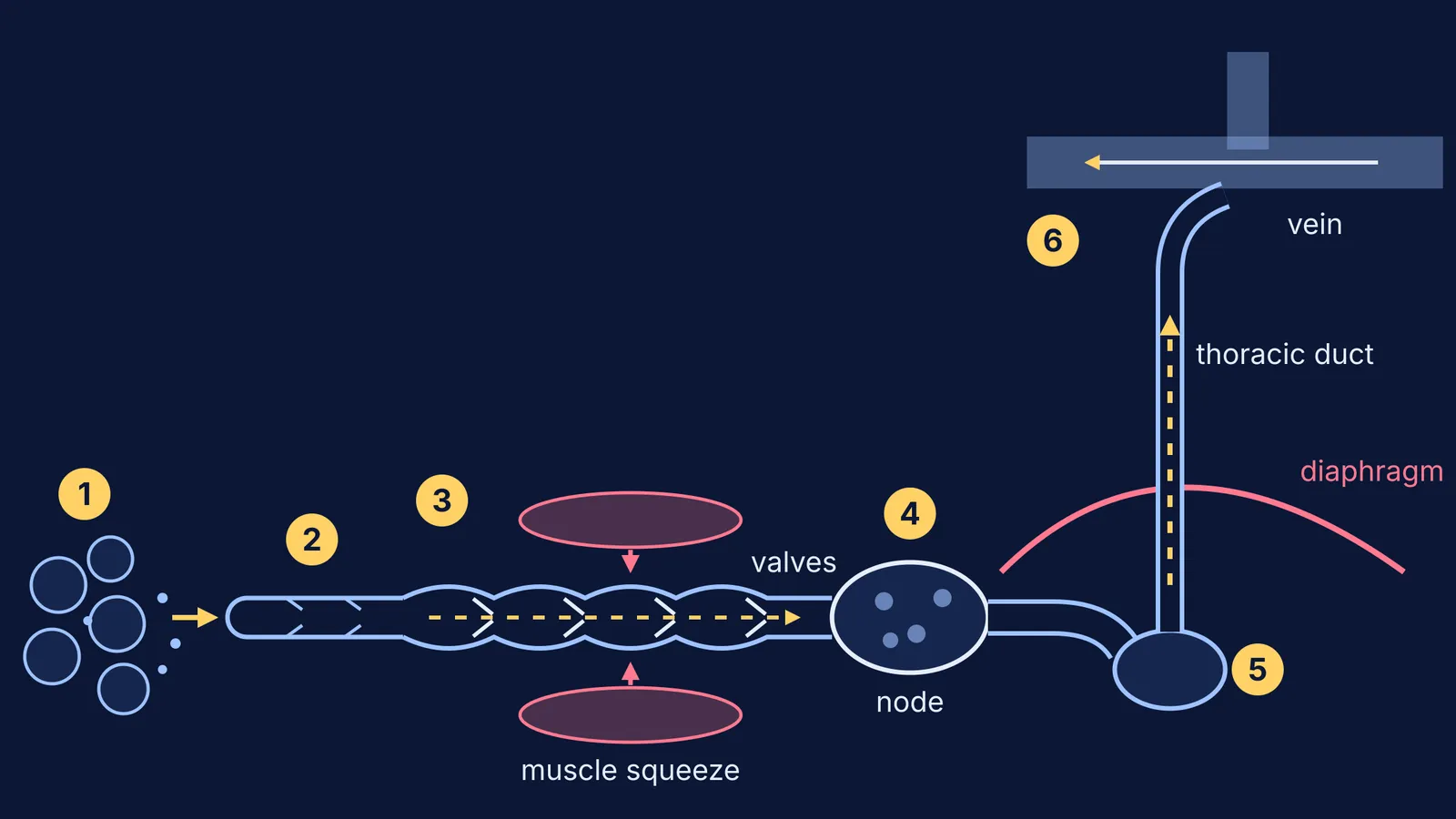
The numbers match the diagram at the top of this post. The route details come from OpenStax.
Tissue fluid. Plasma leaks out of blood capillaries and bathes your cells.
Lymphatic capillary. The fluid slips in between overlapping cells in a wall one cell thick, and collagen filaments anchored to nearby tissue pull these flaps open. From here on it is called lymph.
Collecting lymph vessels. Capillaries empty into larger vessels with vein-like three-layered walls and closely spaced one-way valves. Muscle squeezes and the vessels' own contractions move lymph forward here.
Lymph nodes. Lymph passes through some of the body's 500 to 600 lymph nodes on the way. For their immune role, read primary vs secondary lymphoid organs.
Cisterna chyli and thoracic duct. Lymph from the lower abdomen, pelvis and legs collects in the cisterna chyli, a sac-like chamber just beneath the diaphragm. The thoracic duct begins here and carries lymph up through the chest.
Left subclavian vein. The thoracic duct empties into the left subclavian vein, where the jugular and subclavian veins meet in the neck. The lymph is back in the blood.
There is one exception to learn. Lymph from the right side of the head, the right side of the chest and the right arm drains through the right lymphatic duct into the right subclavian vein instead. Everything else goes through the thoracic duct.
How do you write this in a 3-mark answer?
Here is a worked plan for a typical question: "Lymph has no pump. Explain how it returns to the blood."
State the problem: lymph is not pumped by the heart, so the body around it has to move it.
Name the forces: contraction of skeletal muscles, breathing movements, and rhythmic contraction of the lymph vessels' own muscle.
Add the valves: one-way valves stop backflow, so each squeeze moves lymph towards the neck.
End with the destination: thoracic duct into the left subclavian vein; right lymphatic duct into the right subclavian vein.
Watch for three common slips:
Writing that the heart pumps lymph.
Saying valves push lymph. They only prevent backflow.
Swapping the sides. The thoracic duct goes to the left subclavian vein.
Self-test: draw the six numbered steps from memory and write the force acting at each arrow. A step that will not come is your gap to revise.
If the squeeze-and-valve idea is still hard to picture, Fermi's AI tutor can draw the figure and check your understanding as it goes, and the Fermi Concept Library gives each biology concept its own lesson.
For the history, read how Thomas Bartholin described the lymphatic system.


