On this page
You meet this topic in section 7.2.7 of NCERT Class 12 Biology, Chapter 7: Human Health and Disease. It looks like a list to memorise. It is really one idea: lymphocytes are trained in one set of organs and do their work in another. Once you see that, the list sorts itself.
What is the difference between primary and secondary lymphoid organs?
NCERT defines lymphoid organs as the organs where origin and/or maturation and proliferation of lymphocytes occur (NCERT Class 12 Biology, section 7.2.7).
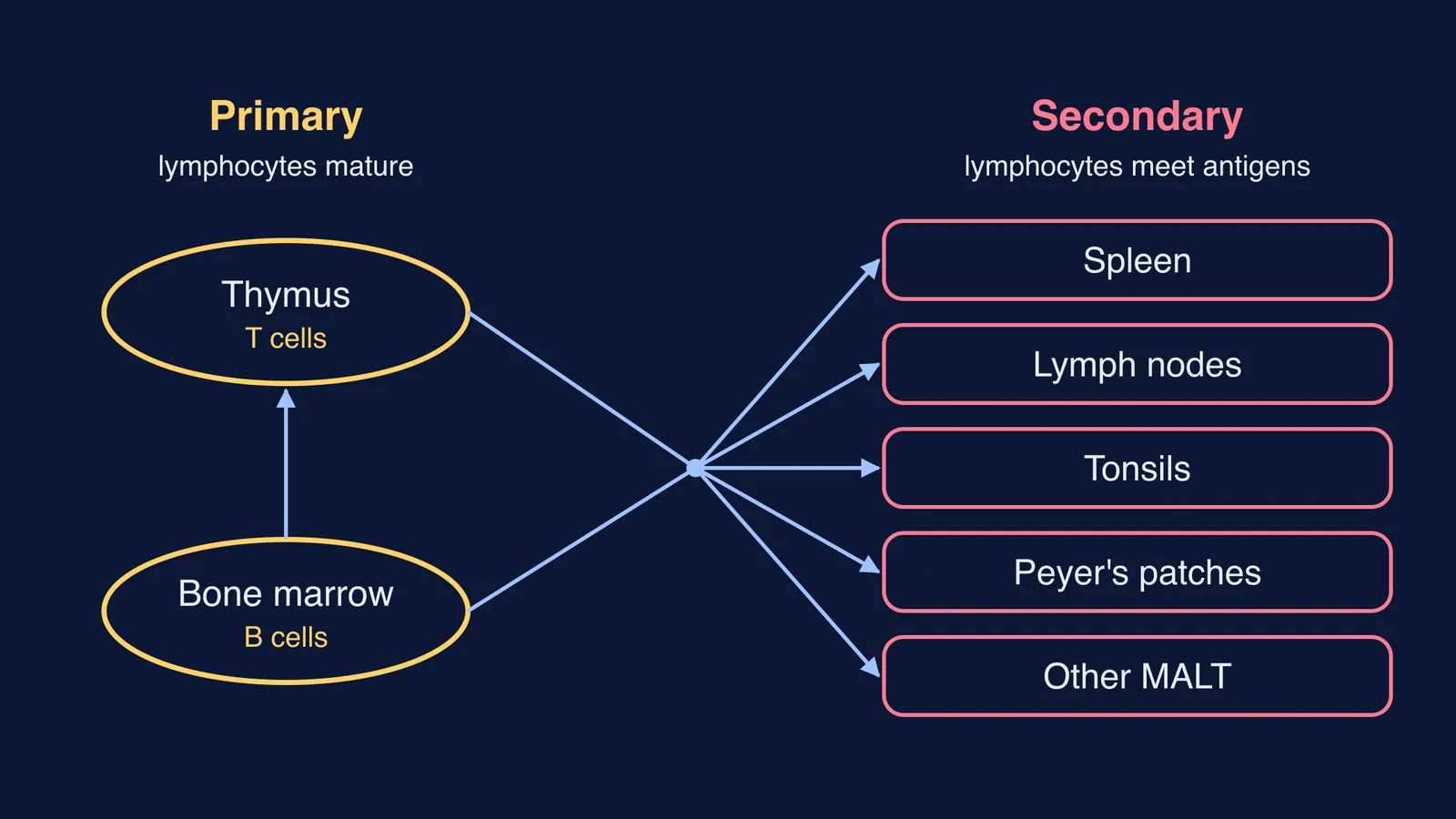
Primary lymphoid organs are the bone marrow and thymus, where immature lymphocytes differentiate into antigen-sensitive lymphocytes (NCERT).
Secondary lymphoid organs are where mature lymphocytes interact with antigens and then proliferate to become effector cells; NCERT lists the spleen, lymph nodes, tonsils, Peyer's patches of the small intestine and the appendix (NCERT).
The open textbook OpenStax Anatomy and Physiology 2e puts it in one line: lymphocytes "develop and mature in the primary lymphoid organs, but they mount immune responses from the secondary lymphoid organs."
Think of a training academy and a set of checkposts. The academy (primary) produces trained guards. The checkposts (secondary) sit where intruders are likely to arrive, and that is where the guards meet them.
Why are bone marrow and thymus called primary?
Both are places where lymphocytes are made or finished, not where they fight.
Bone marrow: NCERT calls it the main lymphoid organ, where all blood cells including lymphocytes are produced (NCERT). B cells mature in red bone marrow (OpenStax).
Thymus: T cells move from the bone marrow to the thymus to finish maturing (OpenStax). NCERT describes it as a lobed organ near the heart, beneath the breastbone, quite large at birth and very small by puberty (NCERT).
One NCERT sentence confuses students: it says both bone marrow and thymus provide micro-environments for the development and maturation of T-lymphocytes. That fits the story above. T cells start in the marrow and finish in the thymus. B cells stay in the marrow. Our explainer on B lymphocytes vs T lymphocytes and where they mature goes further into what each cell does next.
What does each secondary lymphoid organ do?
Each one sits where antigens are likely to arrive, and the trick is to ask what it filters.
Spleen: filters blood. NCERT calls it a large bean-shaped organ, made up mainly of lymphocytes and phagocytes, that traps blood-borne micro-organisms and stores a large reservoir of red blood cells (NCERT). It sits in the upper left abdomen, just beneath the diaphragm (NCI SEER Training: Spleen).
Lymph nodes: filter lymph. They are small bean-shaped structures, usually less than 2.5 cm long, that filter lymph before it returns to the blood (NCI SEER Training: Lymph nodes). More in our post on what lymph nodes do.
Tonsils: guard the nose and mouth. There are three groups (pharyngeal, palatine and lingual), and their lymphocytes and macrophages protect against pathogens entering through the nose or mouth (NCI SEER Training: Tonsils).
Peyer's patches: guard the small intestine. OpenStax describes them as a type of MALT in the small intestine (OpenStax).
MALT: lymphoid tissue in the lining of the respiratory, digestive and urogenital tracts, which constitutes about 50 per cent of the lymphoid tissue in the human body (NCERT).
How do you remember which lymphoid organ is which?
Use one question for every organ: is this where lymphocytes are trained, or where they meet antigens? Trained means primary. Meeting antigens means secondary.
Try this sorting drill. Cover the answers, say primary or secondary out loud, then check.
A B cell becomes antigen-sensitive. Answer: primary, bone marrow.
A T cell precursor leaves the marrow to finish maturing. Answer: primary, thymus.
A bacterium in the bloodstream is trapped and lymphocytes respond. Answer: secondary, spleen.
Germs from a cut on the foot are caught on their way back towards the blood. Answer: secondary, lymph nodes.
A pathogen swallowed with food meets lymphocytes in the gut wall. Answer: secondary, Peyer's patches (MALT).
A virus breathed in through the mouth meets lymphocytes at the back of the throat. Answer: secondary, tonsils.
If you get an item wrong, the gap is usually a word, not the list: antigen, lymph or effector cell. The Fermi Concept Library gives every biology concept its own lesson and shows its place in the map. That helps you fix the missing link instead of re-reading the whole chapter.
What should you revise next?
Once the organs are sorted, link them to what happens there. NCERT section 7.2.2 describes the primary and secondary immune responses, carried out by the B and T lymphocytes that these organs produce and house. Our post on why the second antibody response is faster shows that step as a graph. For MCQs that mix these ideas, the Fermi Problem Library has worked problems with a step-by-step solver that explains the reasoning rather than printing an answer.