

On this page
If you have ever had a sore throat and felt tender lumps under your jaw, you have felt lymph nodes at work. They are part of two systems at once: the plumbing that returns fluid to your blood, and the immune system that guards it. This guide follows one drop of fluid from a capillary, through a node and back into a vein.
What do lymph nodes do?
Lymph nodes do two jobs. They filter the lymph, and they are where lymphocytes meet germs and start an immune response.
The open textbook OpenStax Anatomy and Physiology 2e puts the filter role in one line: lymph nodes remove debris and pathogens from the lymph. The same chapter describes them as bean-shaped organs. It says humans have about 500 to 600 of them, found near the groin, armpits, neck, chest and abdomen.
Think of them as security checkpoints on a road. Fluid from your tissues passes through nodes on its way back to the blood, so a germ that got in through a cut on your foot can be caught by a node in the groin.
What is inside a lymph node?
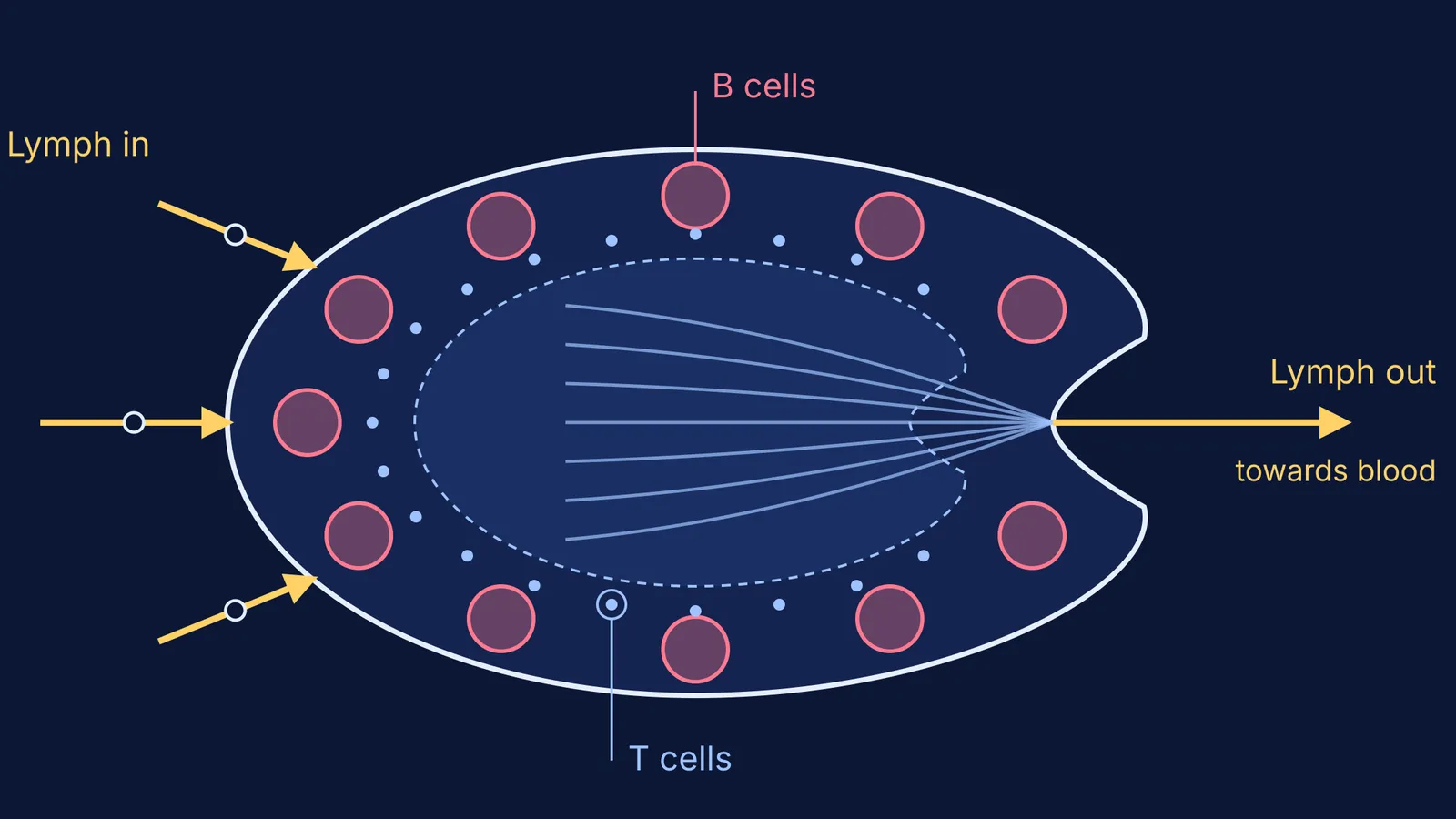
Lymph enters a node through afferent lymphatic vessels and leaves through efferent vessels at a notch called the hilum, according to the US National Cancer Institute's SEER training pages. Inside, the node has layers, each with its own job:
Capsule: a tough outer coat of connective tissue, with inward extensions (trabeculae) that divide the node into compartments.
Cortex: the outer layer, with round follicles where B lymphocytes divide. B cells can become the plasma cells that make antibodies.
Paracortex: the deeper band, where T lymphocytes gather and meet dendritic cells, as the Wikipedia article on lymph nodes summarises.
Medulla: the centre, made of cords of cells and channels (sinuses) where lymph collects before it leaves.
OpenStax explains that dendritic cells and macrophages in the node take in and kill many of the pathogens that pass through. Antigen-presenting cells such as dendritic cells also show pieces of germs to T cells, and that is how a specific immune response begins. For more on the two types, see B lymphocytes vs T lymphocytes and where they mature.
How does lymph return fluid to the blood?
Blood pressure pushes some plasma out of capillaries and into the spaces between cells. Most of it goes straight back into the capillaries, but not all of it. OpenStax gives the daily figures: about 20 litres of plasma leaves the capillaries, and about 17 litres is reabsorbed directly. That leaves about 3 litres for the lymphatic system to drain.
A quick worked example with those numbers:
Fraction left behind: 3 ÷ 20 = 0.15, so about 15% of the filtered fluid depends on the lymphatics.
Per hour: 3,000 mL ÷ 24 h = about 125 mL every hour, roughly half a cup.
The return route matters. When drainage fails, protein-rich fluid builds up in the tissues, and OpenStax calls this build-up lymphedema.
The heart does not pump lymph. The same source explains that body movement, skeletal muscle contraction and breathing push it along, and one-way valves keep it moving towards the heart. Lymph from the upper right side of the body drains into the right lymphatic duct, and the thoracic duct carries the rest. The ducts empty into the blood where the jugular and subclavian veins meet in the neck. Our post on lymph vs plasma vs tissue fluid explains why proteins make the difference between these three fluids.
Why do lymph nodes swell when you are ill?
A swollen node is a busy checkpoint. OpenStax gives the swelling of lymph nodes during an infection as one example of how the lymphatic and immune systems are linked. The NHS page on swollen glands says glands swell near an infection to help the body fight it, and should go down within 1 to 2 weeks, depending on the cause.
This is general biology, not medical advice. If swelling lasts or worries you, the same NHS page lists the signs that mean you should see a doctor.
How do you remember the lymph node story for exams?
Use this five-step chain. Say it aloud, then draw it from memory:
Leak: plasma is filtered out of capillaries into the tissues.
Collect: leftover tissue fluid enters lymph capillaries and becomes lymph.
Filter: lymph passes through nodes, where macrophages and dendritic cells trap germs.
Alert: B cells in the cortex and T cells in the paracortex respond to what is trapped.
Return: the thoracic and right lymphatic ducts empty lymph into the neck veins.
Then test yourself: why would a blocked lymph vessel cause swelling? If one step feels shaky, the Fermi Concept Library covers every concept in biology, each with its own lesson and its place in the map.
When you can explain the chain, practise it on questions. The Fermi Problem Library has worked problems with a step-by-step solver that explains the reasoning rather than printing an answer.


