

On this page
If you cut an artery, blood comes out in jets that rise and fall with the heartbeat. If you cut a vein, it wells up and runs out in a steady stream. The difference lies mostly in the pressure behind the blood.
Why does blood spurt from an artery?
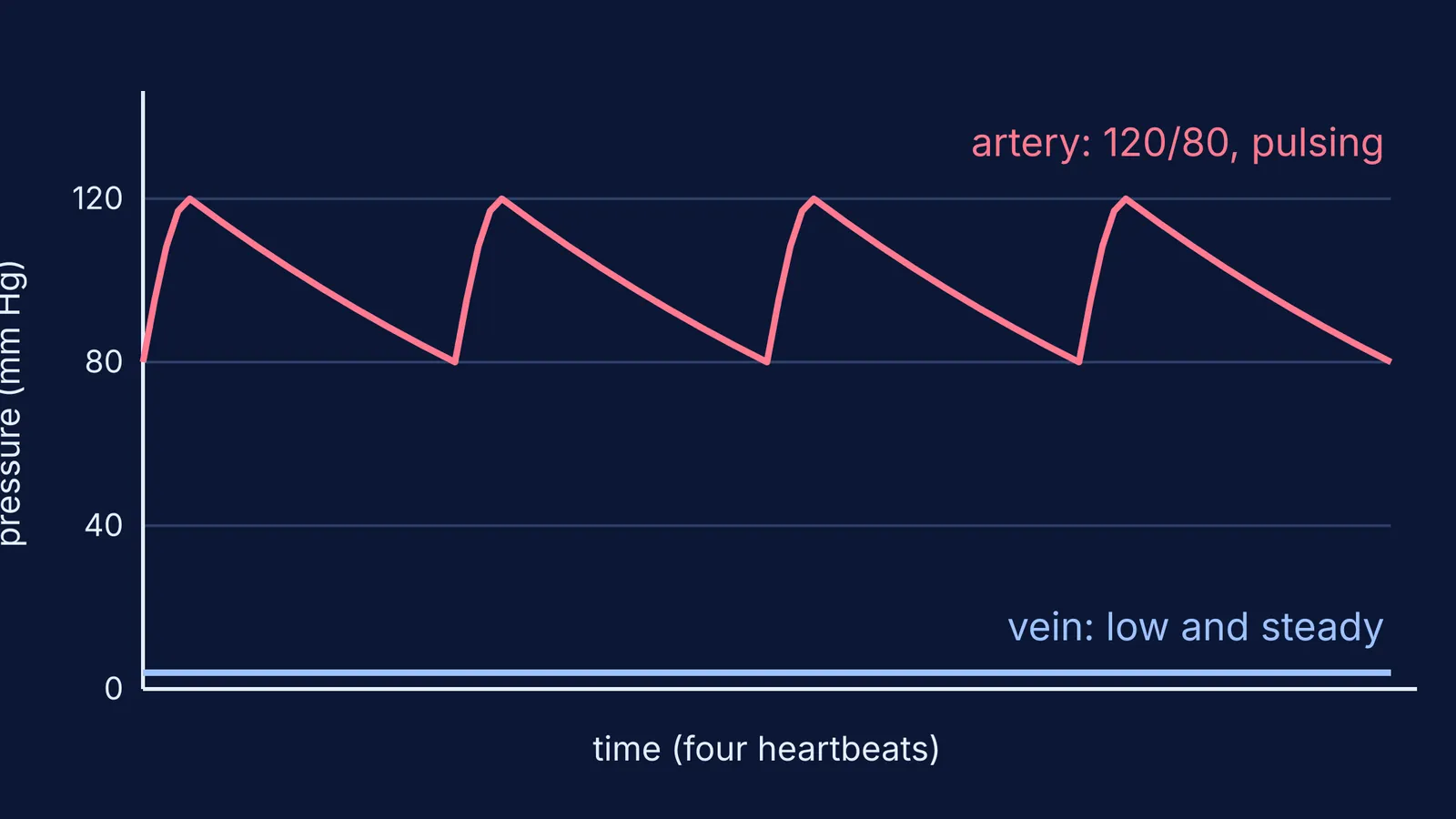
Arteries sit right after the heart's pumping chambers, so they feel every beat directly. In a typical adult, the systolic pressure (the peak, as the heart contracts) is about 120 mm Hg and the diastolic pressure (the low point, as the heart relaxes) is about 80 mm Hg, according to OpenStax Anatomy and Physiology.
That swing is the pulse: OpenStax describes it as the expansion and recoil of the artery wall, which you can feel with your fingers. Now imagine a hole in that wall. Even at its lowest point the pressure is high, so blood is always being forced out. At each beat it jumps by about 40 mm Hg, so the stream surges. The result is a jet that pulses in time with the heart, because flow out of a hole depends on the pressure behind it.
Why does blood from a vein flow steadily?
By the time blood has squeezed through the narrow arterioles and capillaries, most of that pressure has been spent. OpenStax gives the pressure inside a capillary as about 35 mm Hg at the arterial end, falling to about 18 mm Hg at the venous end. The beat-to-beat swing fades too: OpenStax notes that the pulse diminishes with distance from the heart.
That chapter also says pressure in the veins is normally relatively low, and pressure in the atria normally approaches zero except when they contract. Low, steady pressure gives a low, steady flow: a cut vein bleeds in an even stream with no jets. Our guide to why blood pressure drops from arteries to veins follows that fall along the circuit.
If you find the pressure-and-flow link hard to picture, the Fermi Simulation Lab has interactive simulations for ideas that are easier to see than to read.
Why is arterial blood brighter red than venous blood?
Colour comes from haemoglobin, not pressure. Almost all the oxygen in blood, 98.5 percent, is carried bound to haemoglobin, and molecules with more oxygen bound are brighter red, according to OpenStax Biology. So oxygen-rich arterial blood is bright red and venous blood, after the tissues have taken some of its oxygen, is darker red.
In a healthy person, haemoglobin saturation generally ranges from 95 to 99 percent, says OpenStax Anatomy and Physiology. Venous blood is never blue; that is a trick of light through skin, covered in why your veins look blue if blood is red.
How do you tell arterial from venous bleeding in a textbook question?
A standard first-aid manual from the US Navy's Bureau of Medicine and Surgery sums it up: arterial bleeding is bright red and spurts, venous bleeding is dark red or maroon and flows in a steady stream, and capillary bleeding is slow and oozes (Standard First Aid, Chapter 3).
Use this three-step check on any question:
Look at the flow first. Jets in time with the pulse mean an artery. A steady stream means a vein. A slow ooze from a graze means capillaries.
Then look at the colour. Bright red fits an artery in the body circuit; dark red fits a vein.
If flow and colour disagree, ask which circuit the vessel is in. Flow follows pressure; colour follows oxygen, and oxygen flips in the lungs.
Worked example. "A boy cuts his wrist on glass. Bright red blood comes out in rhythmic jets. Which vessel is damaged, and why is it more serious than a cut vein?" Answer: an artery, because the jets match the heartbeat and the colour shows oxygen-rich blood. It is more serious because the high pressure drives blood out fast. The Navy manual calls arterial bleeding life-threatening and difficult to control.
The twist examiners like. OpenStax notes that the pulmonary arteries carry blood low in oxygen to the lungs, and the pulmonary veins bring oxygenated blood back. So if a question asks which vein carries bright red, oxygen-rich blood, the answer is the pulmonary vein. For the full comparison of wall, lumen and valves, see artery vs vein vs capillary.
If you mix up which vessels carry which blood, each idea has its own short lesson in the Fermi Concept Library, so you can fill the gap before the next test.
What should you do if someone is really bleeding?
This is a biology lesson, not first-aid training. The Navy manual calls direct pressure the first and most effective method of controlling bleeding, using a sterile dressing or clean cloth on the wound. For heavy bleeding, especially spurting, get trained help at once. In India, 112 is the single emergency number for police, medical and fire emergencies, according to the Ministry of Home Affairs via PIB.


